
Image Credit: OSWALDO HERNANDEZ
More Q&A Spotlight


Ice dams are a familiar problem in New England and other parts of the country where winters are long and cold. Snow on under-insulated and under-ventilated roofs melts, pools and refreezes to form a dam. Water backs up under the shingles and much to the horror of homeowners often finds its way inside the building.
Spray foam polyurethane insulation is supposed to be a hedge against that problem. By forming an effective seal around rafters, and offering respectable R-values, foam should be blocking the migration of cold air into the roof where it can condense into water.
But a post by a New Orleans resident in our Q&A section showed just the opposite seemed to be happening.
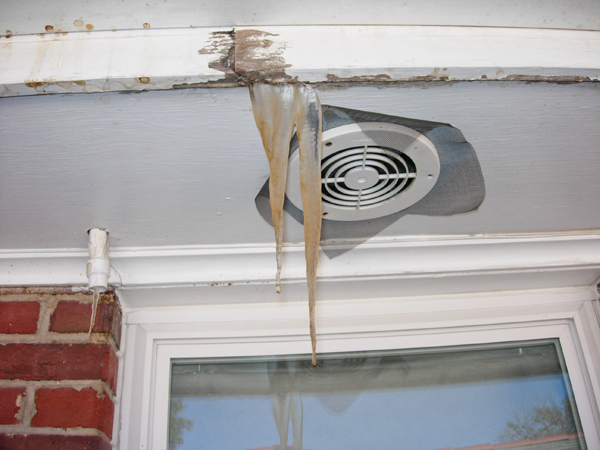
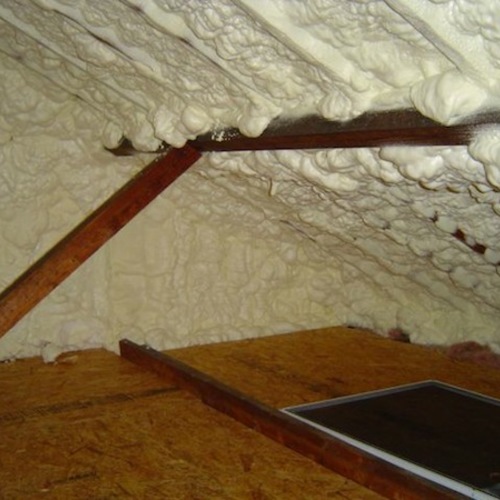
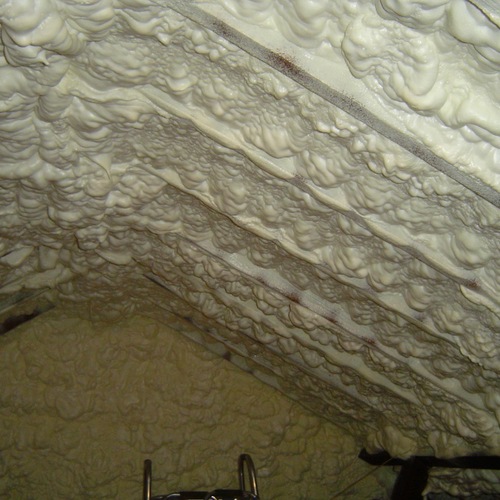
Nick had hired a contractor to install open-cell foam on the bottom of his roof deck, converting the attic from a vented to an unvented space. When temperatures dropped below freezing, Nick noticed icicles forming at the soffit near an old, and by then unused, vent for a bathroom fan.
The roof itself was virtually new, and neither the insulation contractor nor the roofer could explain what was going on.
“This leads me to believe that it has to do with the cold weather on the asphalt roof and somehow the warm air in the attic is going through the insulation in that area to cause the problem,” Nick writes. “The question is what can I do to stop the condensation?”
Open-cell foam is not a vapor barrier
Closed-cell foam, with higher densities and a higher R-value, can be an effective vapor retarder.
But not open-cell foam, It has a perm rating as high as 35 per inch, according to a technical bulletin from Fomo Products Inc.
And this, Robert Riversong points out, could be the source of the problem:
“The open-cell…
Weekly Newsletter
Get building science and energy efficiency advice, plus special offers, in your inbox.

This article is only available to GBA Prime Members
Sign up for a free trial and get instant access to this article as well as GBA’s complete library of premium articles and construction details.
Start Free TrialAlready a member? Log in





58 Comments
Apologies to those with an aversion to 'moist'
Lo!
Is that an exhaust fan vent I see there?
hmmmm
Warm, moist air, right?
Has to be some warm, moist (relatively speaking) air getting to the cold side of that sheathing, right? That has to be the cause of this - but where that warm, moist air is coming from is anyone's guess with the info shown. Could be that exhaust fan, poor job of foam install, penetrations not fully sealed, all types of stuff. But the root cause has to be warmer, moist air condensing on the sheathing... I think...
I agree with Micah
Micah,
I agree.
Brick Siding = older home ?
How does the brick veneer indicate an older home?
Problem MAY be related to the vent in the soffit.....it depends
Another possibility is air leaking from wall to brick cavity to soffit
..............rather than from attic or top plate to soffit.
The whole thing is a 3d network of possible air paths....
Air sealing that attic does not air seal the walls.
What Dan may have meant ...
John,
Perhaps Dan meant something like, "The brick siding looks old to me, so I think this is an older home."
Looking like a case of not venting humid air
As I understand it, this is a hot roof installation. I wonder how the roof/attic space is ventilated. The spray foam also working as an air barrier would prevent the humidity from escaping through the roof. Excess moisture will condense when it reaches the dew point and follow gravity down to the eaves where is appears to be freezing. I wonder if a mechanical ventilation system was added during the renovation work. I'm guessing active mechanical ventiation might solve the issue.
one more thought...
I just read the update. Lots of "gas powered appliances" up in that attic (as told by the new info posted). I recently had a really, really scary situation with a client where they had new (and extensive) levels of humidity in the home which was showing up in the form of condensation on the window's interior (with temperatures in the low 20's here in Indianapolis). I "scratched my head" for some time and took multiple moisture readings until I thought to check his combustion appliances. Yep... sure enough, there sat the HWH with the direct vent exhause pipe 1/2 way off the rubber boot. This was 2+ years into his owning the home (with previously no condensation issues) so we all assumed the client knocked the vent loose with the lawnmower outside or something...
So, sorry for the novel, but I would DEFINATELY check the gas appliances and how they are vented in that at attic space. It strikes me that Nicks says the "roof was converted... 1 1/2 ago" and (I'm assuming) that this problem is just now showing up. Maybe it didn't get cold enough last winter to reach the dew point at the roof sheathing? Don't know - but the issue has to be warm, wet air hitting that roof sheathing... The question now is where is it coming from?
What the IRC says
I learned on a recent project that the IRC allows the foam, without venting the sheathing, if closed cell spray foam is used. The less expensive open cell seems to be the problem here, I think.
Type of spray foam in rooflines
Referring to Ned's comment, the 2009 IRC allows open cell foam in climate zones 1-3, and closed cell foam in zones 4 and higher. There are exceptions to this if alternate vapor retarders are used.
Your Roof is Leaking
Is that photo a speaker or a vent? I see a a/c condensate drain with frozen water too. Has the A/c been running here? Why is there ice in the drain? There is definitely a lot of moving water to make an icicle this big. Is that a bathroom window or a bedrrom or a house window? If its a bathroom, maybe your condensation / mositure theories hold up, but if not, this is from a leak somewhere. It is not the foam's job to stop leaks, that is the roof's job
Fresh air
Open cell insulation is not a vapor barrier. If the air inside the house is humid then the open cell insulation needs an air barrier to prevent the moisture from rising up through the open cell insulation and condensing upon reaching the plywood and then working it's way down the roof and out through the eaves.
Ice Damns
It is possiable that warm moist air is moving into the exterior walls and behind the brick veneer and right into the soffit area. Once the spray foam was installed, the air became trap at the bottom of the soffit and now condenses on the roof sheathing at the bottom of the roof. When trouble shooting a problem "The first place to look, is the last thing you did". Good luck.
The picture tells it
If the roof is a hot roof, then why are the sofit vents still in the house (pic 1). You either vent a roof or completely seal it "hot roof". You have something in the middle. The vents are allowing warm moist air in the attic during the day and when it gets cold out at night it is condensing on the under side of the colder roof. I would also check to see that all the duct work in the attic is sealed as wells.
Condensation from insulation next to roof
Sounds like a problem I had in my 1920's bungalow. I put fiberglas insulation next to my tyne roof, there was ice build up inside between roof and insulation, which later melted and dripped. there needs to be ventilation gap of two to three inches between roof and insulation. In my house the rafters were not consistantly spaced, so I put 2x2's next to the roof for ventilation gap, and recycled plaster lathes to keep the insulation from touching the roof. Worked well. No more condensation problems. I think too many times we try to seal a house up too much.
Several possibilities and two culprits
I agree with all the comments about condensation but I'd be looking into the heating units, how they're exhausted, and why open cell foam (absorbs moisture) was used instead of closed cell foam.
Condensation from warm air inside house.
You mentioned that the bathroom vents through that "speaker grill" on the eave. I think that the roof area is so confined that when the foam was sprayed they shot right over the vent hose from the bathroom on the other side of that window and it has created an evelope allowing warm air vs cold roof situation. You can get lots of condensation from a warm vent pipe and cold roof over a period of 48-72 hours.
Where does the brick veneer and withe end....
I like a good mystery! Could the withe between brick veneer and sheathing be "venting" excess moisture into this space? brick and other masonry cladding can hold water. Sun can heat the brick work driving the moisture out as vapor into the withe. Cold surfaces can collect moisture- think dehumidifier. On a cold night the roof deck will generally drop below dew point and pull water to condense on the surface. Why not the underside too?
Consdensation
Is it in the bathroom area that you have condensation??? ("its now vented through the roof") If it is in that area, you could stop using the bath for a week and see if it dries up?? If it stops, then you know a vapor barrier or more ventilation at the bath. However from the water I see from the pictures, you are simply not getting it vetilated! Check the vetilation!
moisture issue
eliminate the source of the moisture and you will eliminate the problem. Seal the subfloor with closed cell foam. Paint the interior walls and ceilings with a vapor barrier paint. Seal the open cell foam with a vapor barrier then make sure vents are installed and used each time they cook or shower. Dehumidify and add a 4" supply and return to the attic air handler. This should eliminate any possibility of moisture being the culprit.
Venting
I am building a house in Houston where we will be using open cell foam in the walls and roof line. This will seal the building envelope. The gas furnace and tankless hot water heater are in the attic. The furnace and hot water heater are designed for this situation with speacial vents that not only vents exhaust but brings in its own combustion air. Perhaps this is where the problem lies in an older house that has been retrofitted with foam insulation but is still using and old furnace and hot water heater sucking combustion air into the soffits.
The poster claims a new roof
The poster claims a new roof and eliminates that possibility BUT I would revisit it. We had a record breaking 25+ "s of rain last month and we all know open cell absorbs moisture.
Most spray retrofit jobs are dammed/blocked at the top plate, so moisture from inside the brick veneer should have free comunication to the soffit vents.
As another poster noted the back up AC condensate vent appeared to have ice coming from that also. It is not unusual in our area to run the AC and the heater on the same day so a clogged condensate line is also likely along with the possibility of a poorly vented gas furnace. But that would cause high humidity levels through out the attic area..... maybe this is the path of least resistance.
wrong foam...
Open cell will suck moisture ... recommend closed cell or if possible sealing the open cell as Robert Riversong has suggested. Providing the roof has no leaks, this should resolve the icicle problem..... this doesn't mean that there still isn't a broader humidity problem in the home that may need to be addressed. .
more information needed
Phil's comments about the brick cladding and withe caught my eye. If the house is cooling down overnight and presumably cooler during the day than the outside tempurature then sun heating the brick creating water vapor which would then drive inward because the house is cooler is logical. Where this theory gets fuzzy is I have a hard time believing a 1960's house is going to have an effective vapor barrier beyond the withe forcing the vapor to move upward. We need more info about the wall assembly or assemblies.
I'm interested to know how many sides of the house have what appears to be an acrylic finishing system on them. Obviously the side with the soffit issue does not, and if I'm reading the description right seems to be the only soffit area afflicted with moisture problems. If that is the only exposed brick wall of the house I would consider that a clue suggesting inbound moisture is the culprit and that the inbound moisture is coming through the brick.
On the other hand the inconsistency could be based on a foam insulation gap in that area of the roof. Does this attic have a floor and if so was the perimiter removed so the insulation could be sprayed between the attic floor joists at the perimeter and over the top plates?
I'm leaning toward one or more air gaps in the insulation, possibly involving the disconnected bath fan vent(is the old duct still connected?) or an insulation installation issue that is causing water vapor to drive outward as the outside tempurature cools.
I don't think the existence of the old soffit vents is a significant contributing factor, although they certainly ought to be closed up if for no other reason than to reduce air penetration and improve thermal efficiency. I hope I don't eat those words. :-)
Unvented roof deck
The IRC may allow this installation; but it also requires that roofing materials be installed according tothe Manufacturer's installation instructions; one of which is benerally a minimum of one inch of vented space beneath the roof deck - check with the shingle manufacturer to see if this hasn't already voided the warranty on the shingles.
spray foam rot a roof
Going by those photos.Major ventalation issue.Adding foam spray to the attic is a good practice,but at the same time you have changed the dynamics of the attics airspace.
#1 Interior home pressure air test ! Find the air leaks in the building envelope
#2 seal interior air leaks windows,attic hatches etc.(1st picture shows a window at he test spot big time leak at the window.
#3 Supply indepentent source of combustion air at furnace and hot water tank as discribed located in the attic(this will help equalizing the negative air pressure in the attic.
#4 .Those old soffits got to go foresure, install maintenance free aluminum vented soffits,roof vents.
#5 exterior brick make sure the weeping holes are clear.Brick also needs good air movement .
Hope my suggestions help .GO SAINTS all the best at The SUPER BOWL
insulation?
Insulating under the roof deck will trap warm moist air in the attic and you don't want that. The ceiling should have been insulated. I lived in the N.O. area and am quite familiar with this problem. Who ever suggested that the roof deck be insulated is in the wrong, you want to keep the warmth and cool in the living space and not in the attic. If systems are in the attic, water, a/c, then protect them.
How about that abandoned bath vent?
If the old bath vent still has a path to conditioned space, or worse, the path exists but the hose was re-routed to the roof, an awful lot of bathroom moisture would have a nice path to the soffit. I also would definitely check the mechanicals as I have had a vandalized chimney cause the same condition described above. A CO detector would've alerted me to the problem sooner...
Unintended Consequences
I believe A Not-So-Complete Air Control Layer is concentrating air flow at the weak links.
Before adding the spray foam the house had more places to leak.
Incomplete spray foam and or lack of structural backer behind spray foam does NOT provide a complete Air Control Layer.
I believe that Spray Foam "the product" did not cause the damage...
An incomplete Air Control layer did.
ice mystery
Based on what info we have to go on I would have to look to the A/C unit installed in the highly insulated attic as my first major problem. I live in Canada and we install them outside,I have actually seen units run so long to try and cool a poorly insulated(almost none) house, and when they run this long the copper pipes that the gas charge runs through actually forms ice build up on it meanwhile it is 95degrees outside .Our units have condensate lines hooked to them to pumps the condensate created by the process of converting the warm air to cool air, is there a pump line on the unit in the attic and if so where is it being drained to ,is the line sweating and dripping out the soffit and meeting the cooler air as it drips outside and freezing. Bizzare as it seems remember the air in the attic will be hotter than the outside ,even more so with the new roof and the appliances installled up there adding even more heat. these are only a few of the issues I can point out based on the info we have to go on.
That vent
Is that an old bath vent or is that vent being used to vent the a/c unit if it is it may not be powerful enough to vent the unit properly and it could have major condensation build up on it ,which is slowly dripping out the soffit and freezing up in the process.
Spray Foam Cannot Rot Your Roof But Water Can
I hate to be cynical, but the title of this blog point misguided. Spray foam cannot rot anything, including a roofdeck. Moisture CAN lead to rot if given a food source and mold spores along with the proper temperature a modicum of oxygen.
The problem here is obvious; moisture is migrating with air currents from under or within this house to a condensing surface where it's forming liquid water. There appears to be a substantial amount of water in an isolated area which makes troubleshooting relatively simple. The author did not mention that the entirety of the roof insulation was laden with liquid water. This would happen if the foam had allowed water vapor to diffuse through it where it condensed to saturate the foam. Instead, a relatively small area is shown and it's located near the bathroom. If the bath fan vent pipe is damaged or displaced, the fan could be discharging into the attic. It's also likely that since the attic above the bathroom is very small and there could be numerous obstructions that caused the spray foam applicator to miss or under-spray the area in question. This is my guess.
The pipe stub coming out of the eave is likely the pressure relief valve discharge and the icicle formed on it is from the opening in the eave and not from within the pipe.
The bottom line is that moist air is moving to a condensing surface; probably through large voids in the foam or missing foam at the point in question. Air flow has to be stopped, the affected area dried, then a proper foam job applied. The gypsum board on the ceiling of the bathroom should be removed and a thorough repair must be made.
And, by the way, open-cell foam is an air barrier material (air-impermeable) at 3.5" in accordance with ASTM E-283 and E-2178. Air is not flowing through the foam.
10 X 3 affected area
Where are the aplliances sitting in relation to the area of condensation / ice build-up.
Hi Mac
I believe that may be a condensate drain...that is acting like a pressure relief valve.
Horrors!!!
This is a MESS!
I don't have the same humidity problems, in my locale, as Louisiana, but I wouldn't have let an installer do this to my home!
Open cell foam, otherwise known as a big sponge, is a big no no in the Bay Area for all kinds of things, even in backing rod for sealant. Was the the brand certified for this use? What kind and composition is it? Hopefully, at least it is not Polyisocyanurate?
When the vents were sealed off, what accommodation for venting was designed? I didn't see much on the roof. Where is a vapor barrier?
Is the house air conditioned? What is that condensate drain for?
As others above referenced, gas appliances put out a lot of moisture. The venting design should have included that.
The problem is not a incomplete foam job. The photos clearly show that water is able to concentrate in the foam and at the roof line. Get it OFF Now!
Tesing and Inspecting!!
I agree with Mac Sheldon. Additionally, as a building consultant who has been working with homes insulated with spray foam insulation for many years, I would also look at the following:
1. The gas fueled aplliances wihtin the attic should all be sealed combustion. If they are not, then you are introducing moisture into the attic every time they turn on (ie.. furnace during heat and hot water heater year round.) You may not notice a problem in the summer months simply because nothing wil freeze when you are looking at an ambien temp of say, 100 degrees fahrenheit mixing with an interior temp. of say 70 degrees fahrenheit.
2. Even if it is caused by moisture from these appliances, the air has to mix (hot/cold) Which would mean that the attic air is mixing with the ambient air which means there is a leak around that area of the eave.
3. The bathroom exhaust vent may have become disconnected from the soffit which means the air being discharged from the bathroom is no longer dumping outside but into the soffit. The air from within the building envelope is warmer than the ambient air and if it reaches dew point, which it probably did do, then you will definitely introduce condesation which will freeze (winter) mold if not dried out quickly (summer).
4. I would ABSOLUETLY NOT insulate the attic floor. In fact, if the spray foam was installed properly, the previously installed attic floor insualtion should have been removed. If not then you are trapping moist stale air within the attic.
5. You should have a minimum of 5.5 inches of spray foam on the underside of the roof deck and ALL wood should be completely covered.
6. You need to maintain soffit ventilation. The brick wall still needs to breathe. Depending upon how the soffits were connected to the home, the soffit vents will allow the wall to breathe. The intake of the wall would be the weep holes at the bottom and the soffit vents will be the exhaust. (very important).
7. If the attic has ben done properly and the correct appliances are installed, the attic should maintain a temperature of not more than 15 degrees fahrenheit difference from the indoor temperature.
It is encouraged to have someone come out to your home who understands open cell spray foam and have them conduct a thorough inspection of everything and run a blower door (air infiltration) test as well as a pressure differential test between the main body of the home and the attic and the attic and ambient.
Open Cell vs. Closed Cell
You will find that closed cell foam is typically used in colder climates and open cell foam is used more in warm climates such as yours. The decision to use open cell foam was a good decision and the type of foam you chose has nothing to do with the condesation problems.
Rot
I see a fan and I see a condensation pipe. Not enough pictures. locations of foreseen rot and so forth to come to a conclusion or possible cause. Blaming material until resolved is myth.
Energy Flow Accross Enclosures
There is a need for more research on potential negative effects of foam inulation in wall or roof cavities preventing energy flow to and from exterior sheathing, and thereby preventing proper drying of the sheathing. We need to make sure that this unintended consequence of foam insulation doesn't turn into an "EIFS" type disaster. Joseph Lstiburek at BuildingScience.com published a provacative and alarming article in December, 2009 at http://www.buildingscience.com/documents/insights/bsi-028-energy-flow-across-enclosures. He raises important questions. We need for the foam producers and suppliers to respond to these warnings, if they can.
Gutter/fascia leak
Looking at the condensation you'd have to guess a potent vapor source as many have suggested...but I'd also say the brown stains to the left of the icicles in the first picture indicate water running between the gutter and fascia board. That could indicate a roof-edge leak (poor drip edge detail, inadequate lap of starter shingle & first course, poorly sloped gutter, leaking gutter joint...) which is letting water behind the fascia into the soffit area.
Depending on conditions that could be part of the story.
I know exactly what is going on here.
SPF Contrator here - and I know exactly what is going on.
That low pitch roof offered limited opportunity for the SPF installer to ensure the foam reached the end of the soffit and sat above the wall assembly. He/she could not reach and decided to block it off . From the attic it looked sealed - but the reality is, warm thermal energy from the home was cascading over the cold roof deck sheathing near the soffitt and causing condensation. Condensation leads to ice.
Building science novices need not hypothesize about vapor diffusion and closed cell versus open cell, etc, etc, etc. This is a very simple case of a lazy installer.
jp
gas combustion
Gas appliances are in the attic, they consume oxygen and must draw air from somewhere. That air is bringing in the moisture.
Maybe the gas heater and tankless water heater are providing some of that moisture. When gas combusts one of the byproducts is water.
type of insulation?
What would be the negative aspects ,if the insulation was poly-isocyanurate?
Duct-cicle
If the "abandoned" bathroom vent still has some ductwork attached to it, it may have presented an obstacle to the foam installation and resulted in gaps between the duct and the roof sheathing. If moist attic air, warmed by the HVAC, were to come into contact with the leftover duct, filled with cold outside air, condensation would be the result. The moisture would build up and travel down the exterior face of the duct and pond in the soffit. This might be one reason that the problem is occurring at that particular location.
Agree with Craig
Craig....I also believe that the abandoned duct could be contributing to the problem.
I have to wonder if the homeowner has tested the flow of the new bathroom ventilation.
What if the spray foam has jamed the damper?
Low tech flow testing
Some tips at the bottom of this blog for homemade flow testing
https://www.greenbuildingadvisor.com/blogs/dept/musings/designing-good-ventilation-system
Installation Error - NOT the wrong product
Nick, when performing diagnostic testing or performance inspections I often see spray foam insulation improperly installed. One sure way of determining if outdoor air is entering your un-vented attic area and identify exactly where it is entering is to perform a blower door test in conjuction with a infrared camera. When the home is under a negative pressure and is allowing outdoor air to enter the attic area the IR camera will show the differing temperature of the incoming air and easily identify where the air leaks.
When an attic is completely sealed off with spray foam insulation, whether open or closed cell, vapor is not ussually a big issue here in the Gulf South. Good Luck.
Air is Escaping NOT Entering the attic
Paul,
You probably already know this.....
In this case
Warm Moist air is escaping and causing damage.
Mac Sheldon and Eric Smith are correct
Warm moist air is migrating from within the home into the eve (clearly). This is not an open cell foam verses closed cell foam issue. Probably, difficult to access due to low pitch roof and bath fan mechanicals in the way. We always start in the difficult areas. IMPORTANT: Use a Jet tip on gun to make sure the thermal envelope is complete and in-line with exterior drainage plane (complete above the 2 top wall plates). Old bath fan vent pipe should be completely removed.
Permeability of open cell foam
Open cell foam has a perm rating of 11 compared to .6 for closed cell foam (based on a standard ASTM test units are liters per square meter at 75 pascals.) It is also 9 times as air permeable as closed cell foam. Warm moist air is leaking into the attic from the living space(or coming from unvented gas appliances), probably a lot of air is leaking around the vent opening, passing through the foam and condensing on the cold sheathing. Open cell foam also holds water very well, like a sponge and it looses its insulation value when it is wet. This increases the rate of condensation. Open cell foam should not be used in an unvented attic application. Closed cell should have been used.
Also note that all foams are very flammable and have a low ignition point. It is very dangerous to have foam unprotected in an attic with combustion appliances. The foam should be covered with a flame retardant.
several good points
Before I go on my rant I suggest the soffits be removed so you can inspect the foam to see if it created a good seal. On some shallow pitched roofs we have actually started our jobs by spraying from the exterior of the perimeter of the house once the sofftit was removed to ensure we were able to achieve a good air seal. You can also tell by water marks if you have a roof leak which I doubt. I too am a spray foam contractor and we do both types of foam. The type of foam used is not your issue as most open cell foams are considered air barrier at a thickness of 5 inches. Sounds more like an application issue if the foam is causing the problem. There is no need to apply a vapor barrier over the foam this is not your issue. In regards to gas appliances in your attic most codes and manufacture's ES Reports state if there are heat producing (gas fired) appliances in the attic an ignition barrier must be applied over the foam. Also we tell our customers of retro jobs that the house is a system and changing the insulation you are changing how the house works and therefore they should consult with an A/C contractor who is knowledgeable of foam insulation, Changing to spray foam will have a direct impact on how your a/c works as this is also how we dehumidify houses in the south.
So many uneducated opinions in industry
I am someone who makes a point to learn something new everyday, perhaps others should do the same. First of all not all open cell foams are the same, each mfg has of open cell foam has different physical properties per the ASTM test results. On of the biggest differences in the open cell world is the moisture absorption rate of each product and its ability to meet the air barrier test at various thicknesses. One thing for sure is the all open cell foams are not alike, they may look the same bit they don't perform the same. That being said, the issue here is likely a combination of a few things that together would cause the problem. First of all older homes by default are very leaky and not addressing the air leakage issues in combination with the switch to the unvented attic is a serious mistake. Second, older homes were not required to ventilate appliances, kitchens and baths back in the day. So converting to a newer technology building envelop with out adjustments to the ventilation strategy of the home has serious consequences and is likely the case here. Third, in the southern climates it never gets cold (below 32) and still have high outdoor RH. During the winter the south is always fighting the dryness of the indoor air where in the indoor RH is below 30%. If the indoor RH is below 30% how can the moisture in the attic be caused by the high indoor RH? It's not. The indoor RH should be monitored 24X7 to ensure there is not excessive moisture during the winter and summer months. If it is higher than 50% @ anytime we should look at changing the home ventilation/dehumidification strategy. If there are air leaks in the attic to the outside and it is cold and dry outside even lower attic RH would be required to prevent the issue at hand. Also remember in the unvented attic assembly the attic air is a part of the thermal boundary. Given the low pitch of the roof there is not a lot of air volume to mix so if you do not have power vented or sealed combustion appliances they could produce enough moisture where the RH is higher than we would want. There is no one specific size that fits all and the physical properties of the installed foam will also have an impact on the correct approach. It is not the foams fault if the installer did not consider all the factors of the system.
The rest of the story
Great comments & speculations.
I want to know what Nick did to repair the problem?
Or did he? We can only speculate the cause of the problem, open up the ceiling and tell us what was the problem!
David C. James
Open Cell Foam Myth...
It's interesting to see all the people who jump on the "Open Cell Foam = Sponge" myth.
Yes, open cell spray foam does have a lower perm rating compared to closed cell spray foam, BUT vapor diffusion, a very weak force that take quite a while to move very-very-very small amounts of moisture, is the only force acting on the higher perm rating of the foam. If you find soaked open cell foam, it has most likely been exposed to a "gross water intrusion" i.e. a big water leak, it simply cannot adsorb large amounts of water from the air like a sponge, its simply untrue. The ICC National Building Codes all allow the use of Open OR Closed cell spray foam in any climate zone, its simply a matter of installing the products correctly...
The pictures shown do not show condensation on open cell spray foam insulation, they all show condensation on bare wood. When cold moist air comes into contact with a cold surface, it will condense. There has to be a large amount of moist air being released onto this relatively small area, as the temperatures listed by the original poster were not below freezing for a very long period of time. Relatively easy to find the source of the problem. but insisting that Open Cell Spray Foam is a "sponge" is simply NOT TRUE, and will not help correct the root cause of the problem...
Moisture
Simply a result of retro fitting without addressing the whole house as a system. When ever you seal any area you need to address all areas. Old houses were designed to be leaky. To add insulation anywhere in a older house can not be done haphazardly you need to address sealing the house and addressing moisture control together.
People often blame spray foam for causing problems but it is not the insulation that creates the moisture. Is it the fault of the insulation contractor. Maybe? My question is were they hired to just spray the foam in the attic or were they hired to do a complete energy audit and design a new more energy efficient building envelope that addresses building science to handle moisture control?
The problem is Sub-contractors that do only one part of the building system. You have the window and siding contractors, insulation contractors, foundation and basement water proofers, and HVAC contractors all working separately. In the past this was not a big problem since even when we insulated we did not do it to the extent of today.
Now we have replacement windows that are very tight, Siding contractors that install foam insulation on the outside and siding materials that do not breath, we have insulation contractors installing much higher R values using insulation products that provide greater air infiltration levels. Then you have HVAC units that are much more efficient and produce much less positive draft. (most high efficiency units require active venting)
My advice to home owners is hire a firm that does complete energy audits and Building Science forensic investigation. To expect a sub contractor who's expertise is only one part of the over all building system to be able to retrofit your leaking home into a high efficiency home is not practical. And it never surprises me when problems are created.
The sad thing is this does not need to happen. Problem is code and building inspections still do not address the complete building system. You can have all parts be code compliant but as a whole the house still has problems.
My guess is the insulation it self was OK it was that now you have trapped the moisture that was vented out through the vented attic before. Yo need to stop that moisture at the source. Even if with better vapor barriers you may stop the immediate problem but you could still have a problem somewhere else you need to get that moisture out. and the closer to the sours you address it the better. Bath vent fans are one thing but what about the moisture you create just breathing or cooking. When you really supper insulate and seal a house you need whole house active ventilation that requires a air exchanger.
oops...!
Looks like someone didn't insulate all the way out to the edge of the soffit and failed to seal the top plate / veneer air space over the verticle wall. My guess is that the moist air is coming up through he wall and getting trapped in the now semi-sealed, uninsulated soffit....leading to condensation. I work for a spray foam contractor. Its very common to install verticle baffles and block off soffits before spraying...or to shove some rock wool in there... or to spray a bit of foam, let it harden, then stuff it in the soffit and spray over it to avoid foam expanding and blowing out soffit vents, soffit penetrations, etc. The first rule of spraying foam is: do not spray it on anything you don't want it on....because once it's on there, it isn't coming off! Homeowners tend to not like the look of spray foam dripped all over their siding, etc... After reading this post and these comments we really need to re-evaluate how we approach this detail.
Do blower door / IR test
I feel that there is a deficiency in the foam insulation allowing air/moisture to escape and moisture condenses. A blower door test in conjunction with a infrared scan should show the problem in short order
ET... (Foam home)...
In this case Mr. Sheldon is "spot on"...
final conclusion??
Hey, Nick......did you ever figure out what the problem/cause was??
Bernie
Log in or become a member to post a comment.
Sign up Log in