Energy Star Raises the Bar for Home Builders
New Standards Push the Energy Envelope 50% Past 2006 IECC International Energy Conservation Code.
A couple of interesting announcements from Sam Rashkin, the national director of Energy StarLabeling system sponsored by the Environmental Protection Agency and the US Department of Energy for labeling the most energy-efficient products on the market; applies to a wide range of products, from computers and office equipment to refrigerators and air conditioners. for Homes: new standards that raise the bar, and a new program, Advanced New Home ConstructionA proposed U.S. Environmental Protection Agency (EPA) program to promote the construction of “better than Energy Star” homes. The proposal calls for builders to comply with a “Builder Option Package” of measures including superinsulated walls, triple-glazed windows, ducts within the conditioned space, compact duct layout, a furnace with sealed plenums and a variable-speed energy-efficient blower motor, an efficient hot water distribution system, and a solar water heater or heat-pump desuperheater., for the best builders in the country.
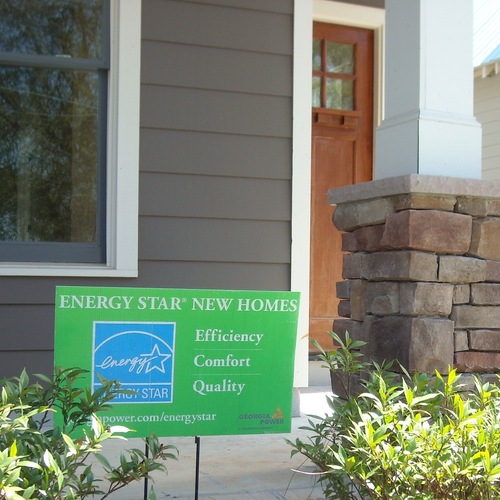
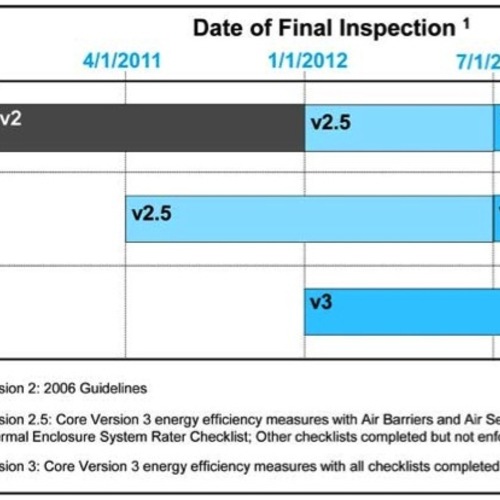
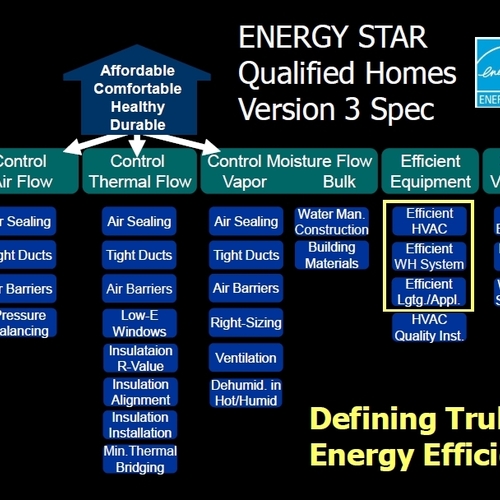
The new Energy Star specs include the following:
- Thermal breaks in walls. When studs touch the inside and outside surfaces of a wall, they cut the R-valueMeasure of resistance to heat flow; the higher the R-value, the lower the heat loss. The inverse of U-factor. of the wall significantly.
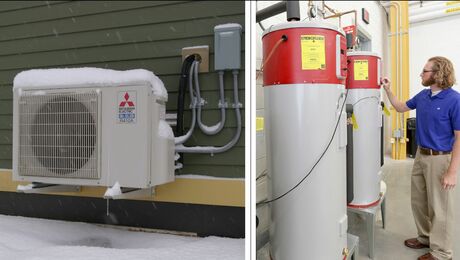
- Correct installation of HVAC(Heating, ventilation, and air conditioning). Collectively, the mechanical systems that heat, ventilate, and cool a building. systems. EPA calls this “best practice installation.” Poor installations slash the efficiency of an HVAC system by 35% (or more!).
- Efficient water distribution, particularly for hot water. Hot water sitting in a tank, waiting to be used, cools. These standby losses at the tank are significant. According to Energy Star, standby losses in pipes can be equally significant.
- Better lighting, appliances, and plug-load management. These loads account for over half of electricity use in homes (major appliances—24%; lighting—18%; miscellaneous—14%).
- Size limits on Energy Star homesA U.S. Environmental Protection Agency (EPA) program to promote the construction of new homes that are at least 15% more energy-efficient than homes that minimally comply with the 2004 International Residential Code. Energy Star Home requirements vary by climate.. The Home Energy Rating System (HERSIndex or scoring system for energy efficiency established by the Residential Energy Services Network (RESNET) that compares a given home to a Home Energy Rating System (HERS) Reference Home based on the 2006 International Energy Conservation Code. A home matching the reference home has a HERS Index of 100. The lower a home’s HERS Index, the more energy efficient it is. A typical existing home has a HERS Index of 130; a net zero energy home has a HERS Index of 0. Older versions of the HERS index were based on a scale that was largely just the opposite in structure--a HERS rating of 100 represented a net zero energy home, while the reference home had a score of 80. There are issues that complicate converting old to new or new to old scores, but the basic formula is: New HERS index = (100 - Old HERS score) * 5.), which scores Energy Star homes, inadvertently penalizes small homes by making it easier for very large homes to meet the energy efficiency requirements.
- Moisture control. Because tight houses have less drying potential, durability details must be well thought out.
These updates lay the groundwork for another EPA program. Advanced New Home Construction will push the energy envelope 50% past the 2006 International Energy Conservation Code. To get there, builders will:
- Superinsulate the walls. An airtight wall with perfect insulation and no thermal bridgingHeat flow that occurs across more conductive components in an otherwise well-insulated material, resulting in disproportionately significant heat loss. For example, steel studs in an insulated wall dramatically reduce the overall energy performance of the wall, because of thermal bridging through the steel. has a 50% higher R-value.
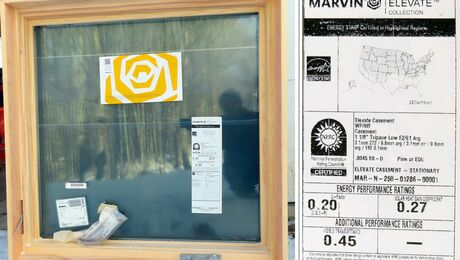
- Install super-efficient high-performance windows. They can block nearly 85% of solar heat gainIncrease in the amount of heat in a space, including heat transferred from outside (in the form of solar radiation) and heat generated within by people, lights, mechanical systems, and other sources. See heat loss. while delivering R-8 thermal resistance. (Typical Energy Star windows block 70% of solar heat gain and deliver R-3.)
- Install airtight air handlers with high-efficiency variable-speed fans. HVAC systems often leak 35% of the air they transport. Half of that leakage is from the air handler. And today’s fans gobble up 70% more energy than necessary. Sealed air-handler units are available and super-efficient fans are about three years away.
- Install super-high-efficient HVAC equipment that's SEER(SEER) The efficiency of central air conditioners is rated by the Seasonal Energy Efficiency Ratio. The higher the SEER rating of a unit, the more energy efficient it is. The SEER rating is Btu of cooling output during a typical hot season divided by the total electric energy in watt-hours to run the unit. For residential air conditioners, the federal minimum is 13 SEER. For an Energy Star unit, 14 SEER. Manufacturers sell 18-20 SEER units, but they are expensive. 18 (rather than 13) for air conditioning, >9.0 HSPF (rather than <8).
- Install solar domestic water-heating system. Most solar water heaters can handle 50% to 90% of the water-heating needs of a household.
The Advanced New Home Construction programA U.S. Environmental Protection Agency (EPA) program to promote the construction of "better than Energy Star" homes. is not open to all builders; it has requirements for participation. As such, EPA is looking for “the nation’s most energy efficient builders seeking recognition as environmental leaders” to join the Advanced New Home Construction program.
To learn more about the program, go to www.energystar.gov/homes next September.
—Dan Morrison is managing editor of GreenBuildingAdvisor.com.
Image Credits:
- energy star
Google
Yahoo
Facebook
Technorati
Reddit
Delicious
Digg
StumbleUpon
Peter Yost is the Director of Residential Services for BuildingGreen, LLC in Brattleboro, Vermont. He has been building, researching, teaching, writing, and consulting on high performance homes for more than twenty years.
Joseph Lstiburek is a principal of
John Straube, Ph.D., P.Eng., is a principal of
Allison Bailes III has a PhD in physics. He is also a RESNET-accredited energy consultant, trainer, and the principal of
Subscribe to the Building Science RSS feed: