Building Science

A Ventless Gas Fireplace Doesn’t Belong in Your Home

Posted on January 23, 2013 by Allison A. Bailes III, PhD, GBA Advisor

First of all, let's call it what it really is. The industry likes the term “vent-free” when talking about gas fireplaces that keep all the exhaust gases in your home. I prefer the term “ventless” or, even better, “unvented.” Some people suggest “room-vented” or “lung-vented.”

Not a huge deal, but the ventless gas industry wants you to feel that you're being liberated of a burden by not having an exhaust vent. I think it's important for people to know that they're actually missing something important when they go with a ventless gas appliance.

How to Install a Branched-Drain Graywater System

Posted on January 16, 2013 by Allison A. Bailes III, PhD, GBA Advisor

Back in the summer of 2003, I was finishing up the green home I'd started building in 2001. One of the last pieces we had to complete was the graywaterWastewater from a building that does not include flush-water from toilets and (as most commonly defined) water from kitchen sinks or dishwashers. In some places, graywater can be collected and used for subsurface irrigation. system, and we'd already put a lot of work into it before we ever moved a spadeful of dirt.

An Innovative Net-Zero Solar Decathlon House

Posted on January 9, 2013 by Allison A. Bailes III, PhD, GBA Advisor

Twelve years ago, I discovered the Solar Decathlon. I was a new physics professor at a small university in Georgia, and I'd received a packet from the US Department of Energy describing the competition. It was set to have its first run in 2002, so I tried to figure out how to get involved and put together an entry. We didn't have design or construction programs, however, and the physics department that I was in was one of the most dysfunctional groups of people the world has ever seen.

A UL-Listed Carbon Monoxide Alarm May Not Protect You

Posted on January 2, 2013 by Allison A. Bailes III, PhD, GBA Advisor

Don't judge a book by its cover? That certainly applies to what may be the best protection against carbon monoxide poisoning you can buy. The two best carbon monoxide monitors, the CO Experts monitor and the NSI 3000 from the National Comfort Institute, don't have the approval from Underwriters Laboratories (UL) that so many manufacturers crave. There's a good reason for that.

Mechanical Systems for Low-Load Buildings

Posted on December 26, 2012 by Allison A. Bailes III, PhD, GBA Advisor

Professor John Straube spoke for a whole day at the Building Science Corporation's Experts' Session earlier this month. His topic, a good one for GBAGreenBuildingAdvisor.com readers, was mechanical systems for low-load buildings.

You know that expression about how the information comes at you so fast in some classes that it's like drinking from a firehose? With Professor Straube, it's like trying to drink from a tsunami! The guy has not only a phenomenal knowledge but he's also a fantastic teacher and incredibly witty.

Joe Lstiburek on Spray Foam

Posted on December 19, 2012 by Allison A. Bailes III, PhD, GBA Advisor

Spray foam insulation evokes some interesting conversation among building scientists, construction professionals, environmentalists, and homeowners who have it in their homes. Many think it solves all problems, no matter how poorly it's installed. Some think it's helping to warm the planet and compromise the health of people and pets. In the middle are those who work with it regularly and see both the warts and the beauty of the product.

What’s a Blower Door Good For?

Posted on December 12, 2012 by Allison A. Bailes III, PhD, GBA Advisor

In last week's blog, I suggested that talking about infiltration rates in terms of air changes per hour isn’t an accurate way to portray air leakage. The problem is that you’re dividing by volume but the leaks happen at the surface. I don’t think ACHACH stands for Air Changes per Hour. This is a metric of house air tightness. ACH is often expressed as ACH50, which is the air changes per hour when the house is depressurized to -50 pascals during a blower door test. The term ACHn or NACH refers to "natural" air changes per hour, meaning the rate of air leakage without blower door pressurization or depressurization. While many in the building science community detest this term and its use (because there is no such thing as "normal" or "natural" air leakage; that changes all the time with weather and other conditions), ACHn or NACH is used by many in the residential HVAC industry for their system sizing calculations.50 is going away anytime soon, and I use it myself because everyone else does, even though it’s biased toward larger houses.

Air Leaks Happen at the Surface, Not in the Volume

Posted on December 5, 2012 by Allison A. Bailes III, PhD, GBA Advisor

During the Westford Symposium on Building Science in 2010,* I was watching the tweets from the people who were there. At one point, I saw this one: “@EFL_Guy: ‘Air leaks through surfaces, not volume’ Joe Lstiburek.” I'd been meaning to blog about this issue for a while, so I wrote an article about it. Now, a couple of years later, it's time for a little update.

Should Flex Duct Be Banned?

Posted on November 28, 2012 by Allison A. Bailes III, PhD, GBA Advisor

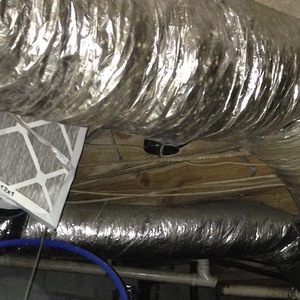
Ah, flex duct. That bane of home performance contractors and green builders everywhere. If you’ve seen only one forced-air duct system that uses flex, you’ve most likely seen a bad installation.

‘Building Enclosure,’ Not ‘Building Envelope’

Posted on November 21, 2012 by Allison A. Bailes III, PhD, GBA Advisor

When I wrote about the debate over the terms “building envelope” vs. “building enclosure” recently, I favored the former but overall felt agnostic on whether we should choose one over the other. I didn't think I'd change my mind.

Register for a free account and join the conversation


Get a free account and join the conversation!
Become a GBA PRO!

Syndicate content