
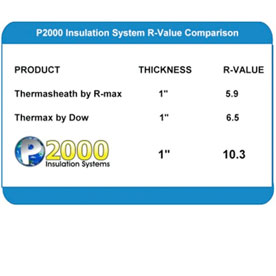
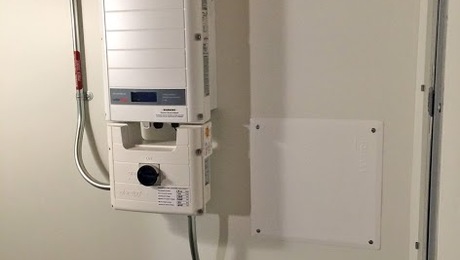
Image Credit: P2000 Georgia
More Musings of an Energy Nerd


Scammers continue to use exaggerated R-value claims to peddle inferior insulation products, in spite of the existence of strong consumer protection laws. Year after year, naïve builders fall prey to Web-based marketing pitches for “miracle” products like “insulating” paint and 1-inch-thick R-10 foam.
In the late 1970s, exaggerated claims by insulation marketers were so common that the U.S. Congress passed a consumer-protection law specifically addressing R-value scams. Although false marketing claims were already illegal, Congress concluded that R-value scams were so rampant and damaging to consumers that the industry needed targeted regulation.
Since 1979, the Federal R-Value Rule (16 CFR Part 460, “Trade Regulation Rule Concerning the Labeling and Advertising of Home Insulation”) has regulated how insulation manufacturers, distributors, and installers test, label, and market residential insulation products. Under the law, all claims concerning the R-value of residential insulation must be based on certain listed ASTM test procedures.
Blatant violations
Unfortunately, the law is poorly enforced and widely ignored. It takes only a few minutes for any Web surfer to find blatant violations of the R-Value Rule.
A few product categories — foil-faced bubble wrap and “insulating” paint, for example — seem to attract scam artists like moths to a flame. Another product favored by flim-flam artists is a foil-faced expanded polystyrene (EPS) product called P2000. This insulating board is manufactured by Polar Industries in Prospect, Connecticut, under a contract with a Canadian building-products manufacturer, RR&D Enterprises of Rivière-Beaudette, Quebec.
Distributors of P2000 often claim that their EPS foam has an impossibly high R-value. Such claims have led several consumer protection agencies to issue warnings to builders. For example, the Nebraska Energy Office issued an alert warning builders about P2000, “a foil-faced polystyrene insulation whose marketers are making claims of an R-Value of 27 or 28 per inch. … It…
Weekly Newsletter
Get building science and energy efficiency advice, plus special offers, in your inbox.

This article is only available to GBA Prime Members
Sign up for a free trial and get instant access to this article as well as GBA’s complete library of premium articles and construction details.
Start Free TrialAlready a member? Log in


44 Comments
The FTC has taken some action
To give credit were credit is due: two days after this opinion piece was posted, the FTC announced legal action against three R-value scammers: Meyer Enterprises (distributor of the Insul-Tarp), EnviroMate Insulation (distributor of PolyCell cellulose insulation), and Sumpolec (distributor of liquid coatings and foil radiant barriers).
A press release announcing the legal actions can be found at http://www.ftc.gov/opa/2009/03/rvalue.shtm. The FTC deserves credit for these important actions.
The FTC actions against Meyer Enterprises and EnviroMate appear to be a direct result of two articles in Energy Design Update (EDU). Energy Design Update highlighted the details of the Meyer Enterprises scam in the September 2005 issue, and highlighted the details of the PolyCell scam in the February 2008 issue. Copies of these articles were forwarded to the FTC. The moral of the story: citizens shouldn't hesitate to contact the FTC when such scams are discovered.
ICC Confirmation
Dear Readers,
The claim above that "P2000...rated at R-10.3 per inch..." is nearly correct. The International Code Council has confirmed that 1" of P2000 is R 10.2. Report #2222 can be viewed at http://www.icc-es.org
Like the GreenBuildingAdvisor, Proactive Technology cares greatly that all performance claims are tested and certified by third party sources. With support (like that from the ICC), we are proud to offer P2000 insulation as one of our energy efficient building products. Find out more at http://www.P2000insulation.com
Respectfully,
Scott Morgan
VP Marketing
Proactive Technology
"Nearly Correct"? No, it's illegal marketing
Scott Morgan is mistaken. Here is the Web address of the ICC-ES report he is referring to:
http://www.icc-es.org/reports/pdf_files/ICC-ES/ESR-2222.pdf .
Here is the relevant paragraph:
“One inch P-2000 RPR with metalized reflective film facings on both sides was installed on the outside of the studs. Three-quarter-inch spacers were installed on the outside of the P-2000, then the OSB was applied. The assembly consists of a 2-by-6-inch stud wall at 16 inches on center with a single bottom plate and a double top plate. The inside surface is 1/2-inch drywall and the exterior surface is 1/2-inch OSB. When tested with an inside temperature of 70 degrees F and an exterior temperature of -10 degrees F and an exterior wind speed of 15 mph the overall assembly (outside surface to inside surface) yielded an overall R-vale of 10.2.”
As the report makes clear, R-10.2 is not the R-value of the P2000 insulation. It is the R-value of an entire wall assembly, including OSB, two air spaces bonded by reflective surfaces, some studs, some P2000, and a layer of drywall. Each component contributes to the R-value, but the R-value of the P2000 insulation is no more than 3.7, as determined by the Nebraska Energy Office and materials testing offices in Canada.
The Federal R-value Rule makes it clear that wall assembly R-values or ceiling assembly R-values cannot be reported in a misleading way to create the false impression that one component in a thick sandwich should get all of the credit for an R-value that is made up of many materials and many layers. In short, Scott Morgan's statement — "1 inch of P2000 is R 10.2" — appears to be illegal, and I am forwarding his comments today to the FTC.
I guess Martin you never used this product.
I am not sure about the things that you are righting here about this product P2000.
I had a very nice helpful salesmen, he did not make claims I did not understand. This company was very upfront about the material, the install, and the code concerns he’d thought I would have. In fact all he said was true and accurate. The cost of living here on Long Island, is so out of hand I needed to control my energy costs as a way to stay living here. I insulated my home with P2000 and I used it on the walls and in the ceiling. My salesman explained to me some points of interest that I had researched and decided to use this product. This is the 3rd time in 27 years in this home I have reinsulated, with products that had high r-values stated on their package, I do not think this product gets enough credit, with having had so called R-19 and R-38 in my ceiling, I have had tremendous oil heat bills and my summer electric bill was insane. Since I have remolded my home the inside was gutted and the wet moldy fiberglass was removed. Using P2000 R-10 product only on the outside of the wall and resided, and on the inside of the ceiling with new sheetrock. I have now the most comfortable home, EVER.
I am into green energy conservation, because I can not afford not to be. R-Value or no R-value, system or no system, fiberglass tests its insulation alone and there are major losses form the wall system. Lots of evidence of that, wind blows through it and they put a plastic sheet they call a vapor barrier just to sop moisture inside the wall so that is creates mold, instead of out side the wall. How bogus is that? Are you aware of cost to remove that problem? P2000 has saved me more that 40% in my energy cost. Its pay back has been quick. After 3 years I have saved 40% a year on the use of my oil and that was $1700 just last year. My electric the same because I did not need as many a/c units in my windows was using 4 a/c units, two 8,000, one 10,000, and one 12,0000 Btu. Now I am down to just two of the 8,000 Btu units, and they actually cycle to the energy saver mode, my electric bill is easily more than $100 less a month, in the summer, and some in the winter, that is a total basic savings of about $2500 a year for me. The recouped savings of energy is paying off for the renovation yearly. There is more to this product then just the EPS. I have researched many products. I am Fortunate to have used such a product. I am disappointed that you feel this way. I respected your columns up to this point. You just seem to have a vendetta on this material, because this is not the first time you bashed P2000 directly, Oh and for the record that is why I looked in to this product to begin with. It was the result of you first article. A few years back in another publication.
To the P2000 people, Thank you, I have an affordable and comfortable home, and although I do not like to be vocal it was a must for me this time. Joseph R.
It's not the product, it's the marketing
Joseph,
I have no doubt that the installation of EPS foam under your siding and drywall lowered your utility bills. I have no problem with the product; I have a problem with the marketing.
Evidently your P2000 salesman did not exaggerate. That's good. However, ample evidence exists that P2000 salespeople across the country have made false claims about the product's performance, with R-value claims ranging from R-10.3 to R-27 per inch — all impossible figures. Consumer watchdog agencies from Nova Scotia to Wisconsin to Nebraska have had to step in, warning builders to ignore false claims.
Just this week I received an e-mail from a P2000 victim, Jeff Goldman. Jeff wrote, "I am a contractor in Lawrence, Kansas, and was directed to your publication from Stanley Gatland with Certainteed Corporation. I have had a recent run-in with the P2000 insulation people that I was led to believe an article exists within your publication with respect to their exaggerated R-value claims, and the FTC. Recently we were sold a 1” mylar-faced insulation board that had a supposed R-28 value. Upon receipt of the product it was labeled as an R-10 on the material, thus our end user rejected the product. They are now threatening litigation over payment for this material, and we are learning that this is not the first occasion that this has occurred. I am looking for data to back our stance on this, and was reaching out to the professional community. Any assistance with this matter would be greatly appreciated. Respectfully, Jeff Goldman."
Plenty of other manufacturers sell similar products -- for instance, foil-face polyiso. However, the polyiso manufacturers are restricted to accurate R-value claims (generally R-6.5 or R-7 per inch), while many of the P2000 distributors pull R-values out of the air. Under the circumstances, legitimate foam manufacturers have reason to be upset.
I'm a very satisfied customer of P2000
I recently had P2000 installed in my home. The salesman, Greg, came to my house with an InfraRed camera and shot pictures before P2000 was installed. Although my husband usually deals with the 'contractors', I happened to be there when the photos were being shown. I was appalled when I saw all that red on those photos!! I'm not exactly sure what R-value stands for, but I do know that after P2000 was in my home, my electric bill was cut IN HALF!! (sometimes MORE than in half). Greg came to our house after P2000 was installed with his fancy camera and there was virtually NO red!! Not that I needed to see the end result photos, the proof was in my electric bill. Greg was very helpful in explaining the product, even "dumbed" the info down for me to understand!! No gimmicks, just the facts. He even explained that P2000 had not yet met all the criteria for that code, now I see from your blog that is has!! Thank You!!
fibergalss markets R-19 when it is 1/2 as good in the system.
That stuff is poision, and polyiso dangerous and combustible smog.
When a product out performs more than the testing allows then it is hard to get the marketing correct, You are bashing and discrediting these guys for bringing new technology, This not there fault, Its your fault and the fault of Politics. Instead of helping the situation you are condemning People from educating the public. The facts are the facts. The standards, the testing, and the rules, what a bunch of nonsense. You are taking advantage of your position. If you have not used the product you have no clue. And because you are so tainted on this you will not give a creditable statement here forward. I am surprised you do not get sued.
I would have not been able to use this product if I believed you, thus I would have passed it by. My contractor said I would need to increase the size of my heating system, because of what you say is evidence, but I did not. In fact I decreased the sizing of the heat system. The P2000 protects more than the stated R-value. There is much more going on than the testing seems to allow. How come R-19 fiberglass does not market it has a loss of r-value when installed that is misleading and false marketing, same as P2000 can’t state it will have increased R-value or efficiency when installed, My research found that because of the insulation combined with radiant capabilities, R-value is insignificant, PolyIso wears out, Why because it does, blame the chemicals. I only put a product that was stated as an R-10 and the calculations they used for the heat were ridiculous. But the house does perform like it is insulated with better than 12 inches of fiberglass in the wall and more than 16 inches in the ceiling what was the R-value of that compared to the R-3.6 you say it is. How confusing is that. My heating and cooling systems work perfectly. The guy who didn’t use it in Kansas has cheated his customer out of saving our planet by reducing their energy costs, and carbon footprint. Now we all suffer when people don’t use this material like this because of what it is capable of. So I clearly see instead of really helping people you just want a column and you do not care what or who you hurt because you do not do your research.
Want to share my research on P2000
Love the web site, but I'm disappointed in how fast Martin is at slamming a good product before doing proper research.
My husband and I own a 40 year old house in Canada (Brrrr) with a 4ft crawl space (more Brrrrr) that was anything but insulated properly. The tile floor in our children's bedrooms was always ice cold and we wanted to fix it. A friend of mine told me about P2000 and, like many others, I thought it was too good to be true.....but we used it anyway under laminate flooring in the bedrooms.....what a difference. We immediately could feel the heat being reflected from a single 60W light bulb back at us....it got too hot to work!!!! Once the laminate floor was laid, it too heated up less than 10 seconds after placing our bare foot on it ... we concluded that there was something to this radiation claim.
My husband and I decided to do a detailed search of the literature to get a better understanding of not only P2000, but the whole concept of "heat transfer" as well as other products available.
We wanted to find credible sources for our information, not just internet opinions.....so we searched the NRC and Canadian Building Digest sites as well as Oak Ridge National Laboratory, USDOE, and ASHRAE .....pretty credible in our eyes.
Let's start with heat transfer.....there are two reports we found useful:
CBD-149 "Thermal Resistance of Building Insulation"
NRCC-50839 "Long Term Thermal Resistance of Closed Cell Foam Insulation"
The latter paper was presented in 2008 at the Global Insulation Conference in Barcelona.
From these, we surmised that the largest contributor of heat lost in our home was by radiation .... followed by convection ..... and finally conduction. We were scratching our heads because we knew that R-value was a measure of how well a material slowed down heat lost by conduction. Conventional thinking led us to believe that this was the only number that matters.
Well, we can throw conventional thinking that "thicker is better" away .... we need a product that will tighten down our home and reflect radiant energy in addition to addressing conduction. Like most people, all of this science was giving me a headache .... but we needed to know.
We also heard of a term called "thermal bridging" which is heat lost through uninsulated wall studs and ceiling/floor joists. We found the following paper from ASHRAE:
"How the same wall can have several different R-Values: Relations between amount of framing and overall thermal performance in wood and steel framed walls" ..... we found this one on P2000's knowledge base that is a link from p2000insulation.com.
The above paper stated that most houses in the US have a "framing factor" of 25%. This means that if cavity insulation is used, 25% of the structure contains no insulation .....Even more Brrrrr.
So to summarize, if we were to insulate our house again, we should choose an insulation that addresses radiation and convection effectively, and also addresses conduction....Several products fit the bill, but P2000 claimed a higher R-value.....So lets get into R-value.....
There are several R-value tests, but we found that the two most common are ASTM C518 and ASTM C1363 .... links to the ASTM site are as follows:
http://www.astm.org/Standards/C518.htm
http://www.astm.org/Standards/C1363.htm
To summarize .... C518 is a conduction test on a small sample whereaas C1363 is a "hot box" test on a wall assembly .... the latter is more real life.
Martin is correct in saying that the R-value result is for a wall assembly.....however, from reviewing the test data with my P2000 representative, the comments Martin makes are not accurate as they pertain to the C1363 test. For starters, P2000 is a SYSTEM that consists of an EPS core with the reflective facers attached to the core.....Martin implies the facers are separate from the P2000 product.
What everyone should understand is that P2000 is a system .... Reflective facers take care of radiation....double flap sealing system allows for a tighter house (no convective losses), and the EPS core takes care of conduction...not separate components like Martin assumes.
Looking at the C1363 tests on P2000, if we take away the wall assembly and air spaces....the actual product has an R-value higher than what Martin is reporting. My husband thinks MArtin's number comes from the C518 test (we did not verify this), which cannot accurately measure new products like P2000 because of the calibration method used. They have to assume it will behave like standard foamboard. Anyhow....it would appear that conduction is only a small piece of the equation.
Now we were disturbed over R-value claims of 28 and higher that have been flying around on the internet.....from my research, I think it was originally meant as a way of comparing the overall performance of P2000 to some "conduction only" insulations. Maybe these quotes should read "performs equivalent to"(Conventional thinkers are so quick to jump on anything that will discredit a new product.) In any event, I don't think the intent was to mislead....maybe someone should come up with a test to measure overall performance for foil faced insulation. Is there one out there?
My husband likes to say "the proof is in the proof". P2000 has testimonials from homeowners all over North America who are claiming significant reductions in cooling/heating bills since employing P2000. You can argue with people, but you can't argue with numbers.
So who are the real crooks? According to our research, anyone who pushes R-Value as the only criteria for gauging an insulations effectiveness is misleading people ... you decide who are the crooks.
Someone once said that "information is power" ... I disagree .... accurate information used in context is power. Beware of anyone who will discredit anything or anyone before doing detailed homework.
Did we miss something here? Does anyone have any additional info to add? We crave knowledge and would like to hear from anyone with credible resources.
We love P2000 and are planning on wrapping our house in it this Spring .... gotta go call my rep.
If you don't like the method of measurement...change the laws.
Martin said: "I have no problem with the product; I have a problem with the marketing."
I agree 100%.
Here's just a few examples of excerpts and sources between 1991 and 2009, on reflective insulations, which failed to show up in the well versed sales and marketing pitches above...
_____
"...multiple reflective materials do not address conduction and convection losses in building envelope cavities well enough to warrant their use in colder climates...The reduction in heat loss suggested by the product literature, however, was not achieved...In terms of cost, reflective materials are subject to the same principles of diminishing returns as conventional insulation. If it is not cost-effective to add more conventional insulation, it is probably not cost-effective to add a radiant barrier."
Source: NRC-IRC, Institute for Research in Construction , 1991
_____
"When the low emissivity sheet material is installed in the wall system...the effective R-value of this material in combination with the air spaces and the strapping material (furring) used to create the air spaces will account for about 26% of the thermal resistance of the wall, whereas the low emissivity material itself will account for only about 5%. (The RSI value of the material is in the order of 0.18.)
Source: Canadian Construction Materials Centre Evaluates Thermal Resistance of Low Emissivity Sheet Material, 1999
________
"Values for foil insulation products supplied by manufacturers must also be used with caution because they apply only to systems that are identical to the configuration in which the product was tested. In addition, surface oxidation, dust accumulation, condensation, and other factors that change the condition of the low-emittance surface can reduce the thermal effectiveness of these insulation systems (Hooper and Moroz 1952). Deterioration results from contact with several types of solutions, either acidic or basic (e.g., wet cement mortar or the preservatives found in decay-resistant lumber)."
Source: ASHRAE Fundamentals Handbook, 2001
__________
“In heating dominated climates, they (radiant barriers) aren't very economical nor recommended in most cases. Unlike other insulation, there currently isn't a standard method for equating how well a radiant barrier works. Many manufacturers use the term "equivalent R-value." This really has no scientific meaning, and it often reflects optimum conditions and not necessarily climate conditions.”
Source: U.S. Department of Energy, 2004
__________
P2000 ” reflective insulation board will only be allotted an R-5 per inch as indicated in the “ASHRAE BOOK OF FUNDAMENTALS-1997” and recognized by s. Comm63.1018(1).
Source: State of Wisconsin, COMMERCE Product Evaluation No. 200602-I Revised 2006 and valid through December 31, 2011
_____
InsulTarp… “reflective insulation shall not be installed as a stand alone product in lieu of the current code requirements.”
Source: State of Wisconsin, COMMERCE Product Evaluation No. 200615-I valid through December 31, 2011
_____
“Distributers and marketers of a foil-faced polystyrene insulation product, met with Nebraska Energy Office staff regarding the marketing of their product within the state, and what product R-values would be acceptable in showing compliance with the R value requirements of the IECC (International Energy Conservation Code (IECC).. It was determined that acceptable R-value claims for the P2000 residential insulation applications are:
3/8” EPS (expanded polystyrene) foil faced board = R-1.45
5/8” EPS (expanded polystyrene) foil faced board = R-2.42
1” EPS (expanded polystyrene) foil faced board = R-3.87
Source: State of Nebraska, Energy Office, Public Advisory, 2009
_____
“Reflective insulation systems are fabricated from aluminum foils with a variety of backings such as roof sheathing, craft paper, plastic film, polyethylene bubbles, or cardboard. These systems are not recommended for the cold and very cold climates. If a single reflective surface is used alone and faces an open space, such as an attic, it is called a radiant barrier. Radiant barriers are not recommended for cold and very cold climates”
Source: U.S. Department of Energy, Pacific Northwest National Laboratory, Oak Ridge National Laboratory, and Building America Best Practices Series: Volume 3 – Builders and Buyers Handbook, 2005
______
Canada Mortgage and Housing Corporation (CMHC), the National Research Center (NRC) and other various agencies across North America have performed studies on reflective films, such as foil-faced or foil-embedded bubble insulation, and caution potential buyers about exaggerated claims and limitations of these products.
Source: Natural Resources Canada, 2007
______________
These are just a few from our library if you want to see more I’d be happy to post a link with a few dozen more…
If you don't like the R value rules then work towards changing the rules...otherwise people like Martin and I will continue to point out how the marketing of these products fly’s in the face of government regulations. Regulations which are based on the work of building science researchers and created by lawyers who are retained with tax payers dollars to protect society from those who break the laws as they have been written.
How much clearer can one get...it's not the product - its the marketing...and the ongoing law suits by the Federal Trade Commision on behalf of the public will continue until the laws are changed or the marketing changes...the best part is you'll have a clear idea what side you were on when the legal bills show up.
Robert Bean, R.E.T.
Registered Engineering Technologist
Building Construction Engineering
R-Value Crooks????
Mr. Holladay-
You have a problem with the company's marketing. I understand that. I am surprised that someone with your background would call these people r-value crooks. I, like your other readers have stated, do not care about claims or marketing. I care about a products PERFORMANCE. That's it. What else matters? This product saves me hard earned money, and it has paid for itself. To me, that speaks volumes, and you want to call out this company because of over stating r-values?? Maybe if you did a little research, you would find, as I have, that test or no test,icc, r-value or no r-value, P2000 is the best insulation on the market. I tell everyone i know about it, I have built homes with p2000 and I have it on my home. I see SO many other problems with building codes and product testing procedures than in company marketing. I find it appalling that you, who's opinion is respected by readers would spend time going after this company or any company for high R-value claims. If you want to inform your readers, why not write about how inefficient a product is? Isn't that what really matters? Now, I am all for full disclosure. However, the product works. It works more efficiently than anything I have ever used. I don't understand why you care about how a company markets a product IF the product works. The performance testing we currently use for insulation should be thrown out. We have had r value stuffed down our throats for decades. You should know how flawed r-value tests are. If you do know how flawed the r value test is, then write about the test. Write about how it got into our building codes. To me, these seem more beneficial than how a company markets its product. I find it insulting that you make p2000 out to be a scam. Like I said earlier, I tell everyone I know about it. You know nothing about this product or how happy me and my customers are with it. Please, for the future, research all angles before writing a topic like this. In regards to the title of your article: Beware of R-Value Crooks- The real crooks are the designers of the test, and those who keep it in place.
R-value tests
James,
You wrote, "You should know how flawed R-value tests are. If you do know how flawed the R=value test is, then write about the test."
I have written about the R-value test. Read about it here:
https://www.greenbuildingadvisor.com/blogs/dept/musings/understanding-r-value
P2000 is not the only foil-faced foam product on the market; there are many. When used appropriately, they perform well. However, of all the foil-faced foam products on the market, P2000 is the only one that regularly exaggerates about the R-value of its product, and regularly gets in trouble with consumer protection agencies in the U.S. and Canada.
Doesn't add up
Martin,
I am curious, you claim p2000 only has an R-value of 3.8. The official R-value of a wall assembly insulated with p2000 is 10.2 I know enough about calculating wall assembly R-value to know without even doing the math that it would be impossible to get an R10.2 rating with the assembly used in the ICC test if the P2000 product alone was R3.8. You seem to be beating a dead horse with your claims. You quote an out of date test and the source of your "p2000 victim" is an employee of a P2000 competitor. You claim to only be asking for honesty, so why don't you tell us your real reason for this artical?
"The real reason for this article"
Ben Ainslie,
The "real reason for this article" is the deliberate and persistent exaggerations made by P2000 distributors. P2000 is nothing more or less than foil-faced EPS. It is not a miracle product. There are many other brands of foil-faced foam out there; the best known are polyiso foams like Energy Shield, R-Board, and Tuff-R. Any one of these foil-faced polyiso products has an R-value that is about twice that of P2000.
EPS has a well-documented R-value in the range of 3.6 to 4.0 per inch.
Any insulation product with a foil facing can be installed in a wall or ceiling assembly adjacent to an air space. If this is done, the R-value of the air space can be measured. The lower the emissivity of the surfaces facing the air space, the higher the R-value of the air space. A wall assembly that includes an air space as well as a layer of EPS foam will have an R-value that is higher than the R-value of the foam alone. The same is true, of course, of all insulation products, including fiberglass batts. If you include an air space in a wall assembly with a fiberglass batt, the value of the air space can be added to the total R-value of the wall assembly.
The FTC does NOT allow manufacturers of insulation to claim the R-value of air spaces in a wall assembly as part of the R-value of the insulation itself. One inch of P2000 foam cannot be sold with a claim of an R-value higher than 3.8 or 4.0.
So, that's the real reason for the article — to warn builders to be wary of exaggerations. Such exaggerations are illegal and are regularly investigated by the FTC.
More on the P2000 victim
Ben,
I'm mystified by your comment, "The source of your 'P2000 victim' is an employee of a P2000 competitor." You appear to be referring to Jeff Goldman, the contractor who sent me an e-mail. Mr. Goldman is the owner of a contracting company (Paul Davis Restoration) in Lawrence, Kansas; his company restores buildings damaged by water, fire, smoke, or mold. As far as I can tell, he is not employed by a P2000 competitor, and I have no reason to doubt his integrity.
Hey Martin- P2000 is Mylar faced, not foil
Martin:
You did not perform enough research. P2000 is not foil faced, it is Mylar faced, and Mylar reflect radiative heat differently than foil (aluminum). If 'foil' (mylar) doesn't add much to the real bottom line of insulation performance, then why are survival blankets constructed with it, instead of fiberglass or another insulation medium. Radiative heat transfer, without a doubt, is the #1 reason for heat gain in sunny regions, at least during daylight hours. Fiberglass insulation only shines with conductive heat transfer, anf performs poorly with convection and radiation. Bottom line is that any product similar to p2000 would be far superior to 'glass' insulation. That stuff was designed in the 40's because it matched up well to a test (ASTM C-518) that has its roots in the '40's. It simply boggles my mind that a heat plate apparatus is used for an insulation test that is applied to products that are used in outside environments. The test does not address radiation or convection, at least not in a meaningful way. How in the world is C-518 still forced upon the manufacturers in this day with what we know now about real world building envelope issues. Another thing, the type of heat the homeowner/building owner uses will affect the performance of their insulation; if one uses radiative heat sources such as radiators or electric heat, I can only guess that a reflective insulation product would shine so much more than glass insulation. Why would anyone want to use fiberglass and all the issues associated with it such as dangers from inhalation, mold retention, moisture retention (which drops the r value dramatically) when he/she could use an expanded or extruded polystyrene product? The glass manufacturers have a huge marketing/sales budget and momentum on their side, and this is the sole reason they still sell the stuff. Builders dislike change unless it helps them in some manner, and that is fine. The end user needs to be more educated and demand a better product.
Lastly, don't throw the baby out with the bath water- the distributors of P2000 who tell lies should have their agreements with ProActive torn up and they should be banned from working with the company. The corporation itself does not tell falsehoods, so please adjust your comments.
"The corporation itself does not tell falsehoods."
The manufacturers of P2000 have repeatedly lied. Their trial of lies is well documented in several Energy Design Update articles I researched and wrote. The fact that the manufacturers of P2000 have recently adjusted their marketing literature with mandatory FTC statements is a direct result of aggressive reporting by concerned journalists and (belated) FTC warnings to P2000.
It's all about performance AND trust
This is the first time I've written in a forum, but I feel I have something valuable to add.
First of all, I want to say that I am not against P2000... I know a few reputable companies in the area that install the product and swear by the performance. What I don't know is how many of these companies have investigated similar alternatives, possibly at a lower price.
I just started investigating this a few weeks ago and have heard from a lot of satisfied customers, but also heard from many wary, non-trusting customers. I also went through the P2000 website and had some e-mail conversations with the authorized Ohio rep, Marc Pack. He seemed very nice and helpful, at first. He did cite the 10.2 R-value pretty quickly. If I would have stopped there, I would have been none-the-wiser.
But thanks to the comments above, I asked "The ASTM R value is 10.2.... is that for the P2000 material by itself or is that a finished wall assembly or something? I didn't think foam could get that high of an R value?".
He responded, "It is 10.2 when added to the wall assembly. Then you would add your framing members and drywall etc."
This sounds like an outright lie. Reminder: I still think this is a good product (and likely a wise choice for attic applications that have more sun and heat exposure). However, my trust in that salesman is broken and I will continue to look at additional alternatives. It's always "buyer beware" in this market, so just make sure you're well informed and asking the right questions!
You're right, Curt
Curt,
Other manufacturers have been making foil-faced rigid foam (most notably, foil-faced polyiso) for years. But all the other manufacturers have confined themselves to the actual R-values of the products themselves -- they haven't branched out into "assembly" R-values that are double or triple the value of the product. Only P2000 has decided to go this route. Many of these claims are outright violations of the federal R-value Rule.
truth and real testing
Martin and Curt,
I know first hand what it is like to have trust broken. I tried to sell that product and that whole sales group is toast. I never could get testing results to suit my architects, only thing I got was pictures and same storybook tails. That 1`` was a R28, then a PR28, then a R10, now I have a hard time responding to my customers who ask " is my material I put in only a R-10 now?"
The product performs very good, but the support is not.
There is a new insulation available 3Ht, they do not play that R-value game.
If I was educated 2 years ago, like I am now, I would have sold 10 times the insulation.
P2000 fire retardation rating....
I am looking to use the P2000 insulation system to line my basement walls for two reasons..."white finish appears to give me a semi-finished look" and "R10 is better than just concrete. I am also worried about moisture issues. I don't know if the mylar finish is better than EPS in regards to fumes from burning. Thoughts?
Ask for documentation
Jeremy,
Ask your P2000 distributor for documentation on whether their product passes smoke and flame-spread tests. Then talk to your local building inspector. Remember, in the colder areas of the U.S., many local codes now require a minimum of R-15 basement wall insulation.
In my own house, I wouldn't install EPS on a basement wall unless it was covered with a layer of gypsum drywall.
R-Value / Inch misrepresentation
The R-Value of 10.3 (as per ICC-ES Report #2222) states that the entire assembly using a P2000 foam was used. That means that the OSB and trapped air plus their product totalled 10.3. It is not fair to say that the product is a 10.3. It is also incorrect to say that the number is per inch.
You're exactly right
Rob,
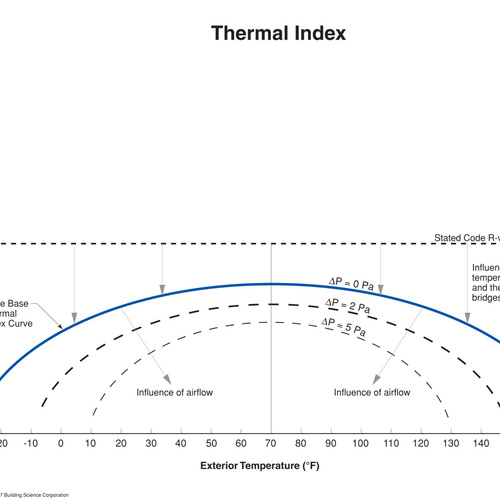
You're exactly right. That's the point of my article. The graphic from P2000 Georgia is in clear violation of the Federal R-Value Rule.
P2000 in my basement
I purchased P2000 a few years ago, and put it in my basement.
It looked like a great product, but the R27 was obviously exaggerated.
When asked about the R27 test, it was boxes built with heat lamps installed inside. If you've ever put your hand in front of a heat lamp, you'll notice there is considerable radiant heat emitted, which is exactly the type of heat the reflective foil does best with.
Anyway, I eventually figured out is was around R10 real world, and bought it anyway, as it was priced comparable to similar products.
My house is 1910, with hot water heat. My basement has no radiators, so it only gets residual heat from the pipes. I had installed a separate thermostat in my basement to keep the pipes from freezing, it was so cold (in Northern Ontario).
I had previously insulated outside my concrete wall with 2" R10 insulation, the Walls are 14" solid concrete. I installed P2000 inside the concrete, then framed 2*3 walls with another R12 of pink.
The basement is now the warmest floor in my house, even with no rads. The product stops all the thermal bridging, drafts, and works well.
So I will bad them for showing stats that were not real world (R27), but they have an excellent quality product, and it's sold for a fair price.
the so called insulating pain
I would like to hear your comments about the claims that are made by a company called insuladd
http://www.insuladd.com/ who blatently claim that their additive can be mixed with paint and applied to inside or outside of buildings with outstanding results. They do not talk about a system, but a thin layer of paint!!
I look forward to reading your comments.
Response to Hjafari
Hjafari,
I have been reporting on Insuladd lies since at least 2003. In the July 2003 issue of Energy Design Update, I wrote:
"Over the years, many 'miracle' energy-saving products have been promoted to homeowners. Among the most persistent such products are 'insulating' paint and its cousin, ceramic beads. ... A Vero Beach, Florida, company called Insuladd is among the latest generation of companies touting the virtues of ceramic beads to homeowners.
"As EDU has reported for years, ordinary white paints (and other paints with high solar reflectance), by lowering the temperature of surfaces to which they are applied, can reduce air conditioning bills in some buildings, especially poorly insulated buildings. But no paint yet invented can significantly increase a wall’s R-value.
"Nevertheless, Insuladd’s promoters, undeterred by facts, describe their product as 'the paint additive that insulates.' The company has coined an undefined phrase, 'insulation equivalencies,' which it uses to promote a fictitious R-value for its paint. According to Insuladd, 'The performance of Insuladd when mixed with a light-colored house paint can be expected to parallel the R-20 (radiant) and R-5 (passive) insulation equivalencies documented by commercially available insulating coatings' — whatever that means. These 'insulation equivalency' calculations embolden the company to declare that their paints 'achieve a very high insulation value.' Not convinced yet? Maybe this will entice you: 'Insuladd insulating additives and Insuladd insulating house paints can reduce utility bills by 40%!'
"Hidden among these deceptive claims is one that rings true: Insuladd paint 'looks and applies just like ordinary house paint.' "
The following year, in the March 2004 issue of Energy Design Update, I wrote:
"In spite of the fact that the Federal R-Value Rule carries stiff penalties for any manufacturer or retailer caught exaggerating the R-value of insulation products, Internet marketers of “insulating” paint regularly make uninhibited claims. Among the companies whose outlandish Web pages have been online for months are the following: ...Insuladd has a Web site that claims, 'In a 2x4 wood stud wall with R-11 insulation batts, 1⁄2-inch plywood exterior and 1⁄2-inch gypsum wall board interior, the actual R-value that occurs is 9.6. When the walls are painted with Insuladd, the R factor increases to 15.6. '”
Although I forwarded a complaint the FTC, Insuladd is still duping the unwary to this day.
To learn more about this scam and tests proving these products to be worthless, see ‘Insulating’ Paint Merchants Dupe Gullible Homeowners.
P2000 Georgia website
Hi Martin,
We've certainly heard an earful about you! In that our website continues to get traffic from your post, I thought I'd take the time to comment. Yes, we were the P2000Georgia.com culprits!
Our main product has been Structural Insulated Panels also known as SIPs. For those readers wondering why you've followed the link in the above post for P2000 Georgia and ended up on a SIP website. Actually it started with the downturn in the housing market and we were looking for another less-costly product to serve our clients.
Our partner's trusted associate recommended P2000 in 2008. This was to be our affordable alternative to our more expensive SIPs. So we took on the product, developed a very informative website. Maybe too informative as they demanded we take it down after we purchased over $40k+ worth of advertising for them.
The fact is, P2000 broke promises to us and the feeling of the overall P2000 expereince sounds alot like John M's posts. I guess we were too commercial for them as their true clientele were the unsuspecting lay-persons.
Needless to say, we wouldn't recommend this product in any way - based on our personal experience with the company.
Again, if anyone is wondering why we have the domain pointed to our CommercialSIPs.com website, well, we'd like to recoup some of our losses. Anyone want to buy a domain?
Response to Meredith
Meredith,
Here's the summary: "Former P2000 distributor now says, 'We wouldn't recommend this product in any way.' "
Here's what I don't understand: How can a SIP distributor be so ignorant of R-value basics as to advertise that 1 inch of EPS has an R-value of R-10.3? Such advertising is clearly against the law. That's why we have the Federal R-Value Rule.
To clairfy, I wouldn't
To clairfy, I wouldn't recommend the product based on the tactics of the company selling it.
The testing we received in the beginning was not the testing that was given to us later after they received their corrected #'s and their ICC code.
Origin of extravagant claims
Our neighbor, the lumber/building supplies salesman, is recommending P2000 to us and quoting about an R-20 rating. I understand after reading all of the above where they are getting the claim that it supposedly is R-10.3 but what are they using for evidence that it delivers R-20 or more? I want to be able to explain to him where that comes from.
Diane Schneider
Response to Diane Schneider
Diane,
P2000 is foil-faced EPS with an R-value of R-3.8 or R-3.9 per inch. Any claim that the product has a higher R-value is a violation of the Federal R-value Rule and should be reported to the FTC.
I don't know why you are asking me the question, "What are they using for evidence that it delivers R-20 or more?" I have investigated these scam artists for many years and tried to track down their deceptive marketing materials; I have many examples of false claims and lies in my files. Needless to say, there is no evidence that the product delivers R-20 or more -- unless, of course, you are talking about a sample of P2000 that is at least 5 1/2 inches thick.
R-20 per inch defies the laws of physics, and therefore evidence that a product delivers R-20 per inch is obviously impossible.
Right, I know the product
Right, I know the product doesn't deliver R-20 per inch but I wondered if there was a wall assembly that did which included 1 inch P2000 that they were using to falsely claim that it does. Just want to be able to debunk our neighbor's contention that it does and explain to him where that figure came from similarly to where the 10.3 figure came from.
Diane
Is this good duct insulation material?
There is supposed to be air space between it and what it is insulating, isn't there? I see it wrapped around duct trunklines in attics. Would something else be better? Why do so many use it?
Response to Rick Jenkins
Rick,
You are asking questions about "this," but you never tell us what "this" is.
If the installation instructions call for an air space between the product and the object being insulated, it sounds like you are talking about a radiant-barrier product. I wouldn't use such a product, because of the difficulty of maintaining a consistent air space (without thermal breaks) over time.
Duct insulation (usually poly-wrapped fiberglass or rock wool) makes more sense than a radiant barrier.
It also performs better.
Foil faced bubble wrap, sorry.
Foil faced bubble wrap
Response to Rick Jenkins
Rick,
Foil-faced bubble wrap has a much lower insulating value than insulation. Use duct insulation -- you'll be glad you did.
Shooting at P2000
After all the pot shots taken at P2000 I had to respond. Yes, there are some scammers out there for sure. There are also scammers who push way more fibreglas than you really need for the cost incurred. Me thinks that the fibreglas crowd don't like anyone crowding in to their holy ground...? Sour grapes perhaps...? Its all a moot point for me and a dozen other friends/family members who installed P2000 in their homes. Works. Keeps bills down. Easier to install. No moisture/mold problems. It just plain WORKS...! If there are people out there in this day and age that get conned without doing some research, then I don't feel sorry for you. With the internet, iPod, BBerry community so prevelent in today's society, there is no excuse to be in the dark. I may sound a little hard nosed here and perhaps I am forgetting the senior folk that can be easily scammed, but a lot of those same seniors, from MY experience anyway, are too stubborn to believe anything "New" will outperform fibrglas. Outright LIES about a product are few and far between in this neck of the woods. Personally, I think there are too many people in the local government/testing lab dept's. that are getting false info from "other" insulation makers/vendors, so as to create a false impression of the "New" stuff....rant ended...!!
Response to Laurie
Laurie,
As long as you understand that the product is basically just expanded polystyrene (EPS) with an R-value of about R-3.8 per inch, then you'll probably be happy with it. It doesn't work as well as XPS or polysio, and it certainly won't meet code requirements for R-value on walls in most areas of the country unless you can install at least 5 inches of the stuff. That said -- you can use it to insulate your walls if you want.
Response to Martin
So Martin, you are saying that the inch and a half fibrglas that was installed in our "new" home will do BETTER than 1" of P2000 in the same stud arrangement(24" OC)...? I really don't give a rat's rear end about "CODE", because working to the "minimum" code that most builders seem to do in our area results in a cold basement and just shows you how cheap many of the "cookie cutter" builders are...! We looked at a LOT of new homes, and there were quite a few that were"at code" that would not keep a wooly mammoth warm in a Canadian winter...! And what exactly do you mean, "I will probably be happy with it"...? The product WORKS...! The temperasture in the room went up by almost 5 degrees C. Thats proof enough for me. This stuff is the same as any other "GOOD" insulation when properly installed and sealed. This makes a HUGE difference when compared to the so-called "Code" you speak of. I have first hand knowledge of contractors using traditional materials and getting away with shoddy work, stalling tactics, and downright BS...! I could care less what the product is made of as long as its not toxic, etc., as long as it does the job. In the end, a good product will advertise itself through word of mouth far faster than any adverts will do. I know that Roksol(Spelling is wrong), has beat the hell out of regular FG in these parts, and I also use that stuff in my hose as well. Combined, P2000 and The rock stuff do an excellent job when installed correctly.
Response to Laurie
Laurie,
If you are saying that there are problems with existing building codes -- then I agree. Read more on the topic here: Are Energy Codes Working?
If you are saying the most installations of fiberglass batts perform poorly -- then I agree. Read more on the topic here: Installing Fiberglass Right.
Respnse to Martin
GREAT articles...!!! Totally agree with the sentiments expressed in them. The codes may be different up here, but "sloppy" work is still "sloppy" work, no matter where on the planet you use fibrglas...!!! I'm a DIYer, and I taught myself a LOT about home wiring, insulation, plumbing, heating, etc., and I can tell you that there are a LOT of people getting ripped off out there...! What REALLY pisses me off, is the excuses and ridiculus reasons some builders/tradesmen give you for the problems once they've left the house completed. As I see it. its all about the builders bottom line. I can't help but recall the statement used by Mike Holmes..."Do it right the FIRST time..."!!! Why would you want to be called back time and again to listen to an angry homeowner's complaints about a drafty basement, when you could have done it right the fist time, and genereated some good will as a side benefit...? Not to mention the free advertising you would get from word of mouth...!!!
It's a NO-BRAINER...!!!
NSHBA member
GREAT artical
as pointed out by Martin theres nothing wrong with p2000
its just there crazy claims high R values
but after all its just Eps foam with an r value of 3.8 per inch
you can buy other eps foams 30% cheaper than p 2000
good product with shoddy claims die fast
ICF
i probably shouldnt stir this can of worms because ICF is our bread and butter
but a claim of R 50 on a wall assambly of 5.5 inches of eps and 6 inches of concrete is absured
Thank you Martin. All that
Thank you Martin.
All that glitters is not gold. And all that is shiny will not lower your fuel bill (even if you believe you are losing more heat by radiant energy than convective or conductive). Like the ridiculous claims of bubble-foil shysters, this manufacturer seems to have a loose grip on marketing. It is a corporate character flaw.
As Martin and others have pointed out, the quality of the assembled wall will dictate the ultimate efficiency. The rest is misplaced loyalty and buyer's pride.
We use Thermax on the inside isolate cold concrete walls and on the outside, under the siding, where every inch counts. The aluminum skin will do a great job of reflecting radiant energy away from the house, in warm weather, if installed properly.
Thank you Mr.Bean for your always astute and accurate, science-based assertions.
Log in or become a member to post a comment.
Sign up Log in