
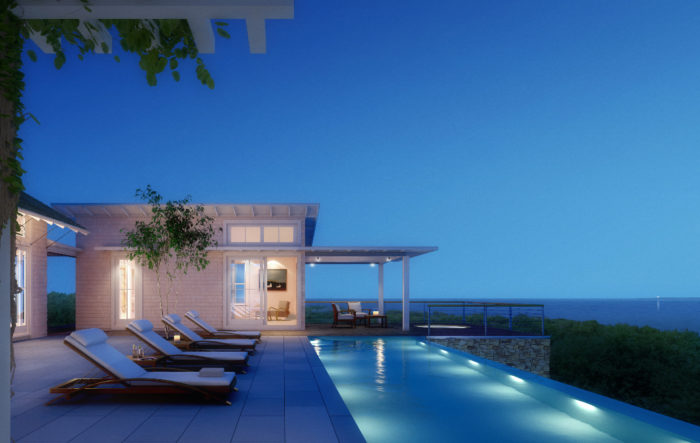
Image Credit: Aquidneck Properties
More Musings of an Energy Nerd


Question: What do the following homes have in common?
- An 11,000-square-foot home in St. Charles, Ill., touted as “one of the greenest homes in the Chicago area.”
- A 5,100-square-foot home at Live Oaks Estates in San Rafael, Calif., marketed as green by an Eco-Broker.
- A 6,100-square-foot home in West Vancouver, British Columbia, aiming for LEED for Homes Gold certification.
- A 3,000-square-foot home on Block Island, R.I., aiming for LEED for Homes Silver certification.
Answer: All of these green homes have swimming pools. That shouldn’t come as a big surprise, since residential swimming pools are increasingly common in North America. Back in 1950, there were only 2,500 private residential pools in the U.S.; now there are over 7 million of them.
Although residential pools no longer raise eyebrows, they nevertheless deserve the scrutiny of the green building community. Let’s be frank: swimming pools are energy and water hogs.
Why is the electric meter spinning so fast?
In homes with swimming pools, more energy is used to run the pool pump than anything else except the heating system and air conditioner. In fact, the typical California pool uses enough electricity during the summer season to power the average home for three months.
One study that looked at pool-pump energy use was conducted by Danny Parker, a senior researcher at the Florida Solar Energy Center. Parker monitored energy use at 204 Florida homes, 24% of which had swimming pools. On average, the pool pumps used 4,200 kWh per year. (For comparison, the average monitored home used 5,695 kWh per year for air conditioning and 2,227 kWh for water heating.)
I’ll need some water — lots of water
According to one source, homes with swimming pools use 58% more water than homes without pools. Another source reports that pool-equipped homes use twice as much water for outdoor uses…
Weekly Newsletter
Get building science and energy efficiency advice, plus special offers, in your inbox.

This article is only available to GBA Prime Members
Sign up for a free trial and get instant access to this article as well as GBA’s complete library of premium articles and construction details.
Start Free TrialAlready a member? Log in



48 Comments
Did you recently fly over North Dallas?
Martin,
Almost every other house in North Dallas has a pool.
You are right on about the pools being HOGS.
We recently sold our old home(and pool)...while it was on the market(unoccupied) we kept the house thermostats set way back...the furnace(gas) and ac were hardly ever running and few lights were on..and the water heater was gas.
The electric demand at the old unoccupied house(with pool) was significantly higher than the new (occupied night and day)sans-pool house.
It is very rare for a pool to be drained and filled .. so your estimate for water useage may be a little high.
Another not so green aspect is the chemicals.
When it rains .. the pools overflow and those chemicals end up in the storm sewers and lakes.
Pool draining
John,
Thanks for your perspective on pool draining. Of course, the water-use estimates in the examples I provided will be high for some climates (or pools) and low for others. In northern climates with cold winters, pools are usually drained annually.
Southern perspective
You got me ... I was wearing my warm climate glasses again.
We probably do have more pools.
Sure feels good to be an ex-pool owner.
BI Island House
Martin,
To be fair, you forgot to mention that The LEED registered project pictured in your piece is heated entirely by solar collectors. People are going to have swimming pools, at least this one will be energy efficient.
Should pools be heated?
Nick,
Purchasing and installing solar thermal collectors to heat a swimming pool does not address any of the issues raised in this blog:
1. The cost of the solar collectors can only be justified if the collectors are replacing swimming pool heaters using natural gas, electricity, or oil. That raises the question: why would anyone want to heat a pool with natural gas, electricity, or oil? In other words, adding solar thermal collectors to a pool installation doesn't reduce the negative environmental effects of the pool. It just adds another expensive gadget to the installation, raising its total cost (and, the the extent that the plastic tubing in the solar collectors had to be manufactured for the project, increasing rather than decreasing the negative environmental impact of the project).
2. Pools with heating systems require additional electric pumps to circulate fluid from the pool to the solar collectors. These pumps use electricity.
3. Solar thermal collectors do not reduce in any way the energy required to operate pool filter pumps. As mentioned in the blog, these pumps use very large amounts of energy — 4,200 kWh per year in the Florida study. Such pumps are required whether or not a pool has solar collectors.
Interesting spin...
Martin,
Your story has an interesting spin but I am just suggesting that there are two sides to this argument, for example, the pool in question also has a fitted pool cover that cuts down significantly on evaporation. Here in New England people don't generally empty their swimming pools during the winter, they merely lower the water just below return inlets, which is approximately 18-20".
My point is, if we are ever going to have a true 'green building movement' then it needs to include luxury real estate...pools and all!
Incorporation into energy analysis? rainwater storage?
Nothing but agreements from me too.
Perhaps there are ways at addressing the exact issues in question--
Energy: why not include the annual fossil fuel energy consumption into the home energy model. I would propose the baseline be the same-- a code-compliant house without a pool. Let the pool penalize the energy performance accordingly.
The same goes for water consumption-- let the annual pool evaporation and refill be counted in the site water consumption calculations for credits.
Of course, I'm sure many would quickly point out that carefully thought out procedures for dealing with the details of baseline pool energy and water performance, as well as proving exemplary performance and management, are both difficult to assemble and potentially challenging to implement. As far as I know, pool energy analysis is not a part of any current modeling software that one customarily uses for residential energy performance-- it's not a part of either Micropas (for California Title 24) or Rem/rate, in my memory. So, easier said than done.
In the meanwhile I've had to assemble my own hourly analysis for evaluating and comparing eficiency strategies.
In a few of my projects, we have considered (though not yet implemented) the following (for a Southwestern climate, mind you):
--Fill the pool with rainwater: if the house occupants don't usually swim in the winter, irrigate the landscaping using the pool water during the autumn (as site percolation can withstand), and then in the winter, direct storm drains and other impervious area drainage as possible to the pool and let it fill up some that way. With a 15" average yearly rainfall, 2,500 sq. ft. of roof should more or less do the trick. and yes... one must be careful with pool treatment chemistry, mosquitos, and poisoning plants along the way.
--Pool as solar thermal heat dump in summer: for projects which primarily use water as their heating fluid through hydronics, prevent thermal stagnation in the underutilized panels in the summer to dump the heat into the pool, or better, hot tub. Really less of a pool heater than a panel cooler.
Both these ideas I know have been well tested by all you veteran green building experts, but I, as a younger practitioner would still love to see them become the rule instead of the exception (at least in homes that insist on having pools).
back to the main point:
One bright side of pools is that the client simply must consider solar, since it's such a slam-dunk. I'd like to believe that it might be the camel's nose as far as getting solar (and more importantly, efficiency) front and center in the design process. I'll report back if that really plays out. ;)
Luke
The Pool Dilemma
Martin, I am completely in agreement.
Here's the rub, though, and why LEED for Homes didn't address pools: If you give points for pools, that means there are more points available for houses with pools than for houses without; that's just plain whacked.
In retrospect, though -- and if I for one had had any idea how swimming pools were madly proliferating across the face of the nation -- we absolutely should have paid attention to this issue. Talk about the elephant in the living room!!
In fact, I had a pool guy in one of my classes a while back, and he took me to task for this very issue. His position was much like yours -- people are building them, you had better figure out how to incentivize having them done RIGHT.
Given the enormity of the water and energy use implications, it is indeed worth considering whether or not a home with a pool should be able to earn a green home rating -- and if so, under what constraints.
I hope you'll weigh in next time NAHB & USGBC, respectively, have their programs up for review. This is something that should be fixed. I'm with you!
Give points for omitting, not for inculding
Ann,
You provided this reason "why LEED for Homes didn't address pools: If you give points for pools, that means there are more points available for houses with pools than for houses without; that's just plain whacked."
I agree. That's why I suggested that points should be awarded for NOT including a pool.
I love the idea of giving points for NOT including things. Now, it's possible to get points for including a dishwasher or a drip irrigation system; why not give points for houses WITHOUT a dishwasher or drip irrigation system? That would address the fact that houses with gadgets use MORE, not less, energy or water than houses without gadgets. Here are some interesting findings:
“Homes with drip-irrigation systems use 15 percent more water outdoors than those without drip irrigation systems. ... Perhaps most remarkable was this finding: The low water-use landscape group (xeriscapes) actually received slightly more water outdoors annually than the standard landscape group because of homeowners’ tendency to overwater.”
“Residential End Uses of Water," an in-depth study conducted in 14 cities in the United States and Canada that was funded by the American Water Works Association.
http://www.thelawninstitute.org/img/c/f185578/Water_Right_Book.PDF
Carried to its logical conclusion, the greatest number of points should be awarded to a builder or homeowner who, after contemplating the construction of a new house, decides not to build a house after all. Such a person should immediately be awarded LEED for Homes Double Platinum. The only problem: there's no wall to hang the certificate on.
Can a Fireplace be Green? Oink..Oink
Ann and others, I hope that this is still on topic.
Can any "luxury" feature be green?
Should we compare ourselves to the Amish?
Concerning current LEED for Homes and NGBS parameters...
What is the penalty for a having a fireplace?
Is there an incentive for not having a fireplace?
Not all ... but most fireplaces are a big negative.
Most people do not "gather" their own firewood.
Most fireplaces waste energy when in use and when not in use.
Most fireplaces(at least in Texas) like whirlpool tubs are VERY rarely used!
Let's establish energy and water budgets
John,
Rather than getting bogged down regulating every gadget or feature – should there be a rule on fireplaces? a rule on swimming pools? — I rather like Lucas Morton's suggestion that green rating programs simply establish budgets for purchased energy and water. (Or, as Lucas phrased is, "Why not include the annual fossil fuel energy consumption into the home energy model?")
We could say, for example, that an emerald home uses
x kilowatt-hours of purchased energy per year and
y gallons of water per year.
A gold house uses 1.5 x and 1.5 y; a silver house uses 2 x and 2 y; and a bronze house uses 2.5 x and 2.5 y.
While we're at it, we could eliminate all calculations based on square feet. Energy use matters, not energy use per square foot.
The problem, of course, is that no one would get a green label until they've lived in the house for at least one year, with utility bills to prove their point. Furthermore, an emerald house could turn into a bronze house in year 2 because of rising gluttony.
Can an air-conditioned home be Green?
What about air-conditioning? I am not an 'energy nerd' but as far as I know the LEED rating system doesn't a penalize homes or commercial buildings that install air-conditioning units?
Isn't that a luxury? It is everywhere else in the world.
What about pool used for Geothermal system?
Martin - I am in agreement with your thoughts on the subject, and seriously jealous of the number of comments this issue has raised. I'll have to blog about pools and see if I get the same response. One thing to consider in this is the use of pools for water source heat pumps. I saw this at Peter Pfeiffer's house in Austin - it is a pump and dump system using the pool for his primary heating and cooling with an auxiliary water tower for the hot months to keep the pool from overheating. This application does provide some justification for having a pool.
This is not a war on luxury
Nick,
I am not proposing to make luxury the enemy. Fireplaces and air conditioning are different from swimming pools in at least one respect: existing green rating programs already take them into account (however imperfectly). Fireplaces negatively affect blower-door test results, providing a strong incentive for green builders to eliminate them, and all green rating programs that I know of have some mechanism to encourage air conditioner efficiency.
However, the national green rating programs have chosen to ignore swimming pools entirely. There needs to be a mechanism to bring their energy use into the green-home equation.
Pool plus heat pump? I'm a skeptic
Carl,
The proposal to use a pool as a heat source or heat dump for a heat pump -- especially one supplemented by a cooling tower, in imitation of a nuclear power plant -- strikes me as unworthy of emulation. This is the gadgetification of green homes, gone amok.
When used as a heat source during the winter, the pool will soon freeze, unless it is enormous. As your example indicates, the tendency in the summer is for the pool to overheat.
What we really need are small, very well insulated houses, with minimal heating and cooling needs -- not ever-more-elaborate mechanical systems.
Points for omitting? sure, NAHBgreen has 'em!
Money for nothing and the points for free:
NO Fireplaces installed section 901.2.2 - 7 points
No Garage or detached or carport 901.3.2 - 10 points
No natural draft heat or H/W in conditioned space 901.1.1 - 5 points
No irrigation needed landscape design. 503.5 & 801.7.4(3) -15 plus
No ducts required for space heating 704.4.2 - 15 points
No ducts required for space cooling 704.4.3 - 15 points
Check it out, http://www.NAHBgreen.org
Thanks for the easy pitch.
The fireplace section is actually very interesting to read. It was the result of some amazingly passionate and contentious debate in the working group. Mostly based on indoor environmental quality rather than energy. Certain curmudgeonly individuals pointed out that we should outlaw dogs and cats while we were at it.
Nothing about swimming pools as yet, but it raises the point, should the carbon footprint of the occupant be taken into consideration?
Is it possible to build a green certified house for Dick Cheney or Donald Trump? Does Al Gore's work on climate change somehow mitigate the carbon footprint of his residence?
Thanks, Michael
Your point is a good one. Since several green rating programs, including NGBS, already grant points for omitting things, there is a good precedent for handling swimming pools the same way.
I'm not sure what you mean when you ask, "Nothing about swimming pools as yet, but it raises the point, should the carbon footprint of the occupant be taken into consideration?" If your point is that occupant behavior affects water and energy use, of course you're right. If your point is that a gluttonous occupant can use excessive amounts of energy and water even in a green home, of course you're right.
But the point applies to most features of the house, not just swimming pools. As long as green rating programs address landscaping, they are already addressing features in the front yard and back yard. So why not swimming pools?
Let's get more inclusive...a little less fanatic.
The current “Green” movement is a good first-step marketing approach to getting people to understand, consider and begin to utilize materials, concepts, and lifestyles that hopefully enhance our environment by reducing its long term ill effects. Programs and opportunities have been initiated toward this goal of preserving a functioning global atmosphere. Our planet is in dire need of help on many fronts that threaten our very existence. Many of us are very passionate about reversing prior mind-sets that have fed this threat. I feel that fanaticism can be as insidious as gluttony in challenging societal pre-sets. It is of great value to set incentives for reaching toward energy independence, and Leed designations are a help. But let’s not forget why we are doing this…it’s not just for the “badges” we can get.
Many of these corrective measures require substantial funds to accomplish. Unfortunately most of us do not have the liquidity required to gain significant measures toward any “Green” awards program. Therefore, you’ll find that the vast majority of applications come from individuals who are relatively well off. In this regard, you can expect to see a good number of pools being installed for those inclined to opt for an “unnecessary”, albeit pleasant luxury. All well and good, these are STILL people motivated enough to invest in reducing their carbon footprint in other ways…AND by putting a “gadget” on their roof to heat the pool from the sun is yet another very good way to reduce greenhouse gasses, etc. ..and why not use the pool as a heat exchanger heat sink as long as it’s there. Might I remind you, Mr. Halladay, that you (and the environment) have already benefitted (thank you)by your roof top gadget in the form of PV. The rest of us might be content to more mundane and less expensive benefits to the environment, such as home gardening, conservation of water and energy, and composting. After all…no matter how many “gadgets” you have and other measures to qualify for fancy energy designations, it still all boils down to… the END USER…
Odd bit of market reality
So far I've only built three homes that have pools but I've never built a home with a pool. The market reality around here is that the pool is generally added after the house is built and is not part of the construction contract or the construction permit. It's clearly not a part of the house.
I was being a bit cavalier about Donald Trump and Al Gore and their carbon footprints but to me a pool is a lifestyle choice so it should be possible to build a green certified house even if the owner decides to have a pool or an SUV or even a private airplane in the back yard.
Good suggestions, but a step further
A pool must be taken into account for a "green rating". Giving credit for not having a pool doesn't accomplish much (other than give easy credit to a home in Alaska). Instead, raise the bar for a home with a pool: increased minimum energy and water savings should be required for the home (say 40% above the minimum level for a home without a pool.... if you don't reach the "with-pool" minumum level, you don't get the certification). For Commercial LEED projects, it could be relatively simple. But for Residential Certification systems, it's tougher due to the "prescriptive approach". So extra or different check boxes would apply.
Possible ways to show/require extra water efficiency: Zero irrigation systems allowed (or only from rainwater harvesting and/or a gray water re-use system); require a "permanently affixed"/retractable pool cover (no purchasing the cover and putting it in a storage shed); Requiring all of the mentioned water saving/energy star fixtures, including a maximum 1.5 GPM shower head (no multiple shower head enclosures....); make-up water sub-metering, and possibly a minimum amount of rainwater or gray water use per year/fixture unit count/etc. to be used for non-irrigation.
For energy use: Only on-site non-renewable energy for pool heating (solar or heat recovery only; no "I buy nothing but renewable power" excuse to say you're using renewable energy to heat an energy hog); premium efficiency motors for the pump (maximum BHP pumping per pool surface area; filter controls to reduce use); maximum pool size!; limit on maximum allowable glazing (30% of building) and X% better miniimum U and SHGC glass/frame; Z% increase in insulation systems over minimum, and possibly requiring Y watts of PV panel per XYZ Sq. Ft. of building footprint.
It may not fully account for the energy/water used by the pool, but it's a start. And the extra hurdles should be enough to cover at least 50% of the extra energy/water use. And if a homeowner doesn't want to go that far, don't go looking for a green stamp of approval if you're not willing to make the effort.
As for someone adding the pool after-the-fact, the site considerations for a "green home" shouldn't allow this back door approach.
a green pool
you don't literally want a pool to be green (with algae), but here is how I run my pool, which came with the house.
A variable speed pool pump, plumbed to an oversize filter (to reduce pressure). The pump only uses 100W (same as my ERV). That's a max of 2.4KWh per day or about 300KWh for the season. This is nearly offset with just one 200W PV panel when pointing south where I am (Long Island).
Water comes from a well, so not wasting city water. If the water is drained it goes back where it came from.
A salt water pool addresses the chemical issue.
That only leaves evaporation, and embedded cost. Well mine came with the house, so zero incremental embedded cost.
So the cost of my pool is limited to the evaporation of fresh water, my guess about 2 ft per season. I guess I could mostly solve that with a removable cover.
An idea for a relatively green pool
Here's an idea for a relatively green pool: Make one from a recycled dumpster. Read about it here:
http://www.nytimes.com/2009/07/20/arts/design/20pool.html?_r=1&hpw
Popularity of pools in decline?
I agree that pools should be included in any accessment of a home's energy use. But I wonder if the declining economy and new water rules might soon take care of much of this issue without other incentive from LEED?
I'm thinking about all the pools I've read about in hard hit areas of the country where homes are sitting empty in
foreclosure and watering restrictions are quickly becoming the standard. The stagnant pools have become a health hazard.
They are the modern ruins that attest to the rapid changes taking place.
At the very least, our values will likely be shifting in the near future as we re-evaluate MANY unsustainable lifestyle choices that we once took for granted. Kind of like allowing gravity to work for you rather than adding additional weight to an already deflating balloon. I'm curious...what ARE the most current statistics on new construction of pools and luxury homes? And should we extrapolate out into the future in a linear fashion,
assuming that these trends will continue more or less unabated? I honestly don't see how they could.
Although I feel new technology can and will offer some solutions, I hope rather than relying on them to lead the way, they instead
arise within the newly forming revision of values
relative to sustainable, natural and whole systems that don't rely
on fossil fuels. For instance, what is the future of micro hydro applications in the home?
And is there an argument to be made or perhaps even a necessity for sustainable homes to incorporate some kind of pool/pond
that serves multiple purposes only one of which is recreational as we learn to value and use water in new ways? I don't know, but will allow for the possibility.
Instead of assuming it's only a matter of less use or eliminating pools, perhaps the key is more in HOW resources are used, playing with multiple yet more efficient applications for water use, recycling, storage, heating, cooling, and even its kinetic function as an energy source.
can swimming pools be green?
Great post. Unfortunely "green" rage is just another nail in the coffin for the pool industry. What the current economy (that is NO loans for even the qualified) is doing the new water shortage surely will end the industry. An industry employing thousands from design architects to stone masons.
I am a pool builder and I believe I am the only builder with an energy efficient swimming pool. Just utilizing existing technologies I can design and build a pool that is 75% more efficient than the standard 15 x 30 kidney pool with an 8' raised spa. And by the way is only 15% more costly.
My "gold" design will save gas and electricity, water (up to 6000 gallons/year, pool and spa lighting that uses 75% less electricity than standard incandescent, when closed is the safest pool available and the pool pump runs daily at a whisper even addressing noise pollution.
So gentleman, lets not steer the public away from a product just because its a perceived HOG when the pool industry is changing and adapting to this new green thinking. Swimming pools should be more energy efficient and I think they are heading that way.
Remember alot of us grew up with a pool that provided countless hours of family enjoyment and is a great source of excercise.
Owning or not owning a swimming pool should remain a personal choice.
I always wonder when people
I always wonder when people talk about going green and making the environment clean and safe again . People have been playing around or lets call it fooling around with nature from the word GO . Us humans have been developing , exploring and moreover destroying nature from a long time and now we are taking initiatives to change the world . Now what buzzes me the most is the fact that many of the regularly used stuffs such as pools and cars are the main factor behind global warming and drastic climate change . Now at this stage , if any restrictions are made regarding these stuffs , it would be very hard for us to try following it . Since , mostly in hotter areas swimming pools are a must and it would almost be impossible for people to quit building and owning pool .So , what really needs to be done is to bring in some other alternative regarding this issue rather than just avoiding . Recycling the water and putting over pool blanket can be the best alternative , as for now , for the sake of keeping the earth green .
This is an interesting debate
I am in the process of looking for a house and one that I looked at recently had an above ground pool, so I did a little research (which is sort of how I landed here) and was shocked at how un-green a pool really is. I just wanted to see how much water my little above ground pool would theoretically use and saw that it was over 14,000 gallons! (chart referenced is here). Though, it is interesting to see some of the "greener" ideas that people have tossed around here. I've never been in a salt water pool, for example...
Without making this a true "war on luxury" though, it does seem ludicrous that there isn't some sensible rating program that takes a pool into account.
can we get rid of the pool and add a geothermal system?
We're getting a little tired of our 20by40 foot pool --too much work, we don't use it much, we can only use it 3 -4 months of the year--and thinking about filling it in. Does it make sense to look into switching out our HVAC system at the same time with geothermal?
Not really
Lois,
If I understand your question correctly, I think you are asking, "Would the excavation hole for a swimming pool be large enough to hold all of the PEX loops required for a ground-source heat pump?" The answer is no.
For a ground-source heat pump, you either need to drill one or two wells about 200 or 300 feet deep, or you need hundreds of feet of fairly wide 6-foot deep horizontal trenches. Neither a vertical nor a horizontal loop system will fit within the dimensions of a residential swimming pool.
In the deep end
The fact that we have to ask the question "Can swimming pools be green?" suggests we are in big trouble as a civilization. It also calls into question the meaning and value of the word "green." It's pretty much like asking the proverbial question "Is it art?" Always interesting to philosphers. Builders would be better served with a question like "How can we reduce the environmental impact of swimming pools?"
Response to Sea Wolf
Sea Wolf,
I agree that it is meaningless to use the word "green" unless we first define the word.
Clearly, many organizations have already entered the fray by introducing their own definitions of "green." Although the definitions vary, the aim is clear. As you point out, that aim is to reduce the environmental impact of our work, our purchases, and our daily decisions.
The point of my blog was to highlight an apparent contradiction: while many green building programs give high points for relatively minor savings in energy and water use, they ignore backyard swimming pools that use far more energy and water than the amounts being battled over in the home's kitchen or bathroom.
This is not an "is it art?" discussion. This is a challenge to existing rating programs to address a contradiction.
Martin, how about a penalty?
LEED-H and NGBS already penalize larger homes (LEED much more so...) Why not add a points threshold penalty for pools as opposed to reworking the rating systems scales? This could be done as a design credit (negative) in the systems. But I think you're right. To ignore resource use on site does not make for real assessment of sustainable building practices. Next we can move on to materials and do the same by considering life cycle costs of the products we use.
Solar pool pumps
One thing you failed to mention is that in sunny climates you can use solar pool pumps to greatly reduce electric use. My pump runs 8 hours per day here is central Florida and uses about $100/month worth of power with a 1.5 hp pump. I can't reduce the runtime much without algae issues in the summer months. At that rate, you can install a solar pump system and payback in less that 3.5 years. That is a no-brainer.
Response to Samuel Jones
Samuel,
Your best bet is probably to replace your 1.5-hp pump with one of the more efficient models of 3/4-hp pumps. (Improvements in piping -- larger diameter pipes with long-sweep elbows instead of 90-degree elbows -- can also be helpful.)
PV-generated electricity is not cheaper than grid power; it is considerably more expensive. If you have grid power, it's the cheapest source of electricity for your pump.
Response to Martin Holladay
Martin, your comments are well taken but I feel they are short-sighted. With a 3.5 year payback, after that the pool pump costs NOTHING to run and saves me $100/month. I already have 2 inch piping which is pretty much standard these days. I'm not digging up the yard to replace all the 90 degree fittings. On a new pool that would be another matter and I can agree with you. Even with the more efficient pump, I'm still paying for electricity, not to mention the cost of a new pump/motor. If I'm going to do that I would much prefer to go solar. It is a better ROI (return on investment) in the long run.
PV payback
Samuel,
We're all waiting for the day when PV is cheaper than grid power, but it hasn't come yet. Most experts calculate that PV power costs between 25 cents and 50 cents per kWh -- considerably more than the national average of about 12 cents per kWh for grid power.
If you live somewhere with huge PV incentives or grants from your state government or local utility, then that means that taxpayers or other utility customers are helping pay for the electricity to run your pool pump. So that subsidy may explain your hard-to-believe payback calculation.
Count me a skeptic. I have never seen any PV installation with a 3 1/2 year payback.
Your 1.5 hp pump probably draws 1200 watts. To purchase enough PV modules to power the pump would cost about $8,400. However, your pump runs for 8 hours a day -- and most U.S. locations only have an average or 5 or 6 hours of full sun per day, so you'll probably need more PV modules.
If your 1,200 watt pump runs for 8 hours a day, that's 288 kWh per month, which costs about $34 per month in most locations (higher utility costs in some areas, of course). If you invest $10,000 in your PV system, the simple payback period is 24 years, not 3 1/2 years.
Response to PV payback
Martin,
Let's take a closer look at the payback. My current pump is a Pentair Wisperflow 1.5HP with a 230VAC motor rated @ 8 amps. Doing the calculations:
230 volts x 8.0 = 1840 watts
1840 / 1000 = 1.84 KWH
1.84 x 8 hours = 14.72
14.72 x 30 days = 441.6 KWH/month
441.6 x .10318 cents per KWH = $45.56/month
$45.56/month X 12months = $546.72
If this were the actual power use the payback would be 6.4 years (see cost below). What's interesting here is that is not what it is actually costing me to operate it. We use the spa a lot and that greatly increases the resistance across the pump which in turn loads up the motor more increasing energy usage. I have a cartridge style filter which is cleaned monthly and the pressure drop across it is always very low. When I get a moment I'll measure the actual current draw across the motor with the spa jets on and off and rework the calcs and post what I find. Note that power in other parts of the country are higher than here in central Florida.
FWIW, you can purchase a complete solar pump/motor/controller/panel package for ~ $3500. Of course that does not include installation but it is an easy DIY project if you are fairly handy. If not, it would not cost much to get it installed (especially on an existing pool). If it was a new installation, I would do it anyway because you are still saving money over the useful life of the pool and equipment, not to mention all the pollutants you are keeping out of the air from generating all that grid power.
Response to your new figures
Samuel,
Thanks for providing more information.
I see that your anticipated savings number has changed -- from $100 per month (in your June 30 post) to $45 per month in your latest post.
If someone is selling a swimming pool pump / PV package for $3,500, a few things are clear:
1. The PV array is considerably smaller than 1,840 watts (since a 1,840-watt array would cost at least $7,300).
2. If the PV array has a lower watt rating, then either the pump is much smaller than your current pump, or the PV array is insufficient to power the pump.
So, if the main advantage of the PV package is to swap out your huge pump for a smaller pump, then go for it. I'm sure I'm right, however, that the savings accrue from the smaller pump, not from the fact that it is PV-powered. So the cheapest option is to just buy a smaller pump, and continue using grid power -- since grid power is always cheaper than PV power.
Response to new figures
Martin,
As I mentioned, it really IS costing me ~ $100 more a month to operate the pool pump than the power bill without it. I've looked at the history prior to adding the pool and afterward and the KWH consumption increase is obvious. We'll know more once I get some actual amp readings on the motor.
Regarding the solar package price, the DC motor is inherently more efficient and a 3/4hp motor and pump is used in that option. I look more at return on investment and after the inital cost of the package is recovered, it operates basically for free. So you really cannot compare PV cost to grid cost straight up. If you look at it over the useful life of the pool, the PV system pays for itself and then saves you a lot of money. Even it the payback was 6.5 years, it is still a very good investment.
Solar covers
Great article. Thanks! Solar covers could be really useful when it comes to being eco-friendly & saving money and energy.
I think you have all drunk
I think you have all drunk the Kool Aid. The article begins with a question, what do all those houses have in common, but gives the wrong answer. The correct answer is "They are all many times larger than they need to be." However green they may seem, they are horrendously wasteful just by virtue of their size. A 1000 SF house using the same technologies would be many times greener and quite adequate. I grew up with three other brothers and both parents in 960 SF and it was fine. The only way those gigantic houses could ever be green is if they were converted to boarding houses or B&Bs or something like that where they are housing a lot more people than the average family.
Hidden Benefit of a pool?
While I am hesitant to comment on an post that is 4 years old, this one may become active again since it relates to Martin's current article on pool pumps (and is linked as a related article). In addition, my comments fit this topic better. So with that...
About 6 years ago I did a project for Extreme Makeover Home Edition that included a back yard pool. The pool was actually the reason the show chose this client as she turned it into a home business by teaching hundreds of kids how to swim. The lot was a small existing lot in an urban environment just north of Seattle, and if I recall it was 50 x 100. One of the first challenges we faced was increasing the footprint of the house by about 25% as well as adding a garage/shower facility/ with a "party" room above without exceeding the impervious surface limits imposed by the jurisdiction.
My initial calculations showed that we would not be able to do it despite a 100% pervious paver driveway and patio along with extensive use of rain gardens to handle all of the stormwater. We were close but still over the limit; that is until I learned that the pool was NOT considered a pervious surface. Really? Yet a gravel driveway is?
Don't pools (not to mention ponds, lakes, etc) NEED to be impervious in order to exist (aka, retain water) in the first place? The logic given to me by the city planning dept. was that pools typically evaporate moisture in excess of annual or even storm event related rainfall. So, if limiting impervious surface is one of your objectives, consider a pool...unless of course reducing energy consumption and water useage is also one of your goals. By the way, gravel driveways eventually become compacted to the point of being impervious due to compaction, but I digress.
So there you have it, a large impervious object you can put on your lot that is not considered an impervious surface. Personally, I tend to agree with your thinking on this Martin as I used to ride my bicycle to the local community pool too, but then to each their own.
Response to Brian Godfrey
Brian,
You accuse me of having drunk the Kool Aid, because you assume that I failed to notice that all of the over-the-top "green" homes described in the first paragraph are huge.
I can assure you, Brian, that my lips are Kool-Aid-free. I not only noticed that the houses were huge, but I went out of my way to track down their square footage so that I could hold them up to public ridicule.
GBA has consistently advocated that green homes should be small, and has consistently pointed out the hypocrisy of wealthy homeowners who brag about their "green" McMansions.
For more on this topic, see these two articles:
Who Deserves the Prize for the Greenest Home in the U.S.?
Green Building for Beginners
Response to Daimon Doyle
Daimon,
Every time I think I have heard every possible story about illogical building codes, I am surprised by a new instance. Thanks for sharing your story about building code officials who categorize pools as pervious.
"Green" pools and copper ionization vs. chlorine or salt water
Interesting article and comments. Certainly raises questions. I have a pool, and put it in about 7 years after I built my house, when my kids were young, and well before "An Inconvenient Truth". While it would be politically correct to say "I wish I did not have a pool, bc it is unsustainable", I am on a journey, and I make tradeoffs all the time. I eat local organic food (and my farmer cousins think that's a complete fallacy and disservice to farmers - a fad and in fact I've even been called "the enemy" by some non-organic farmers). I buy second-hand clothes and furniture when I can (reduce, and re-use), and recyclable/made from recycled plastic toothbrushes, bc I'm not willing to give up brushing my teeth. I try to be real and honest with myself when making decisions, but sometimes I "need" coffee on the road, and the only cup available is styrofoam (HATE it). SOOOO... Re: pools. They are not going away soon. I agree that many pools go in after the house. People also move in to homes with pools. Our pool has been the center of our summer living, and entertaining for over a decade. We taught our kids to swim, and we have deep connections with neighbors, having shared many an organic (and not so organic) beer and wine around the pool. I've had important conversations with my kids while relaxing by the pool (and while driving in my hybrid car). The human value has been high for our family. Several years ago I became concerned about the chemicals that we use in our pool. My husband is a cancer survivor, and I am generally very careful and conservative about chemicals - whether in the pool, my skin care products, my food, and I have a dandelion filled lawn. I will offer up that I googled green pools, and chemical-free pools, and finally found a link on Green Pages/Green America for Intec, which has a copper ionization process. Huge payback, much better system, and I would suggest also better than salt water pools. Take a look. http://www.intec-america.com/products/pools.asp Of course, it needs to be a "do-it-yourself" project, because the local pool companies are unaware of this, and would want nothing to do with it, because we buy almost nothing from them anymore! Better may be the enemy of best, but it's still better. I think perhaps we should have a standalone "green pool" certification process. I share the concern about McMansions (I don't have one), and what really can/should be declared green, and I don't have all the answers, but I also think an "in use" actual consumption model for green certified houses, buildings, pools, cars, whatever, needs to be part of the solution set.
OK, I apologize. While it
OK, I apologize. While it was not obvious that you meant for us to ridicule those houses, please consider it done. :-)
Hey, I've got a more
Hey, I've got a more constructive comment, too:
If you live in a fire-prone area, a pool can double as a water storage tank - assuming you cover it when not in use. The fire departments in the southwest are very diligent about finding and mapping these resources and they do use them. We will be installing gutters in our gutterless house in a few months (when we get the money) and intend to install a large storage tank beneath our deck to collect rain water. We don't have a pool, but if we did the rainwater would be a good source of replenishment water for it. Instead, we irrigate a few olive trees once or twice during drought years just enough so they don't become fire fuel and that is what we will be using our rainwater for. The rest of the yard is very nicely landscaped in native plants which require no irrigation.
Where are the women? oh, BTW, great article too!
This is a great article. I eagerly read the exchange between Samuel and Martin.....
To be a responsible global citizen, I should ditch my dream of owning a pool. But I really want one - for my kids, for my family, for the lifetime of memories a pool in my backyard would give me.
My goal: limit my impact. It's the best I can do, I'm afraid.
If anyone reads this and feels like doing the math, let me know how long I should abstain from meat to cover the environmental footprint of my pool. And I plan to convert 0.2 acres of my yard into a vegetable garden. That should help too, I hope.
Lastly, and most importantly, where are the women in this conversation? I saw a Melissa O'Mara, but otherwise, more than anything, I was struck by the lack of females contributing to the conversation. That seems the most unsustainable thing we can do globally - we have to get better at making the STEM topics important to both genders. My guess is that in the US, it's mothers and wives who ultimately make decisions about the pool. And they need to be informed.
Response to Erin Horbach
Erin,
Thanks for your comments. Compared to other construction-related websites and construction-related magazines, Green Building Advisor has a high percentage of women readers, and that's good.
Whenever a group gathers together for a discussion, the men tend to talk more than the women. On websites, they tend to post more comments. That imbalance can be problematic, so it's good when men quiet down for a while and do some listening. Again, thanks.
Log in or become a member to post a comment.
Sign up Log in