
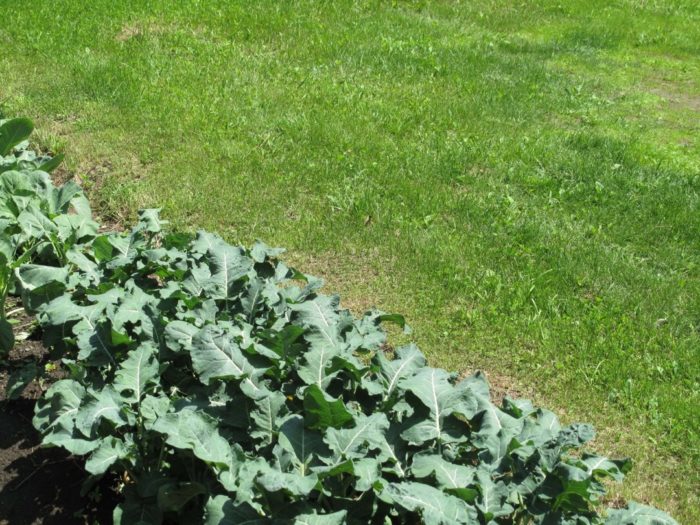
Image Credit: Martin Holladay
More Musings of an Energy Nerd


Environmentalists often bad-mouth lawns. The anti-lawn stance was summed up in a recent essay by Kerry Trueman, who wrote, “The typical American lawn is pretty much an unmitigated environmental disaster.”
Here in the damp Northeast, however, many of the anti-lawn arguments don’t apply. I rather enjoy my areas of lawn, which are low-maintenance, attractive, and sunny. Lawns are great places for Frisbee, soccer, and baseball.
When I moved to Vermont, I planted vegetables. (So far, so good. If there’s one thing the anti-lawn crowd loves, it’s vegetable gardens.) Once my garden was established, the question arose: what do I do with the land surrounding the garden?
Keeping the forest at bay
Left to its own devices, untended land in Vermont follows the rules of ecological succession, passing inexorably from wild raspberries, poplar, and birch to a mature northern forest. The result is beautiful, but no garden can grow in the shade of 80-foot maples. So after whacking away at the underbrush for a few years with a machete, bow-saw, and chainsaw, I bought a lawnmower.
If tree stumps are cut very low and stones are removed, a gas-powered lawnmower can make short work of wild raspberries and small-diameter saplings. Twigs and thick stems are soon pulverized into organic mulch. I was pleased with my new method of keeping the forest at bay.
After just one season of intermittent mowing, I was surprised to see that I had created a lawn. After thirty years of mowing, my lawns are smooth and the grass is deep green, all summer long. I have never planted any grass seed, applied any fertilizer, or watered this lawn. All I did was mow the wilderness.
I challenge the anti-lawn crusaders to propose a less labor-intensive way to maintain a border around my vegetable…
Weekly Newsletter
Get building science and energy efficiency advice, plus special offers, in your inbox.

This article is only available to GBA Prime Members
Sign up for a free trial and get instant access to this article as well as GBA’s complete library of premium articles and construction details.
Start Free TrialAlready a member? Log in


7 Comments
sure
It's all about appropriate solutions to climate and region. I think the reason so many greens are so anti-lawn is because they are so often in inappropriate contexts, with no thought as to whether a classic New England solution makes sense in the southwest, or the north. (If the average green was a building geek, we'd probably see a similar outrage against the traditional New England-style house as well.)
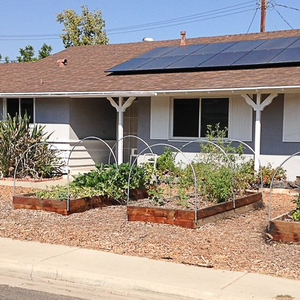
I can't imagine using grass as a garden border though. Most of the grass varieties that volunteer in California seem to be the types that like to encroach and invade —- not what you want around your garden. In our back yard, where the main garden is, we have woodchip mulch which we laid down over cardboard. It keeps down most weeds and provides a medium from which it is easy to extract those that do grow. In the front yard, we do have grass, but they're bunch grasses - a mix of natives and climate adapted imports.
Cardboard and wood chips
Brent,
I agree that cardboard and wood chips can make a fine garden border. However, if you want to allow sun to reach the garden at angles of 45° or higher, you need to keep at least 80 feet of your yard tree-free between your vegetable garden and the nearest 80-foot tree. That's a lot of cardboard, and a lot of wood chips.
yep...agreed, all about context
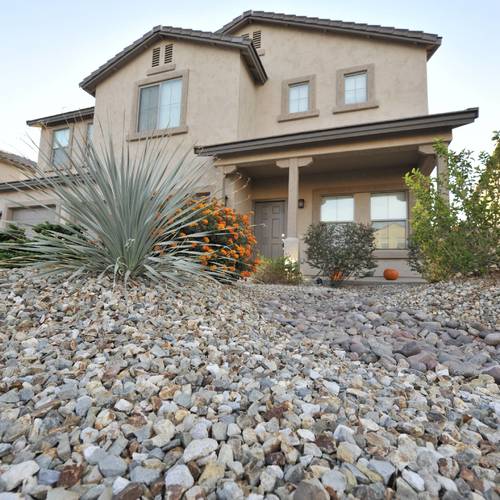
In San Diego (a particularly arid CA lawn affronter) faux lawns are becoming a more widely accepted alternative. I am not certain what they are made of, but I imagine that they are not entirely dissimilar from turfs made from recycled tires, water bottles and athletic shoes. You get space filler, playable area and some semblance of aesthetics without the maintenance or objections that are mentioned within this article. they cost a bit, but such costs will surely be driven down as the cost of water inches higher and they become more popular.
Bush-hog a meadow
I agree that a little bit of lawn is a great thing. We like to play frisbee, kick a soccer ball, and keep larger vegetation away from our house. But that does not require much space really. The rest of our land is divided into areas where we want trees to block cold winter winds and damaging storms, and areas where we don't want trees to preserve sunlight and views. In the latter areas, we just bush-hog once a year, and wa-la, with even less maintenance than a lawn, we are surrounded by beautiful meadows. You need to do a little control of invasives, but the natives will fill in themselves pretty easily. A bonus is that in much of the East Coast, meadows are an endangered species (our area still has lots of forest, and of course development, but hardly any meadows...) and thus have special ecological value.
Drought Tolerant and Hybrid Grasses
I fully agree that lawns serve an important purpose (and we should include in that discussion, public parks and spaces as well). However in arid regions and given the effects of global warming, it's important to reaccess the proportioned area dedicated to turf in favor of either a food producing garden or xeriscaping along with various strategies such as rainwater collection and/or redirecting roof/grey water into the landscape more effectively.
In areas dedicated to turf one might also consider using
some of the native or new hybrid grasses being introduced. Turffalo, for instance, offers both a sun and shade variety of turf that are both drought tolerant and require little mowing (not growing beyond 4 inches), while providing a thick, lush mat. However in a weak economy, these pricey new breeds might be out of reach to most (lest local/fed governments create some incentives).
And as with most drought tolerant grasses, one must be content with the golden yellow color they turn while dormant at the hottest times of the year, just as we also enjoy the color changes of Fall.
violets and clover
I pretty much follow the same approach as Martin. I cut the lawn, occasionally using the mulching setup, but don't apply any fertilizers. I do have to put down moss control in the more shaded areas. I've found that in my Massachusetts yard if I don't weed it the clover and violets tend to take over. I don't know of any weed control that handles violets so other than hand weeding there's no point to using it. We've also been doing a lot of overseeding with water and shade tolerant grass seed mixes, at least in the back of the house.
The one drawback I see to this is that for most of the year the violets which have completely over taken the front yard aren't as attractive as grass. But for a couple of weeks each year in spring we have an incredible carpet of purple and white flowers in front of our home that just screams "Spring is Here!"
To each, his own.
Long ago,
To each, his own.
Long ago, after 10 years in the country I bought a duplex with a lawn and moved into half of it. Three months later the tenant in the other half nagged me enough about mowing the lawn that I borrowed a lawn mower and cut it. Another three months later he was nagging me again. I called my realtor and sold the house. Problem solved. Since then I only owned one house with a lawn and I just let it go. Much easier and much nicer to look at after a couple of years of encroachment. More birds, too. Gardening might be greener than lawns, but nature is greener than gardens. Besides, it was a small lot with too many trees around to really grow much food on.
Log in or become a member to post a comment.
Sign up Log in