
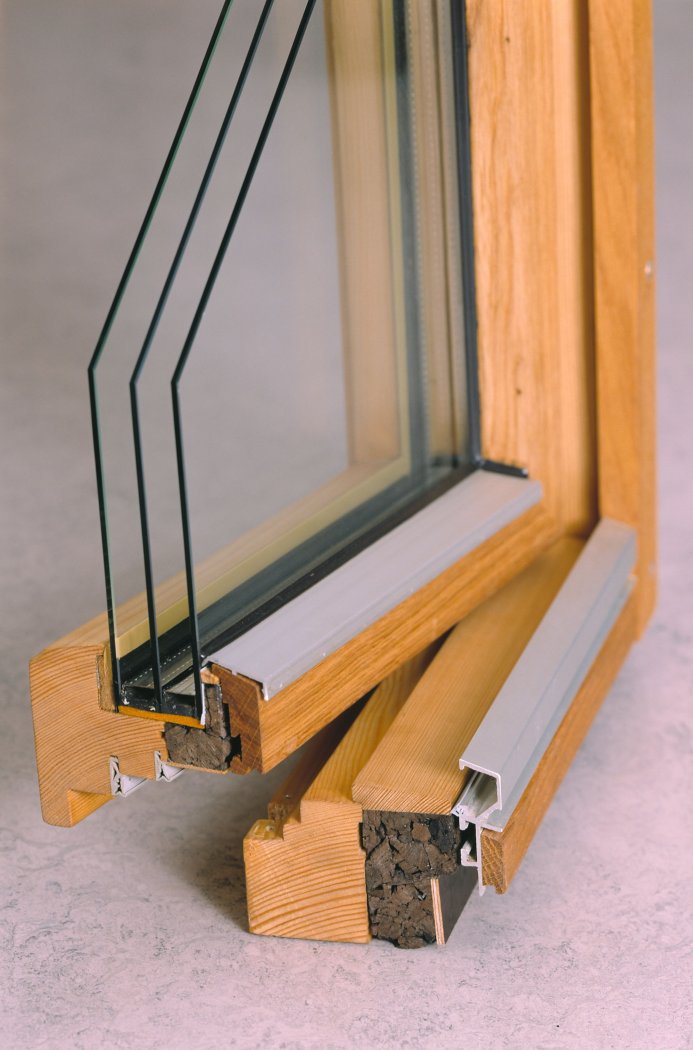
Image Credit: Muller Fensterbrau
More Musings of an Energy Nerd


Designers of high-performance homes know that there is always more than one way to reduce energy use. It can be daunting to optimize investments in energy-saving measures: even with the help of computer modeling software, designers need to exercise judgment.
Designers face such questions as: Does it make more sense to upgrade the attic insulation from R-40 to R-60, or to upgrade the water heater to a more efficient unit? Does it make more sense to upgrade from double-glazed to triple-glazed windows or to upgrade from a gas furnace to a ground-source heat pump?
Saving energy makes more sense than generating energy
Needless to say, it’s always possible to make any home into a zero-energy home by simply installing a photovoltaic (PV) array large enough to meet its needs. However, it make no sense to buy a $300,000 PV array for a wasteful house if less expensive measures can be used first to lower the home’s energy requirements.
Zero-energy home designers start with the smallest possible home. They then optimize the home’s orientation and improve the home’s air tightness, insulation thickness, and window performance. They also specify very efficient HVAC equipment.
Diminishing returns
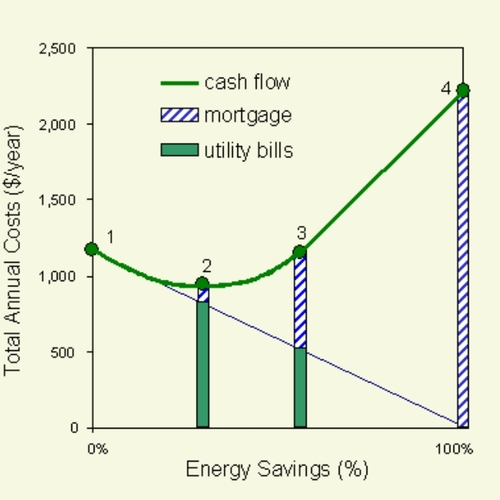
Each new incremental improvement — for example, more attic insulation — saves less energy. At some point, it’s cheaper to install more PV than to further upgrade the envelope.
Energy consultants who need to determine when to stop improving the envelope and equipment, and when to add PV, can choose from more than a dozen available residential energy modeling programs. All existing modeling programs have limitations.
Finding the least-cost path
One of the most interesting modeling programs is Building Energy Optimization (BEopt), a software program developed in 2004 at the National Renewable Energy Laboratory (NREL) in Golden, Colorado. The program determines the least-cost path to…
Weekly Newsletter
Get building science and energy efficiency advice, plus special offers, in your inbox.

This article is only available to GBA Prime Members
Sign up for a free trial and get instant access to this article as well as GBA’s complete library of premium articles and construction details.
Start Free TrialAlready a member? Log in



6 Comments
baseball, apple pie, passive house...
One small thought. I don't believe it's the "german passivhaus" standard anymore. The European Union has adopted the standard in some capacity for residential construction, and thanks to the Passive House Institute of the U.S.(PHIUS), we now have a homegrown American Passive House movement.
Different thinking in Europe and US
I think the different thinking on Equipment versus Envelope comes from the much cheaper equipment and PV in the US.
In Europe it makes financially sense to install more insulation, in the US it makes sooner sense to stop putting more insulation and install more PV. Also, with wood framing techniques practiced in the US it is much more difficult to get to the passive house standard of 0,6 air changes per hour. The workforce in the US has also to go a long way to be thorough on details to make this work. Cheap houses and detailed work don't go well together.
It is also important to notice, that the Passive House approach is trying to bring the heating load to a level of 15kWh/m2 per annum and air infiltration to 0,6 ACH (air changes per hour) to be able to strip the heating system to save the investment for the heating system for more insulation. At this point only a heat recovering ventilation system with a small electric heating element is necessary. To get to these values in a leaky North East house is a challenge -> therefore the big retrofit costs.
The building industry in the US has to rethink their techniques completely - what obviously isn't easy. And they have to begin to use modeling software and blower doors to make informed decisions.
Everything is putting costs on new and retrofitted homes to the point where US homes will be a the same price point like the EU homes. This will only happen on a broad basis when energy prices in the US will increase sharply.
Leaky houses in Europe
Diego,
There are plenty of very leaky existing houses in Europe -- especially in Belgium and the United Kingdom.
Air tightness improvements require builder training, on both sides of the Atlantic. The early CEPHEUS project in Europe ran into many problems achieving air tightness goals, especially in Belgium and France.
In Germany and the U.S., good builders are achieving Passivhaus standards of airtightness. In Europe and the U.S., there are also sloppy builders who need more education. We are all learning together.
In general, building costs in Europe -- especially in Germany and Austria -- are far higher than in the U.S. Costs are higher in all categories: land, materials, and labor.
equipment vs envelope
I live in a small rural town on North central PA. This past spring the local utility sponsored an energy fair and invited local contractors and others to display their "stuff". I and a friend setup a blower door and an infrared scanner and a retrofitted wall example and lots of other items to make the display attractive. There were also three local businesses promoting ground source heat pumps and many other hvac companies. I was the only insulator present. Where was the interest? People were flocking to learn about ground source heat pumps. They seemed to be unfazed when told the systems only cost $25,000 to $35,000. I experienced very little interest in diagnostics, insulation , air sealing.
A year and a half ago, I insulated and air sealed a 100 year old house in town that had new plastic replacement windows and a condensing furnace but not a single bit of insulation in the entire house. I could not believe it when I saw the attic, nice for air sealing but no insulation in a 7000HDD climate.
I think most folks are ignorant of the benefits of air sealing but they sure do like the high tech glitz of that new heat pump. And they have no idea it is oversized and the ducts leak like a screen door or how much the first out of warranty service call will cost. When I tell people that a well insulated, tight new house does not really need a heating "system", just a space heater, they get that far away look in their eyes.
Thanks, Steve
Steve,
Good post -- discouraging but true. Keep up the good work, and don't give up!
Thanks Steve and Martin,
You are right that ground source heat pumps are the sexy thing right now. But there are some of us out there who still favor superinsulated/passive solar homes and there will be more. Perhaps you need some fliers making a contrast between heat pumps and what you do. Educate, educate, educate and the tide will turn,
Log in or become a member to post a comment.
Sign up Log in