
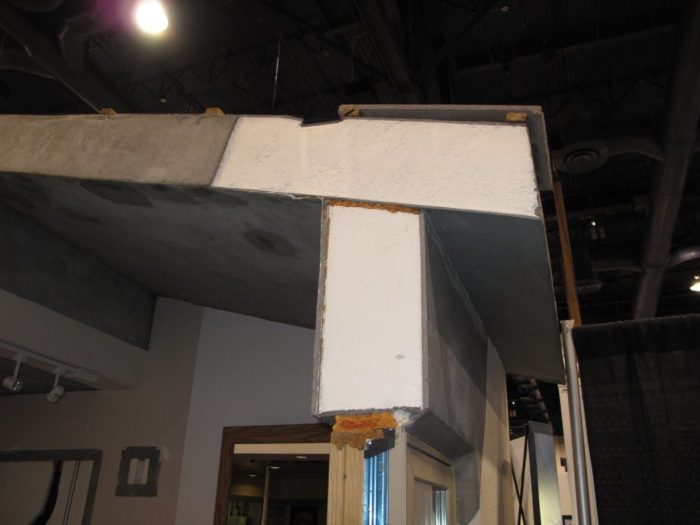
Image Credit: Martin Holladay
More Musings of an Energy Nerd


As the plane descends into the Las Vegas airport, every arriving visitor notices the stark contrast between the desert environment of southern Nevada and the modern city of swimming pools and irrigated shrubbery. After arriving today, I took the shuttle bus to the Bally Hotel, across the street from the Bellagio. The Bellagio overlooks an 8-acre artificial lake — in essence, the largest swimming pool in town, in a town known for its large pools — where a few lonely ducks swim in the chlorinated water.
One of the pine trees bordering the concrete-bottomed lake is dessicated and ill, but the entire top of the tree had recently been spray-painted green, to fool tourists who don’t get too close. When I touched the spray-painted needles, they detached themselves in great falling clumps.
Vegas is a strange town indeed for anyone interested in green building, but here I am at the International Builders’ Show, an annual convention on a gargantuan scale.
On my first afternoon, I had time for only a quick tour of a small portion of the trade show floor, but I still spotted some interesting products. The first booth to catch my eye belonged to Strata International Group of Glendale, AZ (www.strataus.com). Strata has developed a building system using expanded polystyrene (EPS) foam for walls and roofs. Custom-cut foam panels are assembled into the shape of a building, and then both sides of the foam are sprayed with a fiberglass-reinforced cementitious coating. Once the thin concrete layers are cured, the walls and roof become a monolithic mass, resembling a SIP structure in cross-section, but without the OSB, and without the seams. It looks like an excellent way to build a well insulated airtight home without thermal breaks.
Tomorrow I’ll be reporting more news from the IBS trade…
Weekly Newsletter
Get building science and energy efficiency advice, plus special offers, in your inbox.

This article is only available to GBA Prime Members
Sign up for a free trial and get instant access to this article as well as GBA’s complete library of premium articles and construction details.
Start Free TrialAlready a member? Log in



One Comment
Energy Efficient Building Systems
See more Building Systems at:
http://StyroHomeNews.blogspot.com
Log in or become a member to post a comment.
Sign up Log in