Do All Houses Need Mechanical Ventilation?
With a limited budget, is it acceptable to allow some airflow through the building and skip the fans?
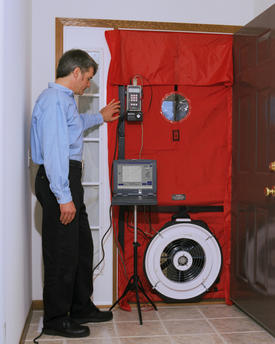
Finding air leaks: A blower door test can identify leaks in the building envelope that increase heating and cooling costs.
A central aim of energy-efficient building is to eliminate air leaks through the roof and exterior walls. A leaky building envelopeExterior components of a house that provide protection from colder (and warmer) outdoor temperatures and precipitation; includes the house foundation, framed exterior walls, roof or ceiling, and insulation, and air sealing materials. not only makes it harder to heat and cool a house but also increases the risk of condensation and moisture damage.
Builders are getting the message about air sealing. But the tighter the house, the greater the need for some type of mechanical ventilation — and that raises construction costs. Is it possible to build a house with just enough air leakage to satisfy fresh air requirements without a ventilation system while still reaping some energy rewards?
This is basically the question Karen Leu grapples with in a recent post — and the subject of this week's Q&A Spotlight.
Leu works for an Arkansas-based energy-retrofit program that aids mainly low-income families. She wonders what's the best use of a limited budget: building to ASHRAEAmerican Society of Heating, Refrigerating and Air-Conditioning Engineers (ASHRAE). International organization dedicated to the advancement of heating, ventilation, air conditioning, and refrigeration through research, standards writing, publishing, and continuing education. Membership is open to anyone in the HVAC&R field; the organization has about 50,000 members. 's Minimum Building Airflow Standard and skipping the ventilation, or aiming for more rigorous air sealing and accepting the extra expense of ventilation?
What's tight enough?
One camp argues there are no exceptions to the mechanical ventilation rule. "All new homes should have a mechanical ventilation system — even those that are trying to include 'just enough air leakage' to supply fresh air accidentally, through the effects of wind and the stack effectAlso referred to as the chimney effect, this is one of three primary forces that drives air leakage in buildings. When warm air is in a column (such as a building), its buoyancy pulls colder air in low in buildings as the buoyant air exerts pressure to escape out the top. The pressure of stack effect is proportional to the height of the column of air and the temperature difference between the air in the column and ambient air. Stack effect is much stronger in cold climates during the heating season than in hot climates during the cooling season.," says GBAGreenBuildingAdvisor.com senior editor Martin Holladay. "Depending on random air leaks to supply fresh air is nuts."
Inadvertent air leaks are greater on windy days, or in winter when the stack effectAlso referred to as the chimney effect, this is one of three primary forces that drives air leakage in buildings. When warm air is in a column (such as a building), its buoyancy pulls colder air in low in buildings as the buoyant air exerts pressure to escape out the top. The pressure of stack effect is proportional to the height of the column of air and the temperature difference between the air in the column and ambient air. Stack effect is much stronger in cold climates during the heating season than in hot climates during the cooling season. is strongest. But, Holladay adds, what about windless days in spring and summer? It's not enough to hope that homeowners will crack their windows at the right time.
Holladay, of course, isn't alone here. But under the circumstances — a retrofit rather than new construction as well as a limited budget — there are other points of view.
RELATED CONTENT
MULTIMEDIA
Blower-door-directed air sealing
Air Barrier or Vapor Barrier? Building Science Podcast
ARTICLES
Tight Houses: A Good Idea (and Code Requirement)
Ventilation Choices: Three Ways to Keep Indoor Air Fresh
Forget Vapor Diffusion — Stop the Air Leaks!
Designing a Good Ventilation System
PRODUCT GUIDE
HVAC Fans
"If you're working in low-income communities in an attempt to improve energy efficiency and reduce utility costs for your clients, then sealing the primary leakage points down to minimum airflow standards is probably a good objective," writes Robert Riversong.
When combined with enough attic insulation, that approach to building will benefit homeowners as well as the planet.
Still, he adds, there's no getting away from the disadvantages of this haphazard means of providing fresh air.
Given Karen's specific situation, writes Michael Blasnik, "you'd be better off not air sealing below your ventilation guidelines and instead spending the resources that would have gone to an exhaust fan (and makeup air inlets!) on other energy saving opportunities in the homes."
Stricter codes may intervene
Homeowners may find a way to get along without mechanical ventilation, but energy codes appear to be nudging us farther down the path toward mandatory ventilation fans.
ChristianSD writes that California Energy Commission Title 24 standards already require compliance with ASHRAE 62.2A standard for residential mechanical ventilation systems established by the American Society of Heating, Refrigerating, and Air-Conditioning Engineers. Among other requirements, the standard requires a home to have a mechanical ventilation system capable of ventilating at a rate of 1 cfm for every 100 square feet of occupiable space plus 7.5 cfm per occupant. ventilation requirements for new construction and additions of more than 1,000 square feet.
It doesn't apply to retrofits — at least not yet — but better air sealing is becoming more important as more homeowners want to maintain a comfortable 65 to 75 degree indoor air temperature around the clock.
"Air leakage in those buildings is not doing any favors to the homeowners' utility bills, nor it is healthy," Christian writes.
"From a performance standpoint, air leakage contributes to reduced efficiency. Up to 40% of heat loss in some areas," he adds. "Therefore reducing the leakage can lead to potential reduction in energy consumption."
Mechanical ventilation obviously adds to construction costs. But Christian also suggests keeping that in perspective by directing readers to Efficiency First. There, a post claims the Gulf oil spill will cost $40 billion to correct while retrofitting 75,000 homes for energy efficiency would cost only $1 billion.
"...The building will perform at a higher level when you reduce the air leakage and use mechanical ventilation," he adds. "You have to look at the building as a whole system."
So, is there really an answer?
Maybe not, at least not one that's easily quantifiable. But with some exceptions, advice follows current building wisdom: mechanical ventilation is a good idea.
And maybe it doesn't have to cost an arm and a leg. Riversong suggests one low-cost approach is to install Whisper Lite fans from Panasonic in the bathrooms. Connect the fans to time-delay or occupant sensing switches, and provide make-up air with passive air inlets, such as the Airlet 100 made by American Aldes.
Other suggestions on just how far to go with air sealing may be found in Maine weatherization protocols, as suggested by Jesse Thompson, an architect in Portland, Maine.
Image Credits:
- Green Building Advisor/The Energy Conservatory
Thu, 08/19/2010 - 08:56
http://www.cnmonline.co.uk/Conservatory-Heating-c-1752.html
by Gareth Jones
This is 2 step process the process as under -
Crush the bag flat and hold the opening tightly over the exhaust hood. The air flowing out of the hood will inflate the bag. Time the inflation. If the bag inflates in eight seconds or more, go to Step 2. If the bag inflates in less than eight seconds, turn the HRV to a lower speed, and repeat the test. Then go to Step 2.
• Step 2:
Swing the bag to inflate it and hold the opening against the wall around the HRV supply hood. The air going into the HRV will now deflate the bag. Time the deflation. If your HRV is balanced, air going into the HRV will balance the air coming out of the HRV. The inflation and deflation times should be roughly equal. If you find that the bag inflates twice as fast as it deflates, for instance, your HRV is unbalanced. If you can see no problem with the filters that would cause such an imbalance, you should call a service person to test and adjust your HRV.
Wed, 09/07/2011 - 17:03
mechanical ventilation
by Forrest Fielder
This balancing effort between the energy conservation and indoor air quality camps is still unsettled. Though California is moving to ASHRAE, the 2012 IECC (residential) still allows natural ventilation. This much is clear - there is an energy penalty to bringing in unconditioned outside air, and the routine opening and closing of doors and windows is how most homes are actually lived in. At a minimum, I'd prefer that the ventilation decision be the owner's (exhaust fans/windows/doors), rather than a one-size-fits-all requirement.
Google
Yahoo
Facebook
Technorati
Reddit
Delicious
Digg
StumbleUpon


Comments