Helpful? 1

How to Stay Cozy in a 1930s Bungalow

Twice renovated, the house is still trying to heat the neighborhood

Posted on Dec 27 2010 by Scott Gibson

Rich Cowan lives in an 1,800-square foot bungalow in northern Massachusetts that has been renovated twice in the last decade but still has some problems: no insulation in the basement, and a furnace and air handler in the vented attic.

"The heat produced by our gas furnace is quickly moving through the ceilings to a vented attic, and then is lost forever," Cowan writes in a Q&A post. Money to correct the problems is not unlimited, but Cowan has a plan.

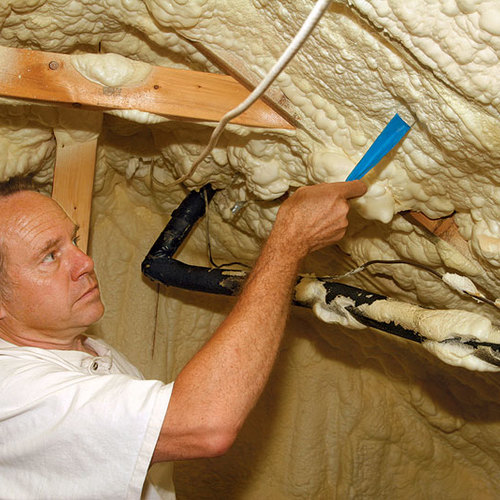
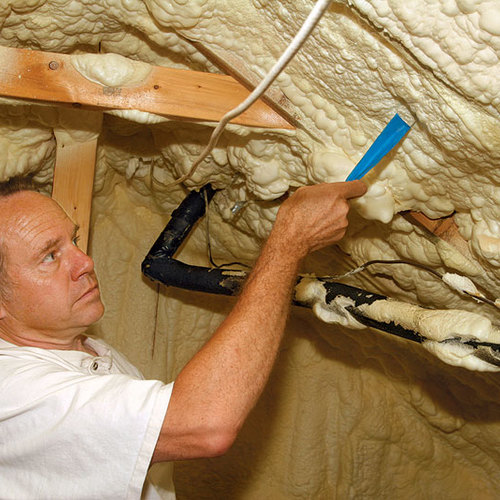
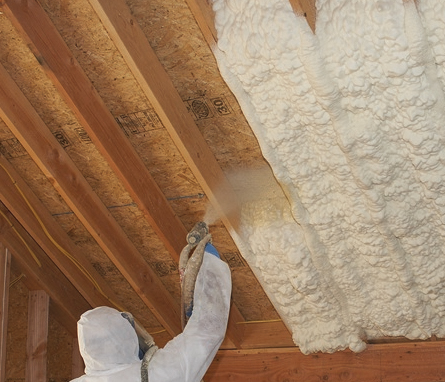
First and foremost, he wants to turn the attic into a conditioned spaceInsulated, air-sealed part of a building that is actively heated and/or cooled for occupant comfort. to reduce the stack effectAlso referred to as the chimney effect, this is one of three primary forces that drives air leakage in buildings. When warm air is in a column (such as a building), its buoyancy pulls colder air in low in buildings as the buoyant air exerts pressure to escape out the top. The pressure of stack effect is proportional to the height of the column of air and the temperature difference between the air in the column and ambient air. Stack effect is much stronger in cold climates during the heating season than in hot climates during the cooling season. that now draws cold air into the lower sections of the house. He hopes to use spray polyurethane foam and has talked with two installers.

One installer suggests 5 in. of closed-cell foam under the roof deck and 3 in. in the gable ends. The other wants to completely fill the 10-in. rafter bays with open-cell foam and put 3 1/2 in. in the gable ends. Both approaches would require intumescent paint as an ignition barrier on the foam if the space isn't finished in drywall.

He likes the open-cell approach and plans to build staggered stud walls in the gable ends to hold more insulation. Plus, he could spray the fire retardant paint himself.

Among Cowan's concerns are thermal bridgingHeat flow that occurs across more conductive components in an otherwise well-insulated material, resulting in disproportionately significant heat loss. For example, steel studs in an insulated wall dramatically reduce the overall energy performance of the wall, because of thermal bridging through the steel. , how to provide a vapor retarder in the roof and gable ends, and whether the gas furnace is a fire hazard.

His situation is more complicated than it may look, and it's the topic of this week's Q&A Spotlight.

Where's the best place to start ?

Although Cowan is focused on the attic and says he'll tackle the basement issue down the road, the basement is exactly where Ottobounds would have him start.

"You mentioned you would describe the basement situation later, but I feel like I would start there before spending a ton of money on spray foam in the attic," Ottobounds writes. "Can't you stop the cold air from getting into the walls from the bottom up? Locate the points of entry at the foundation and I'm assuming balloon-framed walls. Insulate the basement walls, which are 32 degrees already. Slowing down the stack effectAlso referred to as the chimney effect, this is one of three primary forces that drives air leakage in buildings. When warm air is in a column (such as a building), its buoyancy pulls colder air in low in buildings as the buoyant air exerts pressure to escape out the top. The pressure of stack effect is proportional to the height of the column of air and the temperature difference between the air in the column and ambient air. Stack effect is much stronger in cold climates during the heating season than in hot climates during the cooling season. in the attic makes sense, but I think I'd be looking at stopping the cold from getting in first."

"Sorry, Ottobounds," writes Robert Riversong, "but you're out of bounds on this one. The attic is exactly where the improvements need to begin because of the location of the air handler."

An air handler should never go in an unconditioned attic, but if he's stuck with that situation, Riversong says, "encapsulating the attic is essential."

The problem is his furnace. Unless it's a fuel-burning appliance, it must be a sealed-combustion, direct-vent type, one that uses no indoor air for combustion and whose combustion chamber is sealed. If not, count on replacing the furnace entirely, or moving it and improving the air-sealing and insulation in the attic.

Intumescent paint vs. drywall for fire protection

Cowan says either choice for spray-in foam will require an ignition barrier to meet code. If the space isn't finished with drywall, that would mean intumescent paint, a coating that swells up to protect what's beneath should fire get too close. It costs about $75 a gallon.

"Intumescent paints are somewhat controversial," writes GBA senior editor Martin Holladay. "There has been a lot of discussion for years about whether the tests used to prove that the paints reduce ignition time are really meaningful. If it were my own house, I would want to cover the spray foam with drywall."

In a followup post, Holladay dives deeply into the debate over these fire retardant coatings, citing numerous sources to explain exactly how intumescent coatings have been evaluated, and whether uncoated foam can be a safe alternative.

One of those he quotes is Neal Gasner, president of Corbond, a spray foam manufacturer, who says intumescent coatings are not as effective as 1/4-in. OSB, and far less effective than a coat of cementitious material only 1/8 in. thick.

"Good ignition barriers do exist," Holladay quotes Gasner as saying, "but they don’t look like intumescent coatings, in spite of our wishes for a simple-to-install product that actually works.”

Although some manufacturers claim uncovered foam does just as well as covered foam, they appear to be relying on tests that aren't necessarily relevant to attics. "Could we be headed for disaster in an actual building fire that moves to an attic?" Gasner asks. "Could the known flame-spread characteristics of [sprayed polyurethane foam] in an exposed condition endanger lives?"

Drywall as an alternative

Cowan hasn't overlooked the possibility of framing the attic and adding drywall, but he says the work would add as much as $5,000 to the cost of the project. Because the attic will, at least for now, be used only for storage, he's more inclined to leave it open.

GBA advisor Michael Chandler suggests a modified approach, drywalling not the entire attic but only what's accessible from the living space.

"Generally a 12x12 floor area just inside the attic access with that ceiling area framed down to avoid shaving the foam," Chandler says. "And this need not include the area with the furnace in it. It's okay for the furnace to be in an area with exposed foam that is only accessed for service, just not the storage area that is immediately accessible from the living space.

"Close off that other area with a secure fire rated access door and you are fine as we interpret the code here," he adds. "Still worth confirming with your local inspector."

Chandler says he wouldn't bother with the ignition barrier or paint on a vapor retarding paint on the foam but rely on painted drywall instead. "Spend the money you would have spent on the ignition barrier on better duct sealing and thicker foam," he says.

"Even if we do drywall the main open space of the attic (it measures about 22 x 12), it leaves the low areas under the slanted roof and behind the drywall unprotected from vapor penetration," Cowan replies. "So we'd still have to paint 40 percent of the roof with primer. And the area above a drywall ceiling... the triangle that would be above the drywall roof -- would this also need a vapor barrier on the foam?"

And there seems to be the crux of the problem: how to provide a fire inhibitor while providing a vapor retarder for the open-cell foam, all without spending a small fortune on extra framing and drywall.

There may be no perfect answer, but under the circumstances, Riversong would opt for the closed-cell foam rather than the low-density open-cell foam because it can perform as a vapor barrier.

"Because of the difficulty in providing a proper vapor barrier, it may be best to use a closed-cell foam," Riversong says. "But make sure the installed R-valueMeasure of resistance to heat flow; the higher the R-value, the lower the heat loss. The inverse of U-factor. at least meets the International Energy Conservation Code requirements for your climate zone. And make sure that no vapor impermeable layer (such as peel-n-stick membrane) is later applied on top of the roof deck to avoid the deadly 'sandwich.'

"Then you need to decide whether an intumescent coating or taped ½-in. drywall makes more sense as an ignition barrier."

Our expert's opinion

Peter Yost, GBA's technical director, added these thoughts:

Attic vs. basement: Definitely start with the attic and cap the lid of the house to go after the stack effect. One thing to keep in mind is to check radon levels as you make your home more airtight.

Closed vs. open-cell spray foam: There is no easy answer to this choice in my book because the building science issues don’t line up with the environmental ones. I like the higher R-value per inch and very low vapor permeability of the closed-cell foam, but the global warming potential of the closed-cell foam’s blowing agent just does not compute. And just recently, EPA has identified indoor air quality concerns related to spray foam as a top emerging issue.

Ignition barrier: I would add a third option to the intumescent paint and drywall: foil-faced rigid polyisoPolyisocyanurate foam is usually sold with aluminum foil facings. With an R-value of 6 to 6.5 per inch, it is the best insulator and most expensive of the three types of rigid foam. Foil-faced polyisocyanurate is almost impermeable to water vapor; a 1-in.-thick foil-faced board has a permeance of 0.05 perm. While polyisocyanurate was formerly manufactured using HCFCs as blowing agents, U.S. manufacturers have now switched to pentane. Pentane does not damage the earth’s ozone layer, although it may contribute to smog. board. It can serve as the ignition barrier, the vapor barrier, and thermal break on the framing (and the blowing agent used in the plant to manufacture polyisocyanurate board is pentane with very low global warming potential).

Just be very careful with the overall vapor profile in the roof assembly. The type of roof claddingMaterials used on the roof and walls to enclose a house, providing protection against weather. you have can determine your drying potential to the exterior as the choice of cavity insulation and ignition barrier limits or eliminates drying potential to the interior.


1.
Wed, 12/29/2010 - 13:11

Venting the attic
by Jim B

Helpful? 0

I would suggest that cardboard insulation baffles be installed in the rafter bays prior to spraying the foam insulation. There is plenty of rafter depth available and the homeowner can easily do this job. This way you can protect the roof sheathing and roofing materials from moisture and heat degradation. Make sure the baffles are linked to soffit and ridge venting.


2.
Thu, 12/30/2010 - 18:18

Attic
by KissMyAsthma

Helpful? 0

Would cellulose even need a fire barrier? Its another option to consider. Stll would be a VB issue but it would might take one issue off the table.


3.
Mon, 01/03/2011 - 17:10

Venting the Attic
by Dave E

Helpful? 0

I installed one by two strips on each side of the rafters and then placed rigid insulation over those. I filled in the remaining space with fiberglass insulation and installed a plastic vapor barrier over that. Then I installed drywall over that. This gave me a vent into the attic ceiling from the knee wall area.


4.
Tue, 01/04/2011 - 22:44

bungalow retrofit
by Steve McCarthy

Helpful? 0

I'd like to suggest a "not too sexy retrofit". First, get the furnace out of the attic ! Throw it away if it is low efficiency , but in any case install a high efficiency furnace in the basement. Use the attic for storage but before you fill it up with useless unwanted stuff, insulate the space under the floor with densely packed cellulose. And about the " stack effect", you can't eliminate it. The house will leak from the stack effect as long as the sun rises and grass grows. Sealing the leaks between the house and the attic will lessen the impact of the stack effect. If the space under the floor is only 6 inches , you can add some foam on top of the floor to boost the r-value and minimize thermal conduction thru the joists and then lay some osb or plywood on top for a new floor.


5.
Tue, 01/04/2011 - 23:47

Vapor barrier
by Patrick Kitzmiller

Helpful? 0

Am I missing something? What's the problem with vapor? I thought vapor barriers were a big no no. I thought that its best to allow the movement of vapor, but not air.
Why not go with the open cell, because its better for the environment. Add some cross members to pad out the wall for greater depth of insulation and to cut down on thermal bridging. If you're still worried about moisture, put in an HRV. They have a low energy draw and are great for heat conservation and fresh air.
Somebody comment and let me know if I'm way off base here.


6.
Wed, 01/05/2011 - 06:15

Response to Patrick Kitzmiller
by Martin Holladay, GBA Advisor

Helpful? 0

Patrick Kitzmiller ,
While closed-cell foam is fairly impermeable to the diffusion of water vapor, open-cell foam is fairly vapor-permeable. That doesn't make the product better or worse -- just different.

If you spray open-cell foam against the underside of your roof sheathing, the fact that the foam is vapor-permeable is a disadvantage during the winter months. In Climate Zones 6 and 7, humidity from the interior of the house can diffuse through the foam and accumulate in the cold roof sheathing. Several researchers have documented this phenomenon as far south as Boston.

No one wants damp roof sheathing. Depending on how humid your house is, and how cold your climate is, the roof sheathing could eventually rot.

The solution is to spray the interior surface of the cured foam with vapor-retarder paint. Most manufacturers of open-cell spray foam (including Icynene) require the installation of a vapor retarder on the interior side of the cured foam in cold climates.


7.
Tue, 01/18/2011 - 14:06

I would do what is called
by Dale

Helpful? 0

I would do what is called 'flash and batt' on the roof deck. 2 inches of closed cell foam sprayed straight on the roof deck and finishing up with fiberglass batts with the vapor barrier facing in. Cold roof decks are only necessary to prevent ice damming at the eaves - if the top plates and eaves are sprayed with foam this won't be an issue.


Register for a free account and join the conversation


Get a free account and join the conversation!
Become a GBA PRO!