The most recent blogs at Green Building Advisor

Enthalpy Recovery Ventilator

Build Tight, Ventilate Right: Lessons in Hot Air and Sticks and Stones

Posted on April 14, 2009 by Rob Moody in think-spot

Musings on Mazria, Lstiburek and Gifford: Part Three

I just want to set the record straight on one point: I have not imbibed the USGBC Koolaid. I do like its mission, goals, and products, and the organization has the best start of any rating system out there. As I have stated many times before, I’m a biologist by training and I am way into evolutionary biology. That’s all that needs to happen here.

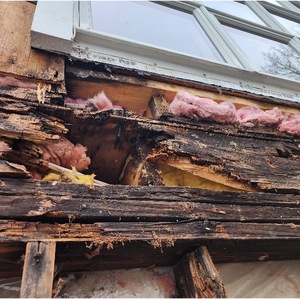
Rotten sill

Don't Let This Happen to You

Posted on April 12, 2009 by michael maines in design-matters

Door design details
The photo at right is from an entry that's just 15 years old. Fortunately, it was able to be repaired. I haven’t always been so lucky. Let’s just say that replacing subfloor and framing is no fun. A safe assumption is that, for one reason or another, doors always leak. They shouldn’t, but they do. Seals wear out. Wind blows. Jambs rot. Sills crack. Weepholes clog. Following are some ways to mitigate the chance of damage.

Modified boat test

Simple DIY Tests for Housewraps

Posted on April 10, 2009 by Peter Yost in Building Science

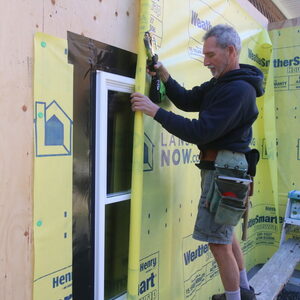
How do you know if your housewrap really works?

In the good old days, we weatherlapped 3-ft. courses of building paperTypically referring to Grade D building paper, this product is an asphalt-impregnated kraft paper that looks a lot like a lightweight asphalt felt. The Grade D designation has come to mean that the building paper passes ASTM D779 (minimum 10-minute rating with the “boat test”) and different products are called out as “30-minute” or even “60-minute” based on D779 results. At times confused with roofing felt, roofing felts and building paper differ in two ways: felts are made of recycled-content paper, building papers of virgin paper; felts are made of a heavier stock paper; building papers a lighter stock. See also roofing felt. underneath our wall claddings, and that seemed to work just fine. But then along came all sorts of snazzy “gift wrappings” (a.k.a. housewraps) in handy, 9-ft. rolls. Some claimed to be both air barriers as well as water-resistive barriers; others claimed to be vapor permeable. Along the way, it got pretty confusing about just exactly what the housewrap’s job is in our walls. (For a practical and detailed perspective on housewraps, see “Making Sense of Housewrap”.)

Complicated Equipment

Simplicity versus Complexity

Posted on April 9, 2009 by Martin Holladay, GBA Advisor in Musings of an Energy Nerd

Designers of energy-efficient homes — especially homes aiming for net-zero energyProducing as much energy on an annual basis as one consumes on site, usually with renewable energy sources such as photovoltaics or small-scale wind turbines. use — must inevitably grapple with the question of simplicity versus complexity.

Residential designers can choose from an array of sophisticated appliances that improve comfort and help homeowners reduce energy use. Examples include heat-recovery ventilators (HRVs), condensing boilers, ground-source heat pumps, solar hot water systems, on-demand water heaters, heat-pump water heaters, photovoltaic(PV) Generation of electricity directly from sunlight. A photovoltaic cell has no moving parts; electrons are energized by sunlight and result in current flow. modules, and co-generation systems.

Stats

I Had a Horrible Stats Professor but Still Learned the Basics

Posted on April 9, 2009 by Rob Moody in think-spot

Musings on Mazria, Lstiburek, and Gifford: Part Two

My college stats prof was out to lunch (figuratively) on a good day. He was ready for retirement, and it showed. What I learned about statistics I learned from my biology professors who had me doing real science with real-world applications for me, not rote learning from a text and a boring, out-of-focus prof. Here’s the point: Median can be a better indicator of trends than mean in smaller data sets that are highly variable. Check out this Wikipedia excerpt:

Roadkill

Green Building Program Roadkill

Posted on April 8, 2009 by Carl Seville, GBA Advisor in Green Building Curmudgeon

First, a little history
The competition is heating up in the world of green-building certification. Things moved slowly and steadily, starting way back when Austin, Texas put together its local program. With a limited amount of green-home certification available in the late 1990s, the NAHB Research Center set up a project to assist local home builders' associations in creating their own green building programs.

enc-heat-pump-air-source

Introducing Heat Pumps

Posted on April 8, 2009 by Alex Wilson in Energy Solutions

I used to think that electric heating should be avoided at all cost. After all, most of our electricity is produced from highly polluting and greenhouse-gas- spewing coal power plants or from nuclear power plants with their own, quite different, risks. I bought in to physicist Amory Lovin’s argument that heating buildings with electricity was like “cutting butter with a chainsaw.” It just didn’t make sense, Amory said, to use such a high-grade and versatile form of energy to provide something as crude as heat.

shoe bench

Favorite Things: The Shoe Bench

Posted on April 7, 2009 by Ann Edminster, GBA Advisor in design-matters

Many years ago, at a green-building lecture that focused on indoor air quality, I gleaned a factoid that has stuck with me ever since: One of the most common ways that contaminants enter homes is by hitchhiking in on the bottoms of our shoes!

At first I found this startling, even laughable—as do many people to whom I relay this information. But then the light began to dawn—when we’re out walking around in shod feet, we inevitably walk on streets, parking lots, sidewalks, and lawns.

Code Edition

What Edition of the Code Are You Using?

Posted on April 6, 2009 by Lynn Underwood, GBA Advisor in Code Green

If it’s so good, why does the Code keep changing?
The answer is…to get even better! Essentially the code changes to improve a (regulatory) process, reduce cost, allow new or different ways of doing something, or sometimes to increase safety. A change in the building code can be suggested by anyone who has a legitimate suggestion to improve it. While that may sound simple, it’s a bit more complex.

Climate Smart

Reducing Our Carbon Footprint—Part Two

Posted on April 6, 2009 by Annette Stelmack, GBA Advisor in design-matters

Boulder County’s Climate Smart loan program

Part Two: A deeper level of action
The first major step toward reducing your carbon footprintAmount of carbon dioxide and other greenhouse gases that a person, community, industry, or other entity contributes to the atmosphere through energy use, transportation, and other means. is understanding how much energy you use. Energy efficiency is often more cost effective than renewable-energy alternatives. The target is to use less energy for the same amount of heating, cooling, lighting, and of course, powering appliances, the stereo, televisions, and iPods. Fortunately, a big benefit of most energy-efficiency measures is creating greater comfort in the home over the long term.

Register for a free account and join the conversation


Get a free account and join the conversation!
Become a GBA PRO!