What are the downsides of ICFs?

Let’s say i’ve set eye on 2 building methods
( sorry if my view is always toward cold climate building ..bear with me )
ICF
PERSIST/REMOTE
I’ve read discussions on this board and other websites,
thought about it ..heck it was my first idea all along!!!
PERSIST building method has to be the most efficient type of building
for passive and or very low energy haus
( why is not everybody building that way on cold climates if it is the best method neway ??? )
But then if we introduce ICF in the discussion
add on more exterior insulation ( like Quad Lock is doing with the + and double plannels .. )
it is possible to get as good R value as required with this method
ICF if detailed properly around openings, should have a very “air tight” building evelope right ?
Without too much efforts .. ( i’d have to see where a 8″ concrete with 8-10″ of EPS on its back
could leak air )
I’ve built my house with quad lock icf … i new little
didn’t get any additional exterior insulation ( and i’m in zone 6-7 ) MY BAD ..but i was young
and it was my first building of any type
but damn, i was less expensive than planned, went superbly easy …
( the ICF part ..all else went wrong .. hahaha )
and i really enjoyed working with the ICF products and rebards and concrete pumps etc…
so as my topic .. what are the downsides of ICF ??
i’m sure my ICF house will be still standin in a few hundred years if it is not bombed or whatever else … don’t think so about most other wood framed houses all around me
( i’ve used a little passed 1600 20′ M10 rebars, and approx 200 1″ X 20′ ..i’m sure the walls are stiff enough to whistand residential abuse :p )
that’s it … would like to know what you think about building high efficient buildings with ICF
VS PERSIST/REMOTE type
or any other you would judged superior in design and performance
( sorry if this was discussed elsewhere..didn’t find any discussion about negatives of ICF
toward efficiency design )
( also note, i may wrongly express myself par my low english knowledge, if i do so, i didn’t mean to ” justify ” my past choice in ICF at all … i am only trying to learn about the best possible construction methods for high efficiency for future projects and to fill my brain space )
🙂
Happy new year all BTW!! hapiness and health !
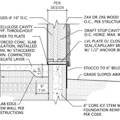
GBA Detail Library
A collection of one thousand construction details organized by climate and house part


Replies
Jin,
Q. "What are the downsides of ICFs?"
A. This method of construction is more expensive than other methods of building a high-R wall (for example, a double-stud wall insulated with dense-packed cellulose).
Most ICF walls have a low R-value. It's possible to increase the R-value of an ICF wall by adding more exterior insulation, but that just raises the cost and complexity higher still.
ICF walls complicate future remodeling and additions.
Thanks Martin, exactly what i was looking for.
Let's assume a design for a passivehaus standard or a near zero energy house...
would you believe it is achievable with ICF ??
i don't see problem to adding more exterior insulation
( seems same as with other exterior insulated method .. )
What is the usual cost for super air sealing requried for those standard with more general construction ?? for Persist the cost of the membrane + man time to apply and detail it ?
on the ICF there is not much more than openings to seal thus a small save in labour here??
I also like possibility to hold up larger weight on walls of icf
( per example my first floor has a few 40ft long steel joist with concrete slab on it )
Jin,
Q. "Let's assume a design for a passivehaus standard or a near zero energy house...would you believe it is achievable with ICFs?"
A. Yes. You can build any way you want, especially if the higher cost doesn't deter you.
Lastly, would you personally rate ( i ask you Martin because i like your answers!! straight and true )
higher an ICF constructed residential than other stick framed methods in terms of value
if everything else is same ??
Jin,
I'm not sure what you mean by "in terms of value."
When you build a house with double-stud walls, you get more R-value for your dollars than when you build a house with ICFs. So the house with double-stud walls is a better value.
If I won a contest with my choice of two grand prizes -- a 1,200 square-foot house with R-40 double stud walls, or a 1,200 square-foot house with R-40 ICF walls -- I might choose the ICF house.
But be careful: very few (if any) ICF homes actually have R-40 walls. And an ICF home with R-40 walls would be very expensive to build.
Have you looked into QuadLock offering ??
http://www.quadlock.com/images/icf_components/R-Values/ICF_Walls_R-Values.png
their R59 really gives ~R50 @ 3.75R/inch
it is very easy to achieve R40 walls without finish
i know for fact ( discussions when purchasing back then ) that they'll sell the insulation panels
( the one u stick in between ) at regular EPS 4X8 equivalent price when purchasing full system
i'm very much leaning toward this for my 60'X100'X20'H shop/factory next year
The problem with fastening finishe on the exterior is not valid since using the connection clips provide for a very stiff connection ( holds #8 wood screws seriously tight )
Some would point to the embodied energy of the concrete in the ICFs as a downside. I know the ICF industry would counter with the reduced energy savings as an offset to that, for what it's worth.
As Martin mentioned, it is very inconvenient to modify or demolish. It can be done, but not in a conventional way.
The only other downside I can think of at the moment is that some ICFs are pre-assembled. The positive is that their built in a factory setting, and the QC is usually higher than site built. However, the downside is that you (pay to) ship a lot of air when sending the forms to the jobsite.
EDIT - Thought of another one. Depending on your opinion of foam insulation, it could be a downside to some.
On the topic of R-value, the ICF industry will use air infiltration data to argue that their product produces an effective R-value much higher than their static R-value. I feel that's a discussion left for a different thread, though.
Yes i've also seem alot of false R value claims.
I guess we all know better than to trust any other than static R value for basic insulation setup.
Unfortunately not everybody does ( just look at the radiant barriers etc.. )
I agree that modifications is not easily done with ICF
but i don't believe it is a "real" downside ..as if buidling is correctly planned in advance,
you can have an exterior "recyclable" shell and modify as one wish interior divisions
and exterior sidings ( modifying window openings is another thing though, but still possible )
demolish is out of the question, as i review ICF as a long lasting building method.
True about EPS, alot of people seem to have different opinion and i cannot argue that most plastics are/will be a nuisance if we do not find a way to dispose of them.
However, EPS seems pretty stable if hidding from damages, thus should serve its 2%plastic weight
for quite some time in the future.
A few small thoughts. I have only done one, 6' wall around a house w/ ICF's, and they were good for below grade. However, they were a LOT of work (bracing) and require a LOT of exact planning( penetrations, door/window framing, etc). People do it all the time, so it must not be extraordinary, but accurately building a two-story with them will be an undertaking, in my limited experience. We had two wall blow-outs, too, so plan for that to happen. Also, plan for the extra weight on the footings.
No offense, John, but blow-outs are mostly seen on jobs with inexperienced ICF installers. But you are right to provide the warning, for those having never used it.
And yes, if doing the whole house, the footers have to be a little bigger and/or deeper. I don't know if that's a downside or not, but certainly something to consider.
I guess I can chime in since I have been down this road and every other road I could find, and it led me to ICF as my final choice. I am currently in the middle of my first DIY ICF build, full basement and main level. Before I arrived here, I looked at about everything as many know. Being in zone 6, needed something efficient. Looked at Sips, thick foam, advanced framing, and the top contendor was the prefered double stud wall. My findings and cost comparisions are a little skewed since very few of my numbers include labor since I was doing it.
However my reasons for choosing it over double stud was:
strength (tornado alley)
air tight (easier to achieve)
continuous insulation/strength from footer to top plate without mud sill area
decrease sound (STC may be comparable double stud however)
I am using vertical forms with a tappered post and beam engineered design resulting in a higher average r value of about 30. It also uses less concrete so my "embodied" energy reduces as well. With energy modeling, we found in my zone that the head load bump from r30 to r40 walls was minimal (about 1200 btu). WIth triple pane windows, properly designed solar temporing and home layout, my heat load for the 3600 sqft is still around 24k.
Super insulation and energy conservation certainly takes lead on this site, however I also believe that part of being responsible is also building structures that last. Obviously a concrete home will outlast a wood house. The details on wood need to be correct. Moisture issues and risks are higher. Mold risks are much higher.
We are currently setting trusses now. Feel free to check out my ICF building blog:
http://www.lizerhomestead.blogspot.com/
John Klingel: Which "brand" of ICF u used ?? because this influences the friendiness to "n00bs" to a high degree.
Planning is nothing but easy with ICF
took me roughly 6months of evenings and off times to plan the house construction once i was set on ICF and few other key products. I didn't make a single error on dimensions or locations of parts.
And let me tell you that my house is large and complexe ( was my first building also .. i am still a n00b ! )
Bracing is not that hard if you know where and when , need to study the product and have some basic mechanical engi. knowledge.
I did a 40ft high ( 40ft of ICF from top of footing to last block ) house of 80' X 45' size as my first time,
and i didn't find it that challenging, was pretty straightforward i'd have to say )
I planned all openings and dimensions based on 1FT heigh increments and 2" horizontal increments, and builded accordingly.
So i really never had to cut some blocks horizontally ( except for a few door openings inside the buidling ) and all windows were custom sized to fit the openings.
Not a single blowout might i add, and i dind't use that much bracing at all...
( might be because QL is placing the clips where they should be, between panels ... )
Jesse Lizer: nice work !! might i suggest you install a minimum of 2" addition EPS on the exterior??
what is used as fastening strips on this brand of form ?? the vertical strips ??
I used only regular 2.25"/concrete/2.25" forms, had i knew better back then,
i would've add a minimum of 4" of EPS on the exterior side.
Still the house is very comfortable ( even though we have some current window and leak problems)
I agree 100% that building green = building that LAST
because building twice something that has "half" footprint and 80% original price,
usually costs 2-3 times more and pollutes as much.
I am "still " seriously considering ICF for all of my next projects which will all be much more energy efficient.
Some ICF manufacturers may or may not calculate the R-value correctly. I know of one manufacturer/system that erroneously calculate the R-value based on the average thickness of foam, not the 'lumpy' method, see http://www.energyvanguard.com/blog-building-science-HERS-BPI/bid/25547/Flat-or-Lumpy-How-Would-You-Like-Your-Insulation. Although the quad lock referred too above does appear to have continuous insulation of same thickness, so this issue would not apply to that specific product.
adding the 2" drives the price to energy savings/payback beyond reachable. The r30 average wall in foam accomplishes a fairly strong r value for my climate. Climbing much higher, and certainly above r40 makes little financial sense.
The black strips are 2.5" wide and are continuous for attachment. They are strong and provide great attachment for about anything. They also held the vertical rebar in internal clips during assembly.
It took me and another person about 2 days to put up the entire level of the foam wall. 1 more day to build window boxes and set them.
The forms are Hobbs Vertical ICF, and the contour panels which are precut to the height of your wall (very little job waste and fast assembly) are 16" oc vertical spacing. They are 9.5" wide out to out with a 2" web of concrete. At each black stud, they flare out to be 2" foam with a 5" concrete column around the vertical #4 bar.
Jesse: looks like a nice engineered product.
I do not hate the vertical layout, puts the strips where they are supposed to be.
R30 is not that bad either.
Would you be able to pull out a quick price of component per SQ FT this system costed you ?
( just the components.. ) just for sake of comparison.
Straight walls looks easy with this system
i guess you used bottom and top tracks to keep everything straight ??
I thing i do not agree with the manufacturer is about having more foam and less concrete.
My house weight a little more than 1 million pounds, and having more concrete in the walls was a requirement for everything to hold up ( most walls are 8" concrete and some are 12" concrete )
That does not change the quantity of EPS, which is also something u can continue to add on
as much as you wish on the exterior.
Regular foam boards usually cost a lot less than the same size of boards from ICF forms.
anyhow, nice product and wish you success in your project! :)
Jin
an often misconception with concrete walls/ICF is that you NEED a solid concrete wall when in a lot of cases 6-8" easily does a foundation and 4-6" can do the main level depending on wind loading and other things. While I am not an engineer, I do work with them on a daily basis so I am quite familiar with it. A lot of engineering has gone into this particular system, and they have the results to back it up. If you read the flexural testing, compression testing and other tests, you can see that the post and bond beam design performs extremely well, structurally. Steel and concrete is a powerful combination, and when designed together it performs well to maximize the charactoristics of each. 6" and 8" walls are usually easily engineered with perscriptive paths. However this system is engineered specicially for each and every project, including steel lintel design, rebar size and layout, etc. You then recieve a sealed and signed set of engineered drawings with the foam package.
As mentioned, all pieces came precut to the heights needed, no matter what they are so this eliminated a lot of construction waste. I think at the end of the project I have about 6 trash bags full of foam pieces, cut furring, etc. The corners are extremely strong and feature steel on each side with 2" foam within. Due to the vertical nature, they are easily straightened with strong backs at the top of the forms screwed to the furring strips. Bracing and kickers is only needed every 10+ feet. The bottom is secured with a supplied metal track screwed to the deck or shot to the footer with a ramset.
My project ended up around about $4.35 sqft for the foam, plastic, corners, and tracks, delivered to my site. My added costs were screws, a lot wood bracing (that I am using up in interior wall plate framing and truss bracing), rebar, and concrete. I have about $1k worth of bar and supplied in it, and then the nearly 4000 sqft of wall surface used only 52 yards of concrete. By comparison, a full 8" wall would have used closer to 100 yards of concrete.
So you get the best of both really. A wall much stronger and better for long term durability than wood and a decent r value in a 10" wide wall.
Jin:
I can also confirm Jesse's 1st sentence above. An 8" foundation wall should not only suffice structurally, but should not present any problems to a local building code department.
Jesse: price doesn't seem too bad it is includes engineering services and rebars!!!
As for the thickness of the walls, when using ICF for basement or first floor only,
nothing is wrong with using 6" walls with rebars, but once u start going up
and use long span floors with concrete/steel decks u get to another level.
I have a "situation" on my rooftop that was designed to hold up a very large sap ( jaccouzi u call them ? ) or a small pool , and i've used 12" of concrete with a super footing and almost double rebars for that " vertical H form " ... but it could probably hold near 200 000LBS on top of it, and is way overkill ( it's 40ft high also )
I understand the point of it being a residence, and as with insulation, too much usually doens't yield anything other than additional expenses, so your system with it's savings and engineered forms looks very good!! :)
On a side note, i've seen and heard of many many builders trying to save on rebars,
and i have a few local stories or failed garage door and large window lintels.
Rebars and proper lintel design is a must with any structural concrete,
thus the engineering service provided to you with your package has a real value here.
On my house, i had to figure out the lintel design myself
( again way over did to be sure ) but it was fun and a good learning experience.
Mike: Yes, blowouts are obviously a result of human error. I was just pointing out that one should be ready, because having concrete streaming out of a wall at huge $$/minute is not real cool. We were lucky that we had stuff and people around to patch the blowouts, or the whole job could have been quite compromised. Jin: "I did a 40ft high ( 40ft of ICF from top of footing to last block ) house of 80' X 45' size as my first time, and i didn't find it that challenging, was pretty straightforward i'd have to say )". Wow. That is all I can say.
JOHN: your word describes my feeling when i got to the 2nd story of the building and finally realised i had WAY over done the dimensions that seemed perfect in my 3d software !! :p
yes, 45x80x40 high is kind of large for a house. have fun in the tub on top.
Unfortunately, the roof terrace has been delayed ( just as much as the basement gym and HT room )
to unforeseen events ( defect products installed etc.. )
But i am sure i will get to it! one day :)
Here is a quick pic of the 5th row of blocs and a more recent picture of the still unfinished exterior
( had 2 shoulder surgery this year, trying to mange 2 business same time, 2 kids within the house construction time ... some tough years but still alive and kids are healthy so! :)
Jin, what exterior finish are you using on the walls above the garage?
John : u are lucky i still had the notifications on or i woudl've never see the thread back up :p
The finish is hand crafted ACP ( aluminum composite panels ) on aluminum brackets
( same thing as ALubond/Alucobond type , but i imported a container directly from a chinese factory )
It is hand routed and folded.
I am waiting to complete my first CNC machine ( going for a first try on cnc machine building )
to use it to fabricate the remaining "blocks" .
Jin I see you used Quad-Lock horizontal ICF. I am planning a project and am strongly interested in ICF. Unfortunately its not used in this area. My project is a hybrid, part DIY, part hired crew. I have over 400 lineal feet of 9' foundation wall and wanted to ask about your thoughts on the Quad-Lock product. I also got a proposal from TF systems, which is just over $2,000 more and Amvic that was over $8,000 more on foam costs alone. Any insights in retrospect you could offer me about QL? btw: They have 90* corners while some other ICFs have an internal contoured corner, any issues with concrete flow? Thanks in advance,
Sal
Hi Sal,
second reply as the first didn't go through ...unfortunately i do not have much time now.
I choosed QL because from engineering point, it puts the strength where it needs to be which is in between each blocks.. i've never seen any block rip in half from the concrete pressure and most blowout happens between blocks where most of ICF systems rely on a tiny plastic connection and some EPS dimples ...
Blowouts with QL are nearly impossible if you've followed the ties placement.
It was a breeze to install, even though some say that pre assembled blocks take less time,
i believe that it should not be of importance to a DIY, and not much more % labor with an experienced crew.
Don't worry about concrete flow,
if you are doing only foundation with a light construction house wall method, u could use 6"
but that hinders alot the placement of the concrete...so if you can do with the additional cost of concrete required for 8".
Then use 10mm ( 3/8" ) rocks and have some Super ( plasticizer ) add on site .
Just quick dip of a 5-7' long concrete vibrator ( doesn't need to be super strong ) each 1-2ft should give you perfect results. ( i've removed alot of EPS from interior sections required to fast things on walls etc, and i have yet to see a problematic void or placement ..and i've used a truck load of rebars)
Also usually u do not pour into the corner itself, but rather at a few ft from it and concrete flows sideways to fill up the corner from both sides.
So quick summ up of QL
PROS -
- ties are where supposed to
- only ICF with a quantity of options for thicker insulation ( up to 8-9" thick each side i believe )
- knockdown blocks ship smaller, takes less storage place
CONS-
- since no inner block reinforc. , the lower blocks of a pour tend to bulge a little
From the Foundation repair industry. Yes there are real downsides to ICF Foundations. We see too many failed basements after 3 or 4 yrs . Voids ,no membrane ,ripped membrane , the concrete was not vibrated to save money not reinforcing the forms during pour. It gets down to only use someone that has poured many regular foundations first. Total nightmare to stop leaks compared to regular concrete. I have wrote an article at https://nextstartech.com/shop/custom.aspx/icf-foundation-problems/36/
Thanks. That's an interesting read.
I know this is an ancient discussion, but since it's been revived I might as well throw in the fact that ICF construction is about as far away from "green" building you can get.
How do you allign ICF's when joining an existing block wall? I assume you would just recess it by an inch or so to allow for a skim coating of concrete?
Trevor Lambert - I have provided a link so you can see that ICF building is not as far
from green building as you think. Not trying to change your mind just showing another
aspect.
https://www.proudgreenhome.com/articles/how-green-is-icf-construction-video/
Using research funded by the concrete industry, which according to the article has pre-determined the results in advance, isn't a great way to shine a light on ICFs green credentials.
Deleted
Here are a couple of reports that may prove of interest:
https://urmca.org/lab-notes-thermal-performance-of-icf-walls/
https://www.rdh.com/wp-content/uploads/2017/07/ICF_Wall_Testing_and_Modeling_Report.pdf