Why not integrate window exterior into WRB?

I’ve recently noticed that several folks are not advocating flashing the exterior side of windows (flanged or unflanged) into the water-resistive barrier (WRB), but instead propose that a properly flashed rough opening (RO) and an airtight interior is sufficient to manage water drainage and air sealing. Notwithstanding window manufacturer recommendations, would it not be prudent to flash the top and sides of the window to limit what water can make it into the RO in the first place? It’s not much extra effort/expense. Jesse Thompson’s recent article in FHB spoke of design pressure issues, which seem to be at play. Admittedly, I don’t fully understand the role of DP. To confuse me further, 475 sells a tape expressly for this purpose (Contega Exo), claiming it to be a wind-weather barrier that works in conjunction with the interior air sealing tapes.
Would someone care to explain why, in light of DP or other reasons, it would be better not to flash the window exterior?
Thanks in advance.
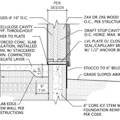
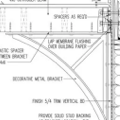
GBA Detail Library
A collection of one thousand construction details organized by climate and house part





Replies
Andrew,
There are many ways to flash a window. Whatever way you choose, you have to adhere to a few basic principles.
At some point, all windows leak. They leak between the sash and the window frame. In addition, they sometimes leak between the window frame and the rough opening.
Your rough opening has to be able to handle this water. The most vulnerable areas of the rough opening are the two lower corners. If there is rot, that's where it starts.
So, at a bare minimum, you need a waterproof sill pan that directs the water that reaches those corners to the exterior face of your WRB. That means that you can't tape the lower window flange, because you don't want to trap water in the bottom corners of your rough opening.
That's my bare minimum requirement.
Beyond that, it's up to you.
It's common for the rough jambs to get wet. So, if I am installing a window, I'm going to flash my rough jambs and direct the water that runs down my rough jambs to the sill pan at the bottom of my rough opening.
I'm also going to include head flashing at the window head, and I'm going to lap my WRB over the top of my head flashing.
Are window flanges part of your flashing system? No. They aren't flashing. They are convenient flanges for mounting the window.
So, to answer your question: should you tape your window flanges to your WRB?
You don't have to. As Jesse Thompson has explained, it's best to create your air barrier at the interior side of the window.
If you want to tape the side flanges and top flange of your window, go ahead. But whatever you do, don't tape the bottom flange.
Finally, if you are ever confused about what to do next, remember my mantra: "Flash the rough opening, not the window."
If you only seal the inside of the window - it means that the outside temperature will come all the way to your interior airseal there - reducing the installed insulated value of your window dramatically, especially if it use good glass and a high performance frame.
Yes, some window will leak day one, some after a while - and some only when they are past their useful lives (20-30-40 years). Depends on materials, design and price....but we should insulated the installation gap of the window and seal on the outside.
The benefit of the vapor open CONTEGA EXO tape is (perm 66 per EN 12572), that any moisture getting behind/below it, will rapidly dry outwards. Allowing you to also tape and airseal/insulate the cavity below your window frame.
Taping the exterior of the window, as shown in the image, improves the insulation/reduces the thermal bridge of the window installation at the sill - you would have to install a metal or painted wood sill over taped connection, that directs the bulk of the rainwater hitting this innie window to the facade, just like you would for a conventional innie window.
Rot and mold can indeed occur when one makes a window sill out of vapor closed material (check the perm rating of you sill tape...). If you think your windows will leak, my company 475 also offers a sill pan solution that indeed can extend under your window made with TESCON tapes, which have a perm rating of 8 - a little less outward drying potential than the EXO tape, but quite a bit more drying potential than other sill products on the market . See this blogpost. In that situation, we do recommend to insulate (with for instance mineral wool) below the frame and face tape the frame with durable and waterproof TESCON Profil tape.
It allows outward drying of unforseen water, and preventing damage to the sill.
Martin, Thanks for the clarification. I understand your point about a well flashed RO. What I was not sure about in what I had read recently, is whether taping 3 sides of the exterior of the window frame or flange to the WRB was optional (an added layer of protection, but no substitute for a properly flashed RO) or if doing so was actually a bad idea. If I've understood you correctly, your point is that it is optional but not bad. After reading Jesse's article it was unclear to me whether he was actually claiming the latter--again due to considerations of design pressure that I don't fully understand. Perhaps he can clarify.
Floris, thanks for your response. Just curious, what's the minimum amount your tape could be applied to an exterior (flangeless) window frame and still maintain durable adhesion? I've seen some installs of building tapes (not yours) where maybe a 3/8"-1/2" strip is actually covered by tape on the window frame itself. I ask because most window frames are only so wide, and by the time you tape and cover the tape with trim/flashing there may not be much window frame left exposed.
Thanks.
Andrew,
We try to stick with the basic priority list.
#1: Stop liquid water from entering the building. Proper flashings come first, well lapped with WRP, top piece over bottom piece, just like the old days.
#2: Stop air movement. Always have a clear and continuous air barrier. This can be exterior face or interior face, but it does not have to be in the same plane or be the same material as the flashing.
#3: Insulate. Slow down heat movement as much as possible with low conductivity materials. No continuous metal from inside to out in a building, and as little continuous wood from inside to out as possible.
#4: Once you've gotten all the other items in line, start to worry about vapor movement.
Honestly, the construction industry (ourselves included, most likely) does a terrible job at getting #1 right, let alone #2 & #3. We talk about #4 far too much, and #1 far too little, in my opinion.
Andrew, noticed my answer is a little late regarding tape coverage on window frames question from this spring. It is generally recommended with Pro Clima tapes to have at least 3/4" on each side of the joint/gap you are taping. On window frames on the interior this could be a problem as the tape would peek out under the sheetrock. (or exterior trim, but mostly that is an thicker material). But the double sided tape allows you to pre-apply it to the frame side, before the window is installed. Which means you don't have to worry about the tape being visible (see image above) as it is no longer taped to the face of the frame.
The TESCON Profil tape has a 1/2" wide strip. This is sufficient if the tape is bonded to a solid smooth substrate, and if it is pressurized well to activate the Solid acrylic adhesive. This will assure a proper durable bond at the window frame. On CONTEGA EXO the strips are 3/4" wide which on the exterior is not a problem when face taping.
Andrew,
Part of your question was: Which seal matters? In or Out??
One of the reason that the interior air barrier is so important is water getting into the rough opening. All building enclosures go through pressure differentials. It even changes with the side of the building your on. (windward / leeward....). Imagine a wet windy day where the building is slightly de-pressurized due to wind velocity. If your airbarrier is at the exterior and is imperfect, (as things often are) then the de-presurization can suck liquid water into the RO. It not too hard to do that because the liquid water is right there next to the penetrated air barrier.
If however the air barrier is on the inside of the frame, then the liquid water is much farther away from the venturi effect of the penetration. Too far and too diffused to have enough "muscle" to draw in water.
This is how water can get into a rough opening without a leak in the frame -and- a further reason why all RO's need to be "well flashed" past the mid-point of the frame and really up to the interior edge of the frame.
It's contrary to what we normally think. We really think of shedding water like a rain jacket. But in a building we have to also think about managing pressure differentials in addition to shedding water.