Energy Solutions

Good News, Bad News: A Glut of Solar Panels

Posted on October 11, 2012 by Alex Wilson

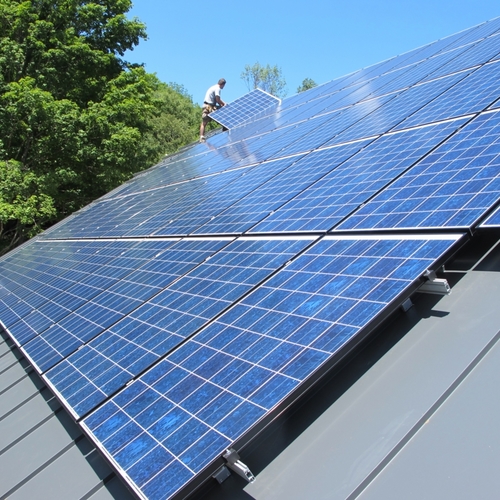
When China dives into a technology, it does so in a big way. Nowhere is this more the case than in photovoltaic(PV) Generation of electricity directly from sunlight. A photovoltaic cell has no moving parts; electrons are energized by sunlight and result in current flow. (PVPhotovoltaics. Generation of electricity directly from sunlight. A photovoltaic (PV) cell has no moving parts; electrons are energized by sunlight and result in current flow.) panel manufacturing, where dramatic growth has not only taken a toll on other manufacturers around the world, but also now threatens its own PV industry through rampant oversupply.

This has significant implications for us here in the U.S. — both good and bad.

Designing Homes and Communities That Can Survive a Disaster

Posted on October 4, 2012 by Alex Wilson

Some 27 years ago, following a five-year stint as director of the Northeast Sustainable Energy Association (which was then based in Brattleboro), I launched my own company focusing on information about environmentally responsible design and construction.

Drainline Heat Exchangers

Posted on September 27, 2012 by Alex Wilson

Over the past few weeks I’ve written about various strategies to produce hot water efficiently. We’ve seen that tankless water heaters are more efficient than storage water heaters (though are not without their drawbacks), and we’ve learned that heat-pump water heaters produce two to three times as much heat per unit of electricity consumed as electric water heaters that rely on electric resistance heat.

Get Ready for Heat-Pump Water Heaters

Posted on September 20, 2012 by Alex Wilson

Last week I wrote about “hybrid” water heaters, a relatively new type of water heater that includes features of both storage and tankless models. This week I’ll cover another type of water heater that is also (confusingly) referred to as “hybrid”: heat-pump water heaters. These produce over twice as much hot water for each unit of electricity consumed as any other type of electric water heater (storage or tankless).

Hybrid Water Heaters

Posted on September 13, 2012 by Alex Wilson

In last week’s blog I compared tankless and storage water heaters and explained why tankless water heaters often don’t make that much sense.

The Difference Between Storage and Tankless Water Heaters

Posted on September 6, 2012 by Alex Wilson

There are two primary types of water heaters: storage and tankless. In this column I’ll try to explain the differences between these two approaches and offer some guidance on choosing between them. (There are also “hybrid” water heaters with features of both that I’ll cover in a future blog.)

Storage water heaters

Most water heaters are storage models. These are insulated tanks holding 20 to 120 gallons with either electric heating elements or gas burners. The storage tank stratifies with hot water at the top and cold incoming water at the bottom, so that as you draw off hot water (from the top), you get consistently hot water until the hot water is nearly depleted. The “first-hour rating” tells you how many gallons of hot water can be delivered in an hour. 

Saving a Little More Energy With Exit Signs

Posted on August 30, 2012 by Alex Wilson

In the years that I’ve been writing about energy and energy conservation (longer than I really want to admit), I’ve reported on several dramatic transitions in how we illuminate the exit signs in commercial buildings. For an energy geek, it’s been an exciting technology to watch.

Why care about exit signs?
Why do we even pay attention to exit signs—those ubiquitous red or green illuminated signs that direct our escape from a building should the need arise? They can’t use very much energy, can they?

Insulation to Keep Us Warm — Not Warm the Planet

Posted on August 23, 2012 by Alex Wilson

I’ve been pretty vocal about a big problem with some of our most common insulation materials: that they are made using blowing agents that are highly potent greenhouse gases.

All extruded polystyrene (XPSExtruded polystyrene. Highly insulating, water-resistant rigid foam insulation that is widely used above and below grade, such as on exterior walls and underneath concrete floor slabs. In North America, XPS is made with ozone-depleting HCFC-142b. XPS has higher density and R-value and lower vapor permeability than EPS rigid insulation.) and most closed-cell spray polyurethane foams (SPF) are made with HFC (hydrofluorocarbon) blowing agents that have global warming potentials (GWPs) many hundreds of times greater than that of carbon dioxide. (My apologies for contaminating this column with so many acronyms!)

Insulation: good news, bad news

The End of Peak Oil?

Posted on August 16, 2012 by Alex Wilson

I first wrote about “peak oil” in 1998, reporting on an in-depth article in Scientific American by petroleum geologists Colin Campbell, PhD, and Jean Laherrère. Campbell and Laherrère believed that up to that time the world had consumed about 800 billion barrels of oil (BBO), and the known reserves of conventional crude oil totaled about 850 bbl in 1996 and another 200 BBO of conventional oil was yet to be discovered.

Fixing Those Drainage Problems, 30 Years Later

Posted on August 9, 2012 by Alex Wilson

When I bought the house in West Dummerston, Vermont, where my wife and I have lived for the past thirty years, one of the first things I did was fix the drainage problems that were dumping water into our basement…

Or so I thought. Let me explain.

Register for a free account and join the conversation


Get a free account and join the conversation!
Become a GBA PRO!

Syndicate content