Image Credit: Martin Holladay
More Musings of an Energy Nerd


You can put away your building science notebooks; this blog is simply a collection of photos from my recent vacation in Greece.
While the purpose of my trip was relaxation, I still managed to point my camera at a few construction sites and examples of renewable-energy equipment.
Scroll to the bottom of the page if you want to see the thumbnails.
Last week’s blog: “When Sunshine Drives Moisture Into Walls.”
Fast Facts
Population of Greece: 11,237,000 (2008)Population of Crete: 630,000 (2005)Area of Greece: 50,949 square milesArea of Crete: 3,300 square milesAnnual precipitation (Heraklion, Crete); 17.8 inchesAverage maximum July temperature (Heraklion, Crete): 84°FAverage minimum July temperature (Heraklion, Crete): 71°FAverage maximum January temperature (Heraklion, Crete): 60°FAverage minimum January temperature (Heraklion, Crete): 48°FHours of sunshine (Heraklion, Crete): 2,916 hours per year (7.99 hours per day)
Weekly Newsletter
Get building science and energy efficiency advice, plus special offers, in your inbox.

This article is only available to GBA Prime Members
Sign up for a free trial and get instant access to this article as well as GBA’s complete library of premium articles and construction details.
Start Free TrialAlready a member? Log in

4 Comments
We could learn something from
We could learn something from Greek energy attitudes. The simple solar hot water setups Martin illustrates are not effective 24/7 and the water is generally cold by morning. Greek solution: take your shower in the afternoon or evening - no problem! I also noticed on my last visit - the first for nearly twenty years - that CFL's have become ubiquitous, even for store display lighting, and small store owners will turn them on only when a customer enters.
Greece is a beautiful
Greece is a beautiful country and the islands are magical. I have not been to Greece in 20 years but the memories are still vivid. I spent time on Santorini and was very impressed by the fact that the population which was mostly farmers, small family restaurants and workers all had solar hot water systems on their modest homes. Many of the small businesses had solar systems also. There were some PV arrays but not many. Water resources have always been an issue on the islands, and the basic population are not wealthy, so most native people that you meet are used to conserving their water and electricity. People naturally lay low during the hot parts of the day so most work activity is done in the early hours of the morning, or in the cooler parts of the late day. People become active later in the evening so it is not surprising to be eating dinner at 10-11:00 pm. I look forward to my next visit to Greece. The photo images bring back many memories. The European nations continue to forge ahead of us in their deployment and usage of alternative energy solutions.
Couldn't believe my eyes
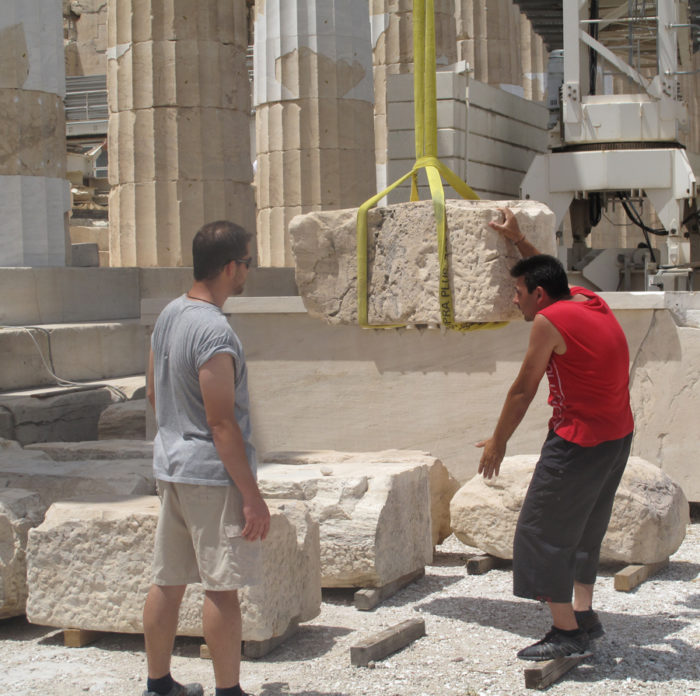
What good is energy conservation if your no longer alive to take advantage of the benefits? I am still shocked by the picture of the guys lowering the stone without hard hats or steel toed boots.
Response to Cliff
Cliff,
Hey, it's just the Parthenon. Who's watching?
I'm with you, Cliff. (A particularly interesting detail: the guy with his hand on the stone -- the guy wearing sneakers -- is standing on the skid where the stone is supposed to be lowered.) If I were to make glib generalizations about Europe, I'd say this: Europeans are ahead of Americans on almost all fronts -- including environmentalism, energy conservation, and universal health care -- with two prominent exceptions: job-site safety and smoking in restaurants.
Log in or become a member to post a comment.
Sign up Log in