
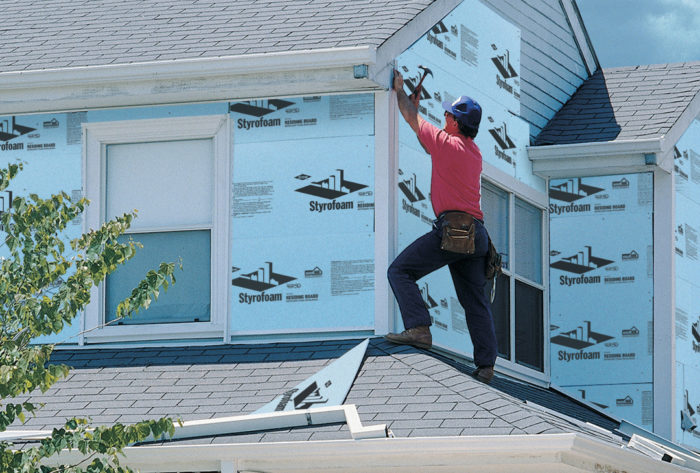
Image Credit: Dow Building Solutions
More Musings of an Energy Nerd


Unlike governments in Germany and the U.K., the U.S. government hasn’t yet enacted an energy policy aimed at addressing global climate change. As a result, prices for carbon-based fuels in the U.S. are far lower than in most European countries.
If Americans continue along our current energy path, wrenching climate change is almost inevitable. That’s why many energy experts advise Americans to prepare for the eventual implementation of steep carbon taxes on heating fuel and electricity.
One prominent environmental organization, the Union of Concerned Scientists, has called for an 80% reduction in U.S. greenhouse gas emissions by 2050, and two states (California and New Jersey) have adopted that target as a state goal. The 2030 Challenge, a program endorsed by the American Institute of Architects, sets a goal of implementing energy retrofits designed to reduce energy use by 50% at 1.5 million U.S. homes annually between now and 2030.
It’s unclear whether the U.S. will be able to meet these challenging targets. But attaining the targets would require almost every U.S. home to under a deep-energy retrofit. In most cases, the work would require walls and roofs to be covered with a thick layer of exterior insulation.
The logical time to do this work is when siding or roofing is replaced.
It stands to reason, therefore, that siding and roofing contractors should:
Unfortunately, few siding and roofing contractors have taken these steps. Although the upcoming need for massive numbers of deep energy retrofits is understood by many climate scientists and energy experts, this type of work isn’t on…
Weekly Newsletter
Get building science and energy efficiency advice, plus special offers, in your inbox.

This article is only available to GBA Prime Members
Sign up for a free trial and get instant access to this article as well as GBA’s complete library of premium articles and construction details.
Start Free TrialAlready a member? Log in



38 Comments
Cash for Cladding
Well, Martin, your post is certainly (passed?) ready for prime-time. Thanks.
Cash for Cladding (Rick words) might be the only way to get it done, but my guess is that both the majority of people, and certainly the government, are clueless. The government radically underestimated the response to Cash for Clunkers. If Cash for Cladding happens, it will likely be like certain select people pissing in the ocean. I'm still expecting the "underprivledged" in my area to be outfitted with PV at the same time I cannot hope to afford that. We're paying their electric bills, anyway, already, and I expect the government to find it "beneficial" to society to give them PV at our expense--any time now.
Brand new news this morning:
WASHINGTON (AP) — President Barack Obama's options for spurring job growth may be limited by out-of-control budget deficits, but he is warming to moves by his congressional allies for a jobs-boosting bill..................One new idea Democrats and the White House are looking at is a program to give people cash incentives to retrofit their homes with energy-saving materials along the lines of the Cash for Clunkers program that boosted car sales this summer.
Full story at http://www.comcast.net/articles/finance/20091203/US.Obama.Economy/
More on White House weatherization program plans
Rick,
I'm not exactly sure what you mean when you say that we are paying the electric bills of the underprivileged. I, for one, strongly support the low-income weatherization program, which has multiple benefits, including (1) job creation, (2) development of a skilled workforce capable of performing essential energy retrofit work, (3) reduction in energy imports, (4) reduction in global warming gas emissions, and (5) alleviation of one of the burdens of poverty.
But you are certainly right that the White House is developing plans for more weatherization programs. GBA has written three recent news articles on the topic:
https://www.greenbuildingadvisor.com/blogs/dept/green-building-news/potentially-stronger-weatherization-stimulus
https://www.greenbuildingadvisor.com/blogs/dept/green-building-news/white-house-recipe-transforming-stimulus-funded-weatherization-nation
https://www.greenbuildingadvisor.com/blogs/dept/green-building-news/extra-push-retrofits-and-it-can-t-come-soon-enough
The Urban Jevon's Paradox
Martin, I did not necessarily mean you, living in the Vermont woods, when I said we are paying the electric bills of the "underprivledged." I cannot speak for Vermont, but you can bet many of us living in more urban environments know exactly what I meant. The following is taken directly from a state government website. These are official programs funded by taxpayers.
The ELECTRIC UNIVERSAL SERVICE PROGRAM (EUSP):
1.Help to pay current electric bills;
2.Help to pay past due electric bills; and,
3.Help with energy efficiency measures to reduce future electric bills.
The UTILITY SERVICE PROTECTION PROGRAM (USPP) protects low-income families from utility cut-offs ....
So, in summary:
1. Increasingly, some of WE are paying more and more for electricity for more and more people
2. It had already been extremely hard to cut customers off of electricity for non-payment. Now it is just about impossible with the new USPP in some areas. That's real.
Martin, if you do not now see that this adds up to some of we are already paying the electric bills of others, then maybe I could interest you in buying this 5-mile suspension bridge crossing Otter Creek that I have for sale.
Also, concerning your strong support for low-income weatherization programs, such as the third element of the EUSP, you need to understand that it's taxpayer money supporting the Jevons Paradox. The urban reality is not exactly the Jevons Paradox in the way you have previously written about it, but strongly related. The traditional Jevons Paradox is an economic principle that basically states that measures designed to more efficiently use a resource do not decrease the use of that resource. Here's the new urban definition of the Jevons Paradox: The EUSP and taxpayer-funded weatherization programs have not stopped Jevon from cranking up his heat and stereo, and opening his windows. There is a lot of reality going around that is stranger than fiction, but continually ignored.
Is this really the way to go?
Martin
I agree that something must be done to address the needed retrofits of many older homes. And yes, governments will very likely be encouraging retrofits in coming programs. What really scares me is that unless proper flashing and rainscreen details (especially around windows and doors) are taken care of at the same time, that the results will be mold and rot problems caused by trapped moisture and reduced drying potential. Other potential problems include poor performance caused by insulation short circuits (air circulating behind foamboard) or short circuits caused by hundreds of steel nails used to attach siding through foamboard. As you have noted, most retrofit contractors are not at all interested in doing a proper job. Adding government money will not improve their attitude.
All this reminds me of the "you can put lipstick on a pig" saying. Maybe the money and resources would be better spent on new low income housing where the build quality and energy savings could be enforced through much tougher building codes.
Doing it right
Garth,
Like you, I strongly believe that remodeling and retrofit work should be done right. That's why I suggested that contractors should "educate themselves on the building science issues surrounding exterior foam insulation [and] be familiar with techniques for installing rigid foam under new siding or roofing." There's no substitute for training and competency.
But exterior flashing is no more complicated than many other residential construction tasks. Any work can be done well or done poorly. If you fail to install a water heater correctly, it can explode. Poorly installed HVAC ductwork can cause condensation and mold. The solution is not to throw up our hands and stop working — the solution is to insist on a skilled, educated workforce, properly paid — and if necessary subject to inspection.
By the way, in my blog I made no mention of federal subsidy programs.
Flashing
Martin
You say that exterior flashing is not a complicated task. I disagree. I say that to really do a proper job that windows should be removed, a proper pan flashing installed, jamb and head flashings, etc. How likely is it that this level of detail will be required and insisted upon?
I do agree with your solution of a well trained work force, and that inspections will be necessary. At this time however the proper incentives do not exist.
And yes, you did not mention subsidies, but it is hard to imagine that proper incentives will come about without some sort of government or taxpayer intervention...
Good blog...I predict a long comment stream to follow...hope it doesn't get too political.
Window details
Garth,
Many of the siding contractors I talked to are "window and siding contractors." The trades tend to go together. Thousands of contractors around the country offer both siding and windows.
If I were replacing my siding, I would want thick exterior foam. Like you, I would also want new windows. I'm not disagreeing with you. I certainly agree that new windows need sill pans and head flashing.
Believe it or not, thousands of contractors know how to install a sill pan and head flashing. (Of course, thousands of others don't.) If you insist it's a complicated task, OK. But lots of tasks associated with residential construction are complicated. Yet we do them every day.
Training is required, as well as consistent work protocols and a well-paid work force. But these things are needed whether or not we perform any deep energy retrofits. They should be par for the course.
two for one
I'm disturbed by this comment stream. People don't try to be in the impossible situations provided by American poverty, and anything the rest of us can do to help children born into these ridiculous, unfair situations can only improve our country in years ahead.
Incidentally, despite the sneering attitude, I can assure you that there are plenty of rural Vermonters trapped in oppressive situations. Their kids, like those in urban areas, have little shot at an 'equal opportunity' in our society, which doesn't strike me as very fair, but fairness aside it's a tremendous waste of human potential, which if tapped would benefit everyone.
And, the rural Vermonter's trailer home probably uses triple the energy of a Baltimore row home, which brings up the idea that weatherization programs provide several benefits. We ought to help families who need it, and we ought to reduce our fossil fuel use--both being in every American's self interest, among other reasons. Jevon's hypothetical paradox notwithstanding (incidentally show us how that plots out, exactly--it's well known to be a very mild effect in most situations, overwhelmed by a variety of other factors), improving our housing stock even with taxpayer money is a great idea.
Compicated?
Martin
When I was referring to proper flashing details, I was thinking more about doing the foamboard, siding retrofit without putting in new windows. How do you keep the water out in these situations?? Even the best of contractors will struggle with this....and water will get in...and rot will result....
I think we agree that something must be done. I am not suggesting that we "throw up our hands and do nothing". I only suggested that the resources might better be used elsewhere...
now it's new windows?
Martin,
A completely agree with Garth, as your first suggestion was to install the foam and siding while keeping the existing windows, this will be an extremely complicated and possibly error producing task. As you mention, sure, we can do complicated and we can do it properly, but this will drive the cost WAY UP. Your second comment following now has the client installing new windows all around to reduce the complication of the install. This now becomes a whole new topic then your original assertion of a 'simple' retrofit.
If we're throwing new windows in, which IMO will be the only way to reduce the complications (and possible weather infiltration) of installing the new rigid boards and siding (and even building them out further (perhaps even 4")) then well...again, this another story all together.
When I build I need to do it right the first time. And I would never recommend a client install foam board without swapping out the windows at the same time. Rare is a client that has all those projects aligned in their budget. BUT... it does happen, and when it does, everyone wins. :)
Great blog...always a good read.
Extending windowsills
Close readers of the blog will notice that I never mentioned windows in the blog. Later, in response to a question, I noted that if I were replacing the siding on my house, I would replace my windows.
The issues raised by these comments are all pertinent. Here are a few points:
1. It is possible to extend windowsills. I have done it a few times myself. The procedure I used was to plane the edge of the windowsill and glue on a cedar extension using resorcinol glue. The cedar is held in place with stainless-steel screws. Of course, the cedar has to be properly beveled to maintain the windowsill's angle. Whether or not a contractor feels comfortable with this detail will depend on the amount of roof overhang and the annual rainfall.
2. It is possible to install thick exterior foam without replacing the windows, although window replacement often makes sense if the intent is a deep energy retrofit.
3. I agree completely that these deep energy retrofits are frighteningly expensive. All the more reason to coordinate them with scheduled siding replacement jobs.
4. Climate scientists tell us we are facing a crisis of unprecedented proportions. These suggested retrofit measures will probably be necessary if we are to preserve a livable planet for our grandchildren. We now face a daunting task, on the same order of magnitude as the moon landing or World War 2. It is far from clear whether our country is capable of rising to the challenge. Can we afford it? Certainly we can, if the alternative is ecological disaster. However, it remains to be seen whether our political leadership will prove up the the task of steering us through the dangerous waters ahead.
Outies Trump
Garth ... I agree...these things are NOT simple
Bryan ... I also think the window should be an outie
Water Control should trump Thermal
I think that the techniques in this new construction video could be used well in retrofit...
https://www.greenbuildingadvisor.com/superinsulating-home-rigid-foam
The water control/air control detail looks more user friendly and "bullet-proof" than the typical(Innie) retro details.
Yes... in new construction the Innie has a thermal advantage...
But mainstream Retrofits ... I am thinking Outie
Drying potential
Martin
1.I agree that this is possible. However, as Joe Lstiburek has pointed out, many existing windows do leak and a significant percentage of brand new windows have been shown to leak. This does not cause significant problems as long as the wall assembly has the ability to dry to either the outside, or the inside. Many of the homes that require retrofits already have a poly vapor barrier inside...adding mostly vapor impermeable foam with taped and sealed seems to the outside??? I see problems...
2. Possible yes. Wise, I don't think so...
3. I agree.
4. Strongly agree. But I must add that we should look at all alternatives.
Thanks again for the good discussion.
Better, more cost effective measures
I agree with those that say installing exterior foam in a retrofit can be very problematic, unless the client has the money to replace windows at the same time. We are expecting too much, I think, from contractors to study the building science, install thick foam, get the details right around windows, etc.
I think, Martin, you are looking for the 'silver bullet' with exterior foam. First we need people to change their light bulbs to CFLs, air seal their homes, dramatically reduce duct leakage, improve duct insulation, add ventilation, change out old inefficient refrigerators and water heaters, add low flow toilets, faucets, and showers, insulate HW lines, reduce phantom loads, improve attic and crawlspace insulation, etc, etc, etc.
In my area, just smarter, more conscientious building practices would save, I think, 40-70% of the energy. I think we need an army of Home Performance Contractors to do the million little things to increase efficiency....before we approach the more complicated measures such as adding thicker exterior foam.
Deep energy retrofits
I'm not saying that we shouldn't start by changing light bulbs and performing routine air sealing. Of course that work comes first.
All I'm saying is that anyone who is buying new siding should seriously consider including thick foam under the new siding. Ideally, new windows should also be installed.
Look, we all know the reasons that people aren't doing deep energy retrofits. The main reason is that the price of atmospheric damage is not included in our current energy prices.
I don't know how long the current era of cheap energy will last. The longer it lasts, the more we'll hear people like Garth and Ed tell us that we don't need to consider deep energy retrofits.
All I'm saying is, if Garth and Ed are right, and we have another couple of decades of cheap energy, we're doomed.
Dubious
I think that retrofitting foam on the exterior is a bad idea. The majority of siding and window contractors, in my experience, do not do a great job of flashing and installation, and adding a layer of foam will make the job much more complicated. Plus, there have been problems with installing foam under wood clapboards. This was done a lot in the 1980s but it was discovered that the foam tended to trap water between the foam and the back side of the clapboards and a lot of buckling took place, along with mold growth. Besides, you'd need a very thick layer of foam to obtain significant r-value.
However, I agree that when siding and roofing are replaced, there is a great opportunity for increasing the energy efficiency. I advocate the use of either dense-pack cellulose or spray foam insulation. Either product is far superior to fiberglass batts (which do nothing to air-seal) and either one can be done by drilling holes in the exterior sheathing.
As for window replacement, don't waste your money. The payback period is decades long in most cases. Most old windows can be weatherstripped adequately and with a good storm window, the combination is nearly as effective as replacement windows for far less money.
Mark Landry
Landmark Services
Wood siding over foam
Mark,
There is an easy, foolproof way to install wood siding over foam: install the siding over rainscreen strapping. Vertical strapping, screwed through the foam to the studs, creates an air space which improves drainage and helps the siding dry out after wetting.
No fan of fan-fold
I was visiting my siding and soffit supplier a while back and made exactly the same suggestion Martin has made, promote serious energy upgrades when residing homes. My sales guy said they really did not see the need. When I went to the back of the warehouse to pick up my soffit material I could see the single glazed windows of the heated warehouse covered with fanfold insulation!
Adding foam sheathing when residing homes makes great sense, for any insulated 2x4 or 2x6 wall the addition of 1 1/2" of R-10 Thermax will about double the R-value and reduce infiltration by a bunch.
The types of retrofits Martin has discussed is the new building opportunity, this country is awash in energy wasting existing homes.
Drying potential
Our house in Minneapolis was built by others in 1978. The walls are 2x4 with fiberglass batts, there is a warm side 4 mil poly vapor barrier and the sheathing is 1" R-5 extruded polystyrene. I have been in the walls for some minor remodeling and all wall components look new, like the day it was built. I do not lay awake at night worried about moisture problems in these walls, would have showed up long ago.
Innovative Solutions
Every building is not the same and the recommended solutions vary per project and budget. Energy loads per building vary on the quality of construction, technologies implemented, design and user habits. I am hoping current builders will put the pieces together and work with sub-contractors that are conscious of the other trades and how each element comes together to complete a sustainable building. Using cameras to evalute a structure for heat loss/gain and mold/water damage are good first steps to evaluting the best next step. Sometimes it is best to rip it out and start over and other times is it best to leave the resources in tact and add.
I would like to introduce all of you to a product that I am currently working with that can give the added benefit of thermal barrier without destroying current roofs, not having full access to trusses has limitations, and so forth. This product is not ceramic based or reflective. It can be applied to any material other than water. It adds UV protection, corrosion protection, Mold will not grow on this, and it can reduce a standard home's heating and cooling bills up to 40%. In retrofit, trailers, warehouses, new construction, I believe this product can address the energy issues without changing the appearance of the building,providing food for mold or requiring "space for insulation." I am supporting anyone that makes any effort to reduce the energy loads off our grids. This product costs the same as a good paint and yet protects your assets from the elements and reduces energy loads by providing a clear layer of nanoparticles that has poor thermal conductivity. Roofing contractors, I invite you to add this to your services, as it protects the product and the roof will have no maintenace concerning mold. Less material in our landfills and less energy pulled off the grid and less water used to cool our power plants. Add me to your contacts if you are interested in learning more!
Caveat - Project financing / Educating Appraisers is key
While our knowledge of building science and improvement opportunities for homes is fantastic, if our clients cannot finance these features, our hands are tied. The new reality for new construction and retrofit financing is in the hands of appraisers. We have recently run into appraisal issues that provide NO recognition of the energy improvement components, their cost, or the future energy savings they will provide. Unfortunately, this is resulting in our clients having to make tough decisions on what features to remove in order for them to afford a new home or retrofit project. The appraisers need education and meaningful guidelines.
As for the technical aspects of oversheathing with foam, I recently completed a retrofit project on my own residence - the details were challenging, but possible. I had to stay on top of all my trades to insure the quality deatails were followed - nothing new as we have to do the same for most of the advanced features that we incorporate into our new homes. While the results have been admirable 1 year later, if I had needed to finance the retrofit project, the bank would not have loaned me the money as the appraiser would provide ZERO value for the improvements. We initially pursued this route and decided to pay out of pocket. Most of our clients don't have this option.
RE: Project Financing / Educating Appraisers
Todd:
I think you've hit on a, if not the, key point. Realtors and appraisers put no value in quality or energy efficiency, just $/ft^2 and nice countertops. Until they do, very few will pay for it out their pocket, because they know they won't get it back when they try to sell their house. And how many people buy or build houses thinking that this will be the house that they live in for 20+ years? When you move frequently, you think about re-sale.
I am personally very pessimistic, but I do appreciate the authors and bloggers at this site who are working hard to come up with better ideas and techniques and who share their successes (and failures) with others.
Require utility bill disclosure when selling a house
Utility bills are part of the cost of home ownership, cheap energy has allowed us to overlook energy usage. With the prospect of a carbon tax to curb energy consumption and slow CO2 rise, it is a matter of time before homes for sale will need a comprehensive energy rating. We will then start to properly value the energy efficiency of a building.
I take that back
Martin,
I take back my objection to your idea. I was on the website of Job Lstiburek, a noted expert on weatherization and he advocates for this same idea. His website, by the way, has a wealth of information on insulation, ventilation, waterproofing, drainage, and other best practices in building construction: http://www.buildingscience.com/ .
Despite the challenge of getting tradesmen to flash things properly, there is no question that we need to make our buildings use less energy.
Mark Landry
Thanks, Mark
Mark,
Thanks for sharing your revised position. Joe Lstiburek and Betsy Pettit were involved in the Arlington, Mass. deep-energy retrofit project that has gotten a lot of publicty.
Ducks in a row....
Martin,
I do agree that if a client is planning to install new siding or a new roof, they should definitely consider adding thicker rigid foam insulation....getting the details correct will be the key to success.
I was merely saying that we (at least in California) have so much 'low hanging fruit' available to improve the efficiency of homes, long before we consider more drastic measures. I'd be thrilled to even get close to improving homes by 50%!......heck, somehow, we have to first flat line our energy consumption before we even start getting better!
CA energy consumption
Actually CA energy consumptions has leveled off according to some sources....but US consumption, in general, continues to rise.
And I agree, Martin, energy prices need to rise.....take into account climate change, air quality, other environmental factors, etc.....before we will ever be able to drastically reduce consumption. I think that any future taxes should be placed on energy consumption....heck, reduce income taxes and place a huge burden on inefficiency or excess usage. I know...not fair for low income people....maybe true, I suppose, but something drastic needs to be done.
Full speed ahead
Great post, Martin. I'm in total agreement with you on the need for deep energy retrofits that wrap the house in foam. Despite the obstacles of educating contractors to do it properly and figuring out how to finance the extra expense of this work, we need to push hard for it. Climate change is one reason. Peak oil could deliver the knock-out punch before a climate catastrophe occurs, however. The more we can do to get ready for this, the better.
Allison A. Bailes III, PhD
Energy Vanguard
This contractor is promoting energy conservation!
My business, Better Siding Solutions, has been trying to promote greener retrofits for a long time.
I look around at my competitors and there isn't any other contractors in my area pushing a decent polyiso ridgid foam. At most they are looking to use 3/8 fan fold only to level the walls, and the roofers want nothing to do with it at all!
I try to sell 2" EnergyShield with my siding and have developed a custom trim and flashing around the window and door casings. This provides an additional R-13 to the home and also prevents Thermal Bridging.
Thanks for the great blog!
I know this is a year old
I know this is a year old article but I just wanted to comment that I just finished outsulating my house (with rainscreen) in addition to windows and siding. None of the builders in my area (that I talked to) had heard of this and just looked at me funny when I told them what I was doing. Homeowners interested in this kind of project may have to go about it themselves until there is a market for it.
Can't justify the cost of foam and windows with new siding.
I am going to have my 13 year old ranch house resided mainly because no house wrap or felt paper was used under the vinyl siding.I would love to go all out but can't justify the expense of foam and new windows (don't have anyone I would trust extending existing windows properly). Propane boiler heating a slab foundation only used 400 gallons of propane last year in snow belt of NW Pennsylvania. That was before I started air sealing the attic and finally found someone to properly service the boiler, so it will be even less this year. With those improvements along with adding tyvek I hope to reduce air infiltration and heating costs even more.
The roof is fading fast too. Thinking about replacing with metal (spent the last 2 days shoveling 3 ft of snowy off ) Does adding foam to the roof only apply to cathedral type ceilings? I have a ventilated attic and trying to determine if that would be an option.
Response to Jayne
Jayne,
If your house has a ventilated unconditioned attic, it makes no sense to install rigid foam on top of your roof sheathing -- unless that work is part of a plan to convert your attic into an unvented conditioned attic.
The work would require installing enough insulation at the roofline to meet minimum code requirements. It would also require air sealing the attic, closing all vents, and insulating your gable walls.
Sensible foam insulation retrofit?
We have a relatively large, old house in western PA. It has painted cedar shingles (protected by a relatively large box gutter). Although the shingles seem to be in pretty good shape, they don't hold paint particularly well. With the new stricter regulations about lead paint (and given the age of the house, I'm pretty sure they have some lead paint on them, unless they were not original), the costs of painting will be significantly increased (and it was not cheap before). In trying to resolve a number of problems at once, I've imagined replacing the siding with something that lasts longer w/o maintenance (perhaps cement fiber siding) w/o changing the look of the house, and at the same time boosting the insulation and the air sealing by adding foam insulation to the exterior. The house was renovated before we moved in (about 15 yrs ago), and they put fiberglass batt insulation wherever they replaced the interior walls, but I'm not sure what's behind the old plaster walls (I had an energy audit, but they did not have an infrared camera). The attic is well insulated with blown cellulose, and the overall feel of the house is pretty good (stays cool on hot days, e.g.), but the heating bills remain significant. I replaced the windows already (double paned vinyl clad wood that were inserted into the existing frames; they removed the sash weights and insulated the cavities). Replacing the windows greatly improved the comfort (the old windows were very drafty). My question is would it make sense to replace the siding and increase the insulation, or should I just keep repainting the cedar shingles every 7 years? If I add the rigid foam insulation, how does it get fastened to the substrate (if that is the right word for the siding under the cedar shingles, which I think is 1x dimensional lumber installed at an angle)? I'd like to put as much insulation as makes sense (2" or more?), but I'm a bit concerned as to how the new siding would be held in place over the foam panels (4" screws? Isn't that asking a lot of the screws?). It seems like gravity would make it tough for such long screws to keep the siding from sagging. I'd appreciate your insights.
Response to Kent
Kent,
1. The minimum thickness of exterior rigid foam depends upon your climate zone and the thickness of your existing walls. Here is more information: Calculating the Minimum Thickness of Rigid Foam Sheathing.
2. If you want more information on attaching foam to walls, you might want to watch these two online videos:
Superinsulating a Home With Rigid Foam
How to Install Rigid Foam Insulation Outside a House
Although the videos depict foam being installed on a new house, the methods of attachment and air sealing details are similar for retrofit jobs.
3. Once the foam is attached, most builders install vertical 1x4 strapping over the foam to create a rainscreen gap. The vertical strapping is attached to the underlying wall sheathing using long screws. Then your new siding can be attached to the vertical strapping.
Sensible Foam Retrofit
Thanks Martin. From the fact that you answered my question, I'll assume it's not a completely crazy idea. I have a related follow-up question. The foundation is stone (about 2' thick or so), but I was not planning to insulate that (I did have the rim joist insulated with spray foam, and that really made a great difference with the air infiltration). I have been told that unless you insulate the entire exposed walls, much of the insulation is wasted (because the heat loss through the uninsulated area acts like a chimney or a hole in a dam?). I can't see how to insulate the foundation walls without a great loss of aesthetics (either outside or in the basement). Would it still make sense to insulate the upper two floors (about 3' of foundation is exposed before the siding starts).
The third floor has a mansard roof (not in need of replacement any time soon), but the inside has deteriorating plaster knee walls, angled and flat ceilings. If I took the plaster down to the lath, would it make sense to but foam insulation over the lath (again with long screws), and then drywall/plaster over that? The lath as blown cellulose on the other side (so the foam would be on the heated side).
Second response to Kent
Kent,
1. Yes, insulating your basement walls is usually considered to be a cost-effective retrofit. There really is only one way to insulate a stone basement wall -- and that's with closed-cell spray polyurethane foam. You are right that it won't look the same -- but you'll be toasty.
2. Why bother removing the plaster from the lath? If you want to add rigid foam to your plaster walls, just attach the foam with buttons and screws directly over the plaster, and then add drywall.
Roofing and Siding ...
Somehow this old blog resurrected itself from 2009 to Aug 2011. Good. I can report that contractors are still clueless and gutless about thick rigid foam. With your help and advice, Marvin, last fall I super insulated a new roof with 9 inches of Dow blueboard. Currently, I'm finishing the re-work of the exterior shell - ripped out the north wall and half the east wall. As you may recall, this is two Post and Beam houses joined inexpertly at the hip, so there was not even studding but poor insulation squished between the vertical planks and the plasterboard. When I did the roof last year, I had to educate the contractor on how I wanted it done. We did 3 inches above the sheathing and 6 below. The same situation now - I downloaded tons of info from your web site on how to rebuild the walls after we blew the old walls out completely and rebuilt with 2X6 studs. I was replacing the windows anyway, but they had to wrap their minds around the 10 1/2 inch window boxes to cover the studs, sheathing, foam, and vertical strapping. (The answer to the contractor who said thick insulation sets the windows in too far.) Cost can certainly be an issue - my answer is to search for recycled foam. I used 2X4X3" blocks. They ran 17.7 % of the cost of new foam sheets. I spent some money on spray foam in a can as we foamed all the joints between blocks. On the up side, working with 2X4 pieces on a scaffold or ladder is a lot easier than 4X8 sheets, and trimming them to fit under peaks, etc. is also easier. Perhaps contractors need to consider re-used materials ... that would be a paradigm shift. Right now we are more than 50% finished adding the new clapboard siding. When we move to the inside, we will install another 3 inches of foam between the studs before installing the plaster board. And I still have 3 inches of space to run wires. Last winter the new roof proved it's value - the upstairs thermostat never kicked on the furnace - only the downstairs zone ran when the wood stove petered out in the early a.m. Anybody thinking of new siding or roofing - DO NOT MISS THE OPPORTUNITY TO INSULATE. If your contractor is resistant, search farther, or tell him/her to get educated. Be adamant that you want thick insulation. It's only scary for the first couple of hours - then it gets easy.
Response to Rock Termini
Rock,
Thanks for sharing your story, and for encouraging other homeowners facing siding or roofing replacement to invest in rigid foam.
Log in or become a member to post a comment.
Sign up Log in