
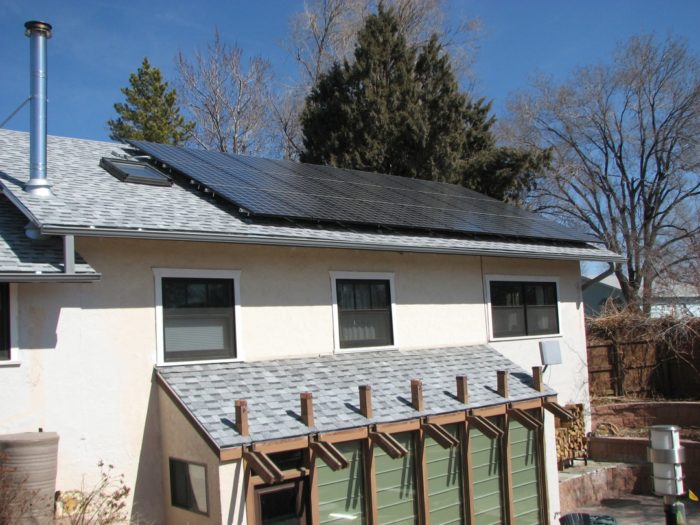
Image Credit: Christopher Behm
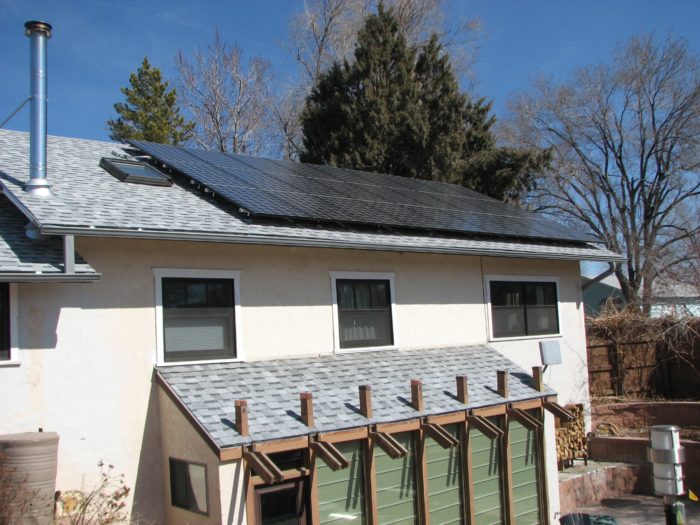
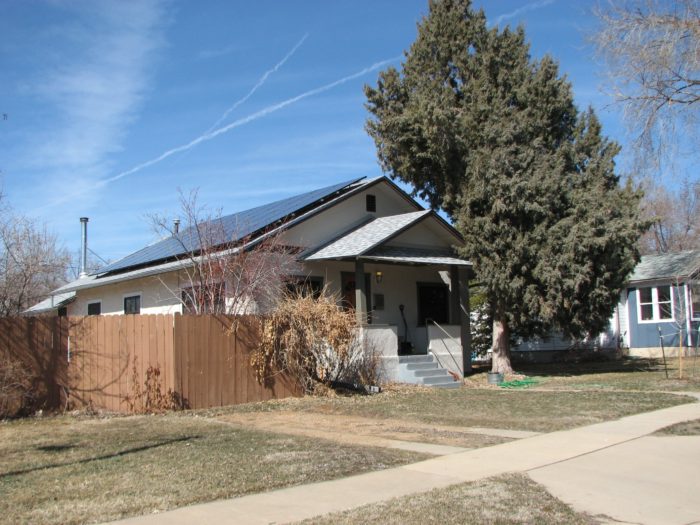
Image Credit: Christopher Behm The two-bedroom house, with about 2,300 sq. ft. of interior space, including the basement, was built in 1948. Xcel Energy installed a net meter at Behm’s house in September 2009. By March, he had seen it run in reverse at least once.
More Green Building News


It’s final – at least to the extent any government agency’s pronouncement is final: homeowners who borrowed money through Property Assessed Clean Energy funding programs to pay for energy efficiency upgrades, including solar power installations, can’t refinance their mortgages without first paying off their PACE loans, according to guidance issued this week by Fannie Mae and Freddie Mac, which underwrite most of the mortgages approved in the U.S.
The ruling was announced on Tuesday despite several weeks of negotiations between the Federal Housing Finance Agency, which oversees Fannie and Freddie, and advocates of PACE programs, which have been implemented in 22 states.
The principal point of contention remains PACE liens’ super-priority status, which gives them priority over whatever private financing a homeowner may have, including a conventional mortgage. As we noted in a previous post, FHFA worries that these energy-related liens will further burden taxpayers if PACE-participating homeowners default on their mortgages. PACE loan obligations, however, are attached not to the borrower but to the property, with which they remain if the property changes hands. The loans have terms of up to 20 years.
A sensitivity to risk
Because of the popularity of PACE in many communities and its potential to reduce long-term energy costs, the Fannie/Freddie ruling, which surfaced in an initial iteration in May, prompted consternation, disappointment, and, eventually, an outcry among many elected officials. A recent New York Times Green blog points out that pro-PACE arguments raised during negotiations, and in lawsuits filed by the state of California and the Sierra Club, have gone nowhere with the FHFA, whose acting director, Edward DeMarco, said in a letter to Representative Ed Perlmutter, Democrat of Colorado, that “PACE programs are implemented state by state and locality by locality without uniform standards for consumer protections and appropriate underwriting. FHFA found this particular initiative threatening to the safe and sound operations of its regulated entities and directed that appropriate steps be taken to address such risks.”
Janill Richards, a California supervising deputy attorney general, indicated the state will maintain its adversarial approach to the FHFA ruling, telling the Times in an e-mail, “It’s absolutely clear now that the FHFA is not at all interested in working out a solution that would allow PACE to proceed — the agency appears intent only on obstructing the program.”
Richards went on to direct attention to a key feature of PACE loans that seems to weaken the FHFA position: “This is another example of the agency treating PACE financing as loans, where, under state law, they’re assessments, and under law, the obligation to pay runs with property and passes on sale.”
A legislative remedy?
A PACE program resource website, PACENow, is currently configured to serve as a resource for supporters of a bill called the PACE Assessment Protection Act of 2010 (H.R. 5766), which is, according to its preamble, designed to “ensure that the underwriting standards of Fannie Mae and Freddie Mac facilitate the use of property assessed clean energy programs to finance the installation of renewable energy and energy efficiency improvements.”
The bill was introduced by Rep. Michael Thompson, a California Democrat, and has the support of 48 cosponsors. PACENow’s strategy is to further raise the profile of the program and make rescuing it from its FHFA imperilment more of a priority for lawmakers. To that end, the service has developed a “Federal Action Grassroots Toolkit,” which encourages voters to contact their legislators about the issue and to promote the bill through local media and municipal resolutions.
Weekly Newsletter
Get building science and energy efficiency advice, plus special offers, in your inbox.







2 Comments
PACE and HomeStar won't get the job done
I've always thought the PACE program was doomed and I'm no fan of the Home Star program either. The solution to me is to finance these low-hanging fruit type weatherization through a contract attached to the electrical service agreement that is paid back with interest through the monthly power bill and is not associated with the equity in the property but only with the electrical service connection. We have plenty of cable and internet service fees riding on the phone bill, why not let energy efficiency improvements ride on the power bill? Make it so easy that a for-profit weatherization company can go into a neighborhood and sell 80% of the homes regardless of the equity or balance sheets of the occupants. Details at http://www.ChandlerDesignBuild.com
And yes, I know that this is a controversial idea, and I respect and have already heard all your objections, but tax subsidies and convoluted owner-initiated financing solutions aren't a sustainable solution.
PACE loans
It seems to me here is yet another example of how the American political structure fails to take the long view. Energy efficiency and conservation is, in my opinion, a national security issue. Instead of Freddie and Fannie feeling sorry for themselves for getting taken to the woodshed for poor management, they should step up and do something positive. This is disappointing at the least.
Log in or create an account to post a comment.
Sign up Log in