
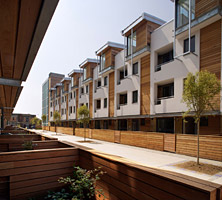
Image Credit: Zero Carbon Hub
More Green Building News


Strict requirements for energy efficiency, water consumption, and use of sustainable materials will take effect September 1
Last week, Wales became the first country in the United Kingdom to set a national standard for sustainable buildings.
The new standard, established by the Welsh Assembly Government (that country’s executive branch of government), will require residential and commercial builders to meet stricter requirements for carbon emissions, energy efficiency, water consumption, and use of sustainable materials in new buildings proposed for construction in Wales beginning September 1.
The Assembly Government says that the new policy, announced by Environment, Sustainability and Housing Minister Jane Davidson, mandates energy efficiency measures for new-home construction that are designed to cut the homes’ carbon emissions by 31% compared to comparable structures built according to current regulations.
Housing proposals will be rated according to a six-tier system established by Wales’ and England’s planning-system code structure, the Code for Sustainable Homes. The code standards range from Level 1, which is the lowest rating, to Level 6, the highest. The Assembly Government’s new policy will require new housing to meet Level 3 standards.
The new standards in Wales are only the latest green building initiatives to be announced in 2009. A couple weeks ago, GBA noted that in mid-April the European Parliament voted 10-1 to require that new buildings constructed after 2018 produce their own energy.
The European Parliament also demanded that the European Commission – the European Union’s executive branch, on whose legislative proposals the parliament and the Council of the European Union vote – implement two national financing strategies by 2014, one that would offer value-added tax reductions on insulation materials, and one that would create an energy efficiency fund to support private and public investment in buildings.
Weekly Newsletter
Get building science and energy efficiency advice, plus special offers, in your inbox.





0 Comments
Log in or create an account to post a comment.
Sign up Log in