
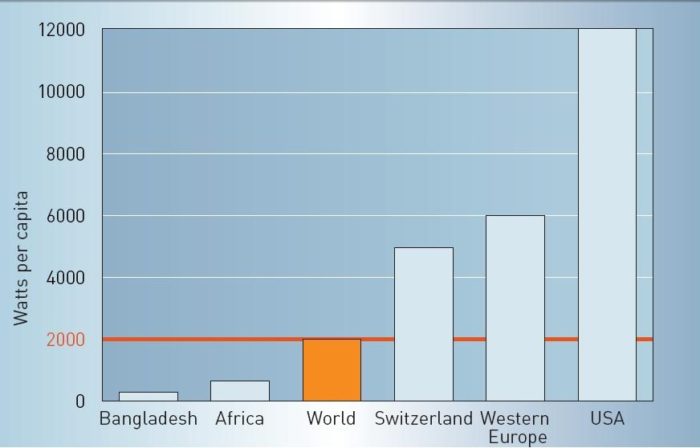
Image Credit: 2,000-Watt Society
More Musings of an Energy Nerd


In the U.S. and Canada, many residential builders use the word “sustainable” as a synonym for “green.” We hear about sustainable development, sustainable homes, and sustainable building products.
Now that the word “sustainable” has become ubiquitous — even at the Green Building Advisor web site, where a new $736,000 home on the coast of Maine is described as a “sustainable spec house” — it’s time to take a step back and consider the word’s history.
Originally, it applied to forestry practices
In 1713, a German author, Hans Carl von Calowitz, used the phrase “nachhaltende Nutzung” (sustainable use) to describe forestry practices that limit woodcutting to the forest’s average annual growth. Many historians consider this to be the first use of “sustainable” in its modern meaning.
Later, regulators proposed limiting catches of marine fish to levels which could be maintained over the long term, a system referred to as “sustainable fisheries management.” In the management of forests and fisheries, debate continues over the methods used to determine sustainable harvests. However, use of the term “sustainable” in these contexts is easily understood.
Is the U.S. lifestyle “sustainable”?
Foresters generally agree that one cord of firewood per acre per year can be sustainably harvested from a Vermont hardwood forest. However, it’s much trickier to determine whether the practices leading to the construction of $736,00 spec houses in Maine are “sustainable.” How many $736,000 spec houses can be “sustainably” built per year in coastal Maine? After a thousand years of “sustainable” spec-house construction, what will coastal Maine look like? (If scientists’ predictions of rising ocean levels prove accurate, cynics might note that the problem of $736,00 spec-house development in coastal areas is self-correcting.)
For those of us living in North America, it’s easy to lose perspective when considering an appropriate definition for a “sustainable” lifestyle.…
Weekly Newsletter
Get building science and energy efficiency advice, plus special offers, in your inbox.

This article is only available to GBA Prime Members
Sign up for a free trial and get instant access to this article as well as GBA’s complete library of premium articles and construction details.
Start Free TrialAlready a member? Log in

22 Comments
Sustainable does mean more than it did, but does not = green
Thank you for this article. It is really important to separate the green from the greenwash as we proceed down a path of improving our planet. Otherwise, we won't improve it! Can we find sustainability within an opulent western lifestyle? I think we can, but it will require a broad social movement, with people from all walks of life buying into the idea that sustainable is not bad for us, that we do not have to have less to be sustainable. (Actually, we will end up having less, but we won't mind because we will have chosen to have less.)
Keep up the good work.
"Sustainable" is not a high goal to aim for
I heard Michael Braungart (William McDonough's partner)speak a few years ago and he asked the question: What would you say if someone asked you how your marriage was doing? Would you want to answer "sustainable?" He hoped that we viewed our personal relationships as somewhat more than sustainable. His suggestion was that we should aim for a regenerative lifestyle, one that actually adds value to the planet. Simply aiming for sustainability doesn't improve the situation, it only aims to not make it any worse.
Good point, Carl
Carl,
Perhaps it is a reflection of our society that the idea of a "sustainable" economy is seen as an admirable goal as well as a nearly impossible dream. We take it for granted that environmental degradation is a given. To imagine methods of agriculture and commerce that are stable and that don't harm the planet — methods of agriculture and commerce that could continue for centuries — is almost inconceivable, since every generation sees shrinking forests, fewer fish, more extinctions, and more sprawl.
The organic gardening movement founded by J.I. Rodale promoted a 1911 book as one of the movement's early Bibles; the book was Farmers of Forty Centuries by F.H. King. In the book, King described how Chinese farmers collected every scrap of organic matter around their homes and farms, in order to build the fertility of the soil. These methods supported an agricultural system that produced dependable yields on the same plots of land — 40 centuries of continuous agriculture.
"Sustainable" may be a low bar in a marriage, but if we ever got to the point where our agriculture, fish harvesting, woodlot management, industrial production, and residential construction methods were truly sustainable, I think we would all shout "hallelujah."
German forestry
So how are those German forests working out?
Could be better, could be worse
I'm no expert on German forestry, but here's some information:
"Germany also has significant lumber production. Almost one-third of Germany's total land area, especially in the south, is forested. German forests produce nearly 40 million cubic meters of timber every year, satisfying two-thirds of domestic demand. However, Germany has to import most of its hardwood.
"There has been growing concern for decades about environmental damage to Germany's forests. By the 1970s, trees were losing their needles or leaves and were growing less full than in the past (see The Environment, ch. 3). A number of laws and regulations have attempted to stem this phenomenon, which the Germans call Waldsterben (death of the forest). The Forest Preservation and Forestry Promotion Act was passed in West Germany in 1975 to prevent destructive and wasteful timber policies. It now applies to all of Germany. Under the act, forest owners must return cut areas to their original condition, converting forests into timber farms in which the cut trees are replaced by seedlings. This policy works better for pine than for other timber. However, despite legislation and the great attention paid to the forests, no lasting solution has yet been found. As a result of the decades of ecological damage, many German forests, including the highland Black Forest in the southwest, are badly depleted."
http://www.photius.com/countries/germany/economy/germany_economy_forestry.html
Why do you ask?
It was a retorical question
Ironically, the couple of instances where 'sustainable' is most accurately used (forestry and fisheries) is still inaccurate. The concept is there, but the reality isn't. European forests are tree farms (which are very different from actual forests).
And fisheries aren't in such great shape either. Why else did I used to see fishing boats from Maine in Southeast Alaska chasing fish? Cheaper fuel?
Precisely
Dan,
I agree. Your point is well taken; all the more reason to doubt that it makes sense to use the word when describing new-home development in the U.S.
However, the word has a meaning. There may be few places on earth where sustainable forestry is practiced, but one can imagine sustainable firewood harvesting. When it comes to determining the levels of permissible harvesting, ecologists will differ. But the word is a good one, and the principle is worth striving for. Our behavior, however, is mostly far from the goal.
Sustainable in the US means...
money for someone folks and the hands being extended with their palms up is nothing short of amazing. It is a money grab that although i wholeheartedly agree is a worthy cause and strived for will not be achieved in my life time (I'm 51). This is a means to a political ends which says you have polluted the world and we want your money because we don't have any. Keep watching with open eyes and finely tuned ears because the scarey people are coming.........
Paranoia and Prejudice
Mark Kinsey's gratuituous remark about "the scarey people" is reprehensible. This is similar to the Minutemen accusing the Mexicans made desperate by our imposition of "Free Trade" of stealing our jobs, or Pat Robertson's blaming the Haitians for their misery (caused by Western imperialism), or the global warming deniers calling the climate change movement a "money grab" on the part of the less developed nations, rather than the attempt at ecological and economic equity that it is. The poor nations didn't create the problems we're facing but are the first to suffer the consequences. Hence we - the penultimate money grabbers of the world - owe an enormous debt to those we've exploited for our pecuniary gain and false comfort and to the earth itself as well as future generations whom we've robbed of any chance of the good life.
Now, back to the article...
Good article, Martin, but for one comment: "there isn’t any shame in living an unsustainable lifestyle."
A sustainable culture maintains its ethical standards by shame - a self-imposed loss of esteem when one does wrong and harms the community. A dysfunctional society, like ours, maintains its (often perverse) ethical standards by guilt (other-imposed denigration), coercion, isolation and punishment.
If we do not feel deeply ashamed of the way we live at the expense of both the natural and the human world, there is no possibility of real change. The perception, among the politically correct, that change has to feel good in order to make it possible, is based on a Madison Avenue salesmanship approach to life - it sells if it's sexy.
Re: Now, back to the article...
Robert Riversong: But that doesn't mean the change should feel bad, it means staying how we are now should feel bad.
So on point
This article is so on point. If I see one more article about *sustainable* million dollar houses, I think I will scream. Yet, you make the point so calmly. It has always seemed to me that basic graduate school economics 101 would suggest that anyone who really wants to make a difference at staunching climate change (or just being green) should *invest* their money in helping as many existing, small houses as possible get basic energy-saving upgrades. I recently heard that right now, we have an excess of 2 million homes in the U.S. Maybe the empty McMansions should stay that way (empty) but many thousands (?) of small, mid-century homes, for example, would seem to be ripe for modest, relatively inexpensive upgrades, that would me a big dent pretty fast.
I agree
Pam,
One agency that has been "helping as many existing ... houses as possible get basic energy-saving upgrades" is the federal Weatherization Assistance Program, which has been doing noble work since the 1970s.
breaking eggs
Martin,
I agree that we should be intellectually honest about how much we consume, and that we are using up resources at a quickening rate. But this is a website used mostly by builders and designers, so we're in the business of 'breaking eggs'. I'm not about to throw in the towel and go live in a tent. In common usage 'sustainable' is a touch word for trying to do better. Better than what? Better than average, better than our last house... we need to get customers in the door before we can sell them on super-insulated smaller-footprint houses. And yes, part of that discussion is that we are nowhere near true sustainability, and most building choices are compromises. But still, the term has a useful common meaning as well as a 'true' meaning. What would you have us say, "doing a little better design and building"? Perhaps "towards sustainable design"...
A new definition
Chris,
You are proposing that the "common meaning" of "sustainable" is "trying to do better." You may be right -- but I was certainly unaware of that meaning of the word.
Your new definition raises a new series of questions, including, "Trying to do better than what?" Better than a McMansion? Better than an existing row house in an established urban neighborhood? Better than Energy Star? Better than the Portuguese? Better than you were doing last year -- whatever that was?
I'm not convinced this "common" meaning is useful. If we are to use words at all, they need to have meaning. I'm proposing we choose our words more carefully.
I've been mulling this one
I've been mulling this one over for several days. This is an incredibly compelling and astute post. It's hard to find a leg to stand on to make a counterargument. And yet, I find myself unconvinced with the claim that we should simply stop using the word sustainable, or that it is fundamentally dishonest to use it to describe or label our efforts to reduce our environmental impact.
Any word can be spun to the point of meaninglessness and "sustainable" is no exception. When sustainable is used to describe a McMansion then it has been so spun. The proper response to that--in my view--is to challenge the spin and work to put meaningful parameters around the use of the word.
And speaking of parameters: I have recently been working with a Newton, MA based residential remodeling firm (Byggmeister) to develop and implement sustainability goals (you can read about them at http://www.byggmeister.com/mission). We have articulated clear and measurable goals for energy and water use, indoor health, resource conservation, and durability that we believe constitute a working definition of sustainable, in the context of residential remodeling.
I think the word "sustainable" does a good job capturing our efforts, recognizing that our successes would still use more than their fair share of the earth's resources. Taking a global perspective on resource use helps keep us honest, but I think you can take a global perspective and still meaningfully and honestly use the word sustainable in reference to construction--just as you can to forests and fisheries. Isn't the "sustainability" of a home just as dependent on local conditions and context as the "sustainability" of forestry practices or fisheries management are?
To take just one example: Sustainable home water use would mean something different in Boston than it would in Phoenix than it would in Sydney than it would in Mexico City. I'm not sure how relevant it is that many in the third world don't have access to our determining sustainable residential water use in Newton MA.
I also have a comment about the historical use of the word sustainable. Every word has a history and words that capture big, complex ideas--like sustainable--are always contested. Words are also always evolving and being used in ways that exceed and sometimes fit uneasily with earlier uses. Just because the word sustainable was first used in reference to fisheriers and forests does not mean that it cannot and should not be used in other contexts.
How's that for a counterargment? I can't wait to read the counter-counter argument
Trying to rehabilitate "sustainability"
Rachel,
You're lucky to have a chance to work with Paul Eldrenkamp at Byggmeister. He's a great guy -- a leader among remodelers -- and his company is doing great work.
For builders working in Newton, Massachusetts, I'd ask these questions:
1. Is any new construction "sustainable"? How about land development? How much land development is sustainable for our planet? A strong argument can be made that developing even a single acre of land is unsustainable. Instead of land development, we should be engaged in ecosystem restoration.
2. Will remodeled homes in Newton, Massachusetts include a dishwasher? An air conditioner? If so, is their use sustainable?
3. Where will these homes get their electricity? Their heating fuel? If they depend on the electric grid for wintertime power, who is generating that power? Is the electricity grid sustainable?
4. Where will the residents of Newton, Massachusetts get their food? Should we be building or remodeling homes in Newton without asking that question? Four hundred years ago, Native Americans living in the Newton area could get their protein from fish pulled out of the Charles River. Yet the Charles River no longer has a fish population that is healthy enough to provide protein for the people who live along its banks. Is it "sustainable" to accept the ecological degradation of the Charles River and the overpopulation of its banks? Or should we strive to restore the degraded ecosystem of the Charles by doing a better job of restoring its fish population and by reducing the number of homes that line its banks in Auburndale and other Newton neighborhoods?
5. What types of vehicles will the residents of Newton be using to get to their jobs? To the local food store? To school? Will the homes being built in Newton include a garage? If so, will there be room for hay storage and somewhere to hang the harness? Where will you harvest the hay to feed the horses?
And so on...
I'm not criticizing projects that don't have answers to these questions, since most of these questions are unanswerable. I'm just begging builders not to label their projects as "sustainable," since current practices are so clearly unsustainable.
Builders vs. Remodelers
Martin,
I'm late to the discussion because I just came across it by way of mention in one of Carl's posts elsewhere on GBA. In any event, here are a few more thoughts / questions.
Many of your comments in the article and in your responses talk about "builders" not using the "S" word. In your mind, does that also lump-in Remodelers as well? (as it does with many consumers who don't separate the two..) I can see making that argument about developing new land and structures .. in fact it's one we make often ourselves.
But what about those of us who make a living remodeling the existing built environment. We are in fact "sustaining" - rather than replacing - what's already there. True, there may be some finishes and products being demo'ed which may end up in land fills (if they don't practice deconstruction) but at least the base structure itself is being preserved and hopefully no new green space is being lost as a result (this assumes the ability of the remodeler to creatively use the existing footprint or to build up and not out).
Next, perhaps this is a matter of the lesser of the available evils? Meaning, if our choices are “Green” vs. “Sustainable” then perhaps the later makes more sense. I often define green this way: “Green as a category is great when talking about a household cleaner or an automobile. Those are limited-lifespan consumables with a defined period of use. How they’re made, how they’re used. and how their disposed-of are immediately important.”
But when it comes to our built environment, we need to take a page from the European playbook (and other cultures) where buildings are aged in centuries and not decades. And to do that, there has to be an interest and willingness on the part of the people writing the checks to allow us to frame the discussion in that context (i.e. the homeowners having to be willing to pay for it.) As we’ve seen with green-washing, this sometimes comes down to marketing-science vs. building-science. People are often times more willing to plunk down money for something they think they can wrap their brain around, whether it’s a legitimate item or not.
Point being, that we (the construction trades) need to have an easily digestible word (marketing-science) that we can use to move the homeowners in the right direction and end results (building-science). So if I’m trying to help them differentiate that it’s more important for their homes to last for centuries vs. just having the latest “green” bamboo on their floor, then “sustainable” is a good place for me to start. Sure, I could also substitute synonyms like durable, but that doesn’t have the same connotation of being long-lasting AND good for the planet.
So is “sustainable” necessarily the perfect word, probably not. But at least it conveys (to most people) both an end-result AND a reason to strive for that result, all at the same time with a single word. So, in lieu of a better option that is equally efficient and capable of moving the homeowners to action in the right direction, it think it’s pretty harsh to say that we are “self-serving, self-congratulatory, and deeply insulting to the world’s poor,” just because we use that word to describe our work.
Response to Andy Ault
Andy Ault,
1. I agree with you that remodeling is usually more environmentally sound than new construction.
2. I don't agree that homes should necessarily last for centuries; for my take on the durability issue, check out Green Homes Don’t Have To Be Durable.
3. It's hard to know what types of remodeling will prove, over the next thousand years, to have been "sustainable." I suspect any attempt to keep investing in homes that allow Americans to have 600 to 1000 square feet per occupant -- homes that require fossil fuel, electricity, and large amounts of fresh water -- may prove to be unsustainable. We all need a little humility here, since all of us in the U.S. are using much more than our fair share of the earth's resources. So I suspect that our remodeling efforts, like our new construction efforts, will prove to be unsustainable.
So, if a client contacts me to perform $20,000 of remodeling work -- enough money to build 10 or 20 small homes in India -- is my effort sustainable? I dunno. Probably not.
Diamond Merchants in India
Okay, fair enough. So let’s go with your third point and last paragraph.
{Third Point} No argument that our current homes are far larger than they really need to be (my own home included - but that’s an argument with my wife for a different day :-) However ... implementing the “lemonade from lemons” philosophy, is it better to continue to improve (and sustain) our existing structures - oversized though they may be - or, as Allison Bailes states in the prior blog you linked to, to tear them down and build newer, more efficient models which will make up for the embodied energy over time by way of their operating energy savings???
When viewed through that lens, we seem to stop talking about the semantics of whether to call it “Green” or “Sustainable” building and instead the conversation seems to move to making a choice between EITHER Green building OR Sustainable building. Now you’re dividing what is typically seen as a relatively unified group into philosophically different camps. (That usually doesn’t end well in my experience ...)
Without a doubt, anyone on GBA is simply trying to do the best that they can for our built environment. Any of our efforts, regardless of motivation or philosophy, will still be FAR better than the Eagle or NV Homes of the world, because at least we care enough to actually think about these things and how to improve them. But, the growing “divide” (for lack of a better term) between Green vs. Sustainable is becoming ever more interesting to observe. Just watch an episode of Carl Seville and Michael Anschel debating each other and that’s about as much evidence of the (good natured) divide as one could ask for.
{Last Paragraph} “Building 10 or 20 homes in India” - So here’s the thing with that ... As someone who has volunteered for almost two decades for groups like Habitat for Humanity, you’ll never get an argument from me about the dire need for affordable housing , both here at home and abroad. But ... my Mother lived in Bombay for 5 years and she would often talk about walking past the slum shanties on her way to see a design client who happened to be a diamond merchant building their lavish new home for the last five years with marble foyers and essentially slave labor.
My point being that it is NOT just us “extravagant, imperialist Americans” who are wiling to display our wealth and overbuild the first chance we get. It is simply (and regrettably) human nature the world over. The relevance of this fact to green / sustainable building you ask? Two things:
First: Charity starts at HOME. We should be much more concerned about taking care of our own less-fortunate right here in our backyard. This is not so much a “green” issue, but it is assuredly a “sustainability” issue. If we don’t sustain our own, then where will we be.
Second: People inherently want to improve their situations and this includes their living environments. That’s never going to change. So our “task” then is not to stop the behavior, but to try to adjust what that definition of “improvement” means in our society. If we simply say, no, we won’t take your $20k remodel because you should be sending that money overseas, do you really think that they’ll just drop the project? Of course not, they’ll just find the next hammer-swinger who doesn’t give a rip about this stuff and will slap together something that is neither green nor sustainable.
But .. conversely, if we accept that project and we put on teacher’s hat (and NOT our preacher’s collar) we have the golden opportunity to walk them through a list of choices and options they may never have considered. We can show them how to be responsible with their choices and still get the final product they envisioned. Then we aren’t simply working for profit’s sake (although we all have to make a living) instead we are making a profit (hopefully) while working for the greater good of the world around us. And in so doing, we are sustaining ourselves, our families, our structures, and presumably our natural resources.
So all that brings me back to my original question: I just don’t see how sustainability is a bad thing or a bad word? (so long as the intentions are honest...)
Andy, we're mostly in agreement
Andy,
I share your values and have no need to argue with you. It sounds like you're doing good work.
I'm a little baffled as to why you want to cling to the word "sustainable," though. It's just a word -- and not a particularly appropriate one, in my mind, because it implies that whatever we're doing today can continue the same way for a thousand years. And it can't.
So, I think we should use another word -- maybe "green," although I don't particularly like that word either.
Or maybe we should just call ourselves "carpenters" or "builders" -- and make ordinary carpentry and building, our everyday work, into a thoughtful (mindful) exercise. Just old-fashioned right livelihood -- nothing fancy.
The Next Generation
A "thoughtful - mindful - livelihood." Now THERE'S a concept we should ALL be teaching the next generation every chance we get. (vs. "make as much as you can, as fast as you can, and screw everyone else...)
That's what I call a truly SUSTAINABLE concept ;-}~
Log in or become a member to post a comment.
Sign up Log in