
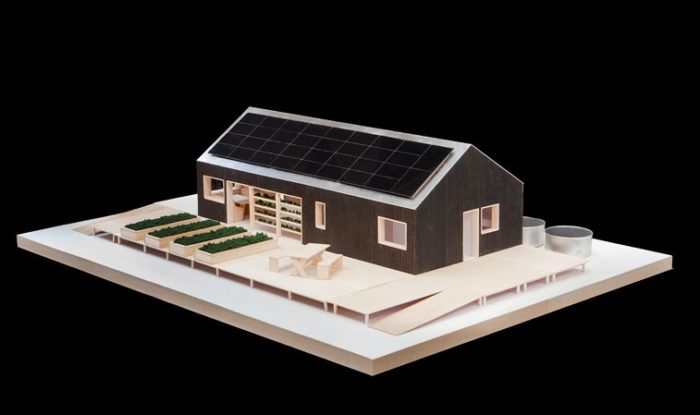
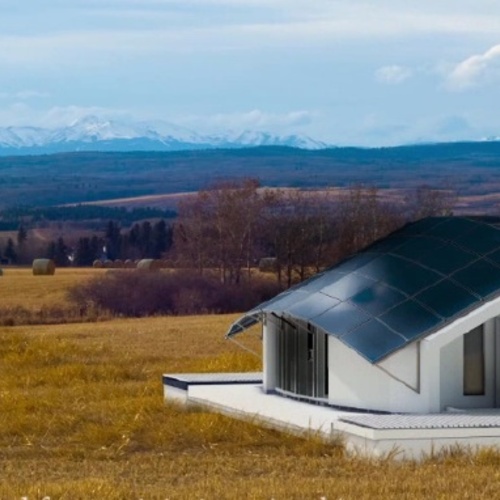
Image Credit: U.S. Department of Energy Solar Decathlon (image 1); Middlebury College (all other images)
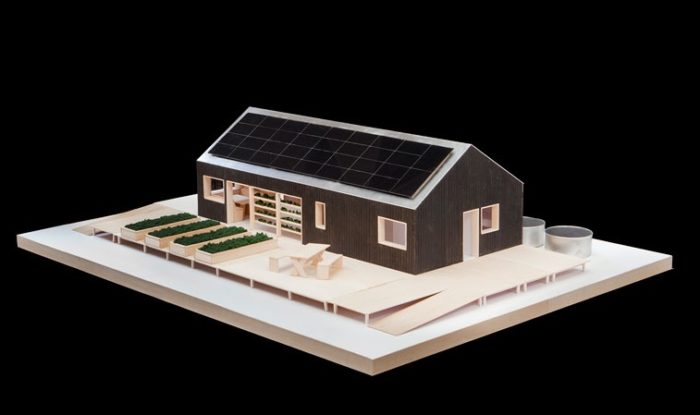
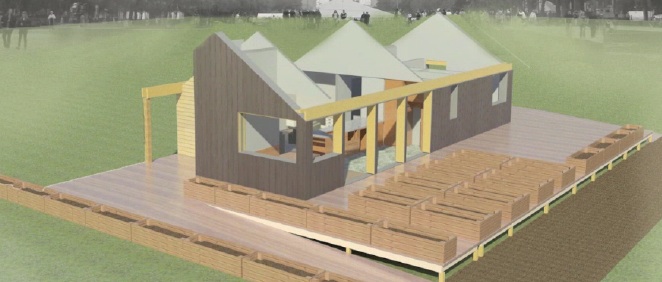
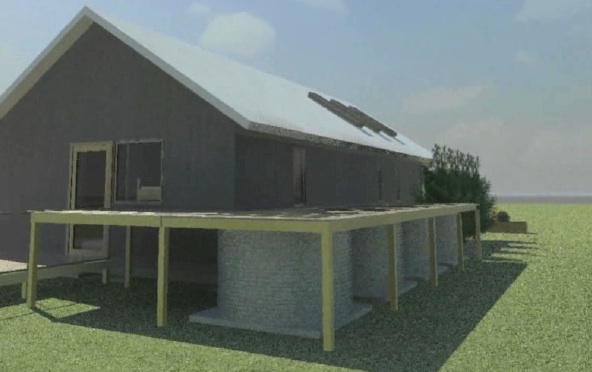
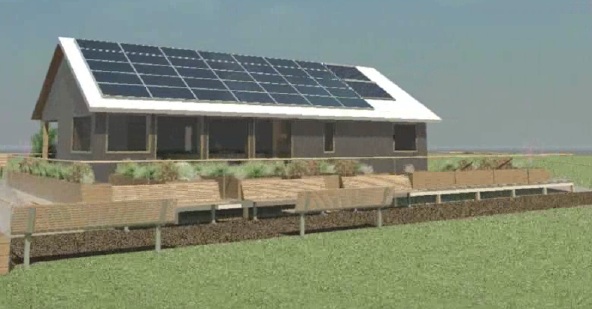
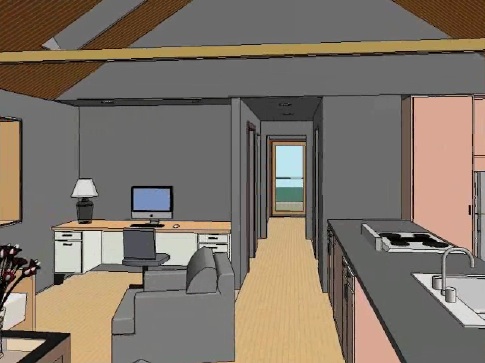
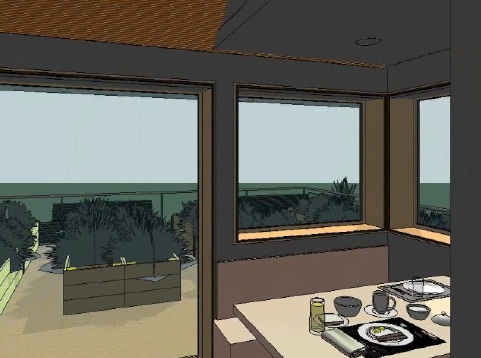
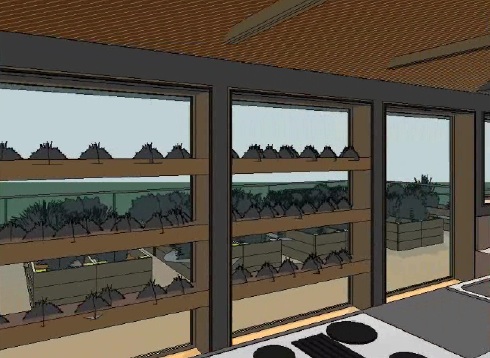
Image Credit: U.S. Department of Energy Solar Decathlon (image 1); Middlebury College (all other images) Self-Reliance features staggered-stud exterior walls with 11-in.-thick cavities and enough cellulose insulation to bring their thermal resistance to R-42. Four water tanks near the northeast corner of the house are designed to capture and store both potable and non-potable water. Benches and garden beds in front of the house create an extension of the public space. The interior’s public space is designed to make the home feel spacious. One corner of the living room area features a dining nook. Edible-garden planters line the triple-glazed windows on the south wall.
More 2011 Solar Decathlon


The individualist spirit that became Ralph Waldo Emerson’s calling card found a home at the 2011 Solar Decathlon when the team representing Middlebury College decided to name its entry Self-Reliance, after the title of one of Emerson’s most famous essays on the virtues and challenges of independent thought, originality, and action. Not surprisingly, the name is intended to be more than a tribute to one of New England’s best-known philosophers. The Middlebury team wants the project to bring Emersonian ideals to life. So while the building’s gable form is a common one in northern New England, and the project certainly conforms to Decathlon guidelines, the Middlebury team has been working hard to deliver a project that not only is comfortable, affordable, and energy efficient, but also ecologically fine-tuned to Vermont’s weather and natural resources.
Live at the International Builder’s Show
A classroom strategy … Construction of the house, expected to begin on the Middlebury campus by the end of March, will double as a technical affirmation of the design and a showcase for the surrounding community – a live demonstration of green building. Team members say they are developing lesson plans and interactive presentations designed to help students and teachers from the surrounding area understand green-building concepts and their implementation in Self-Reliance. “I think one of the things that we acknowledge as a team is that this entire project is going to be meaningless, totally useless, a complete waste if we don’t share it effectively with other people,” team member Abe Bendheim recently told the Addison County Independent. “The project centers on providing a real, sustainable solution that people can adopt and construct themselves. It’s about changing the way that residential infrastructure is constructed in the U.S., and part of that outreach is what we’re doing right now.” … and an environmental strategy With a footprint of about 990 sq. ft., Self-Reliance features staggered-stud exterior walls whose 11-in.-thick cavities are filled with cellulose insulation, bringing their thermal resistance to R-42. The decision to use cellulose over other insulation materials, notes Addison Godine, an architecture student and team member, meshes with the project’s environmental goals.
MIDDLEBURY SOLAR DECATHLON LINKS
Middlebury Solar Decathlon Web site News and Blog GBA’s Solar Decathlon Resource Guide
“Other insulation types, we found, don’t biodegrade in 500, 1,000, 2,000, 10,000 years,” Godine said in an interview with Fine Homebuildng’s Justin Fink at the International Builders’ Show in January. “Cellulose does. It returns to the earth’s natural cycles. So while it’s not the best insulator, we found that it is one of the most environmentally friendly insulation materials.” To help maximize solar gain, large triple-pane windows will be installed on the south-facing exterior wall of the home’s open living-room area. Each of the windows will be fitted with three tiers of edible-garden planters. The floors of the house, a video walkthrough of Self-Reliance explains, will be locally harvested maple. The floor plan is intended to accommodate a family of four, with a bedroom big enough for two children, a master bedroom with an exit to the deck that surrounds the exterior, a dining nook off the common area, and a main-entry area for depositing boots and jackets during cold and wet weather. Ceilings in the living area and bedrooms run to the roof, while the ceiling height in the rest of the home’s private area drops to provide the occupants with extra storage space, which will be accessible from the bedrooms. The outside area will include an arrangement of benches and plant beds, and, near the northeast corner of the house, four large water tanks designed to capture and store both potable and non-potable water. Once the Decathlon is over, Godine added, the house, which breaks down into eight pieces (two floor modules and six roof trusses) for transport, will return to the Middlebury campus, function as housing for students, and resume its role as a living lab for green building. For an overview of the Solar Decathlon teams, see GBA’s 2011 Solar Decathlon Resource Guide
Weekly Newsletter
Get building science and energy efficiency advice, plus special offers, in your inbox.

4 Comments
More info, please...
Richard,
Good project, I like the affordability component but I couldn't find any of the specs on their website. Do you have an estimate of $/sf? What mech. equipment will be used? Lighting? Appliances? Projected energy use? HERS rating and ACH goal?
ACH goal
Their blog mentions ERVs and passivhaus certified components. I'd imagine gunning for less than 0.6ACH50.
Regarding cost: max size is 1000sf and their fundraising goal is $500000. Is $500/SF affordable?
One of the things that I don't see is how this pushes any design or technology boundaries.
RE more info and the cost estimate
Hello Mr. Cobo and Mr. Eliason. Thank you for the article and further genuine interest.
.
.
My name is Erik Fendik and I am one of the Middlebury College Solar Decathlon Team members. I would like to inform you that the content on our website has been recently updated. It includes many interesting design features introducing the main ideas of architectural, technological and material choices. The appliances and other will be added later.
.
As far as the costs are concerned, the fundraising goal and thus the project budget includes many extra costs, for example external expertise from professional architects and engineers, logistics and transportation costs. Therefore the house is NOT going to be $500/SF. Something like that cannot be called affordable and we despise that previous Solar Decathlon designs allowed for promotion of ridiculous $700/SF designs. Our aim is to reproduce the house for roughly $250,000.00 but I do not know the most up to date cost estimate.
.
Please keep checking on our website for more information!
.
.
I hope this helps...
Regards, Erik Fendik.
.
.
.
http://solardecathlon.middlebury.edu
.
.
.
PS: The way we push both technological and design boundaries is not necessarily via creation of new elements, but rather through using the most appropriate ones which have been proven to work over time and are environmentally friendly.
.
For example, we found out that the 'best, most environmentally-friendly foam', a soy-based polyurethane, was a 90% petroleum product and would, long after the house's useful life, clog soil. That would stunt the growth of plants, thus damaging the ecosystem. Installing that foam requires a full suit, mask, respirator, etc. Cellulose, on the other hand, bio-degrades in a matter of months once it is exposed to the environment and it requires a minimum of personal protective equipment to install. Also, TJI and cellulose walls turn out to be cheaper that SIPs.
.
So to answer your question Mike, affordability would be the greatest boundary we are trying to break. We are trying to spread sustainable way of living to general public with average income. We see no point of creating expensive designs which cannot reach masses. You cannot call that 'sustainable'. That is unreasonable.
.
Self Reliance is about the choices we make. The choices of technology and materials used. In conclusion, we are not making a revolutionary change in presenting something completely new - we are making a revolutionary change in presenting a set of best choices already discovered, but not yet presented in context that Self Relince educates. Our house will be not only a model for new houses but also an inspiration for existing structures which shall undergo a renovation for improvements in performance and overall livability. We hope to have an impact on how we define pleasant and environmentally friendly living of 21st century.
;e)
Response from Team Self-Reliance
Hi and thank you for your comments! My name is Hilary Cunningham and I am writing on behalf of Team Middlebury.
Our $500,000 fundraising goal covers a lot more than the square footage of our house. There are other costs in our project, Self-Reliance, that include student wages, tools, educational outreach, drawing materials, computer programming etc., (So many details!). Our student cost estimating team has determined the cost of our house to be about $280 per square footage. This cost includes the deck and PV array that will be a part of our family home.
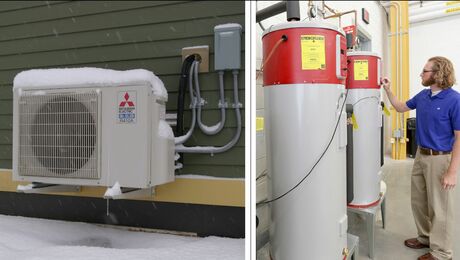
As far as pushing design & technology boundaries, our mechanical team, led by Chester Curme ’11, has determined the mechanical equipment that will be used in Self-Reliance. He and his team have chosen to use a Zehnder ERV (ComfoAir 200 model), a Mitsubishi Mr. Slim ducted heat pump, a vacuum tube solar hot water collector (from Solar US), and Sunpower 225 panels. All of these items are among the most energy-efficient materials on the market.
I hope this helps, and thank you for your interest in Self-Reliance. Keep asking questions—We appreciate your support! We are also very excited to say that our first wall will stand April 5th, (unless another Vermont Blizzard hits us as it did last week...)
Log in or create an account to post a comment.
Sign up Log in