Forced Air HVAC Systems
Keep Air Ducts Short, Direct, and Inside the Conditioned Space
Bird's Eye View
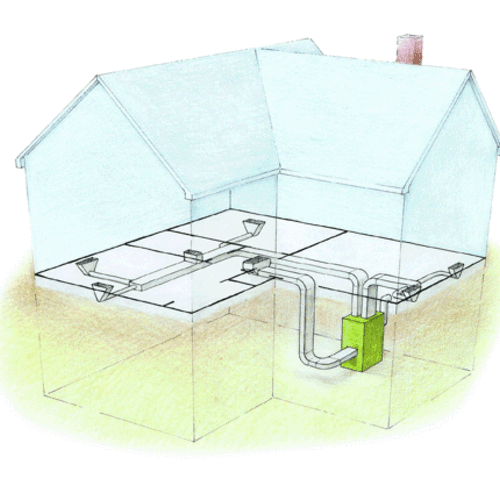
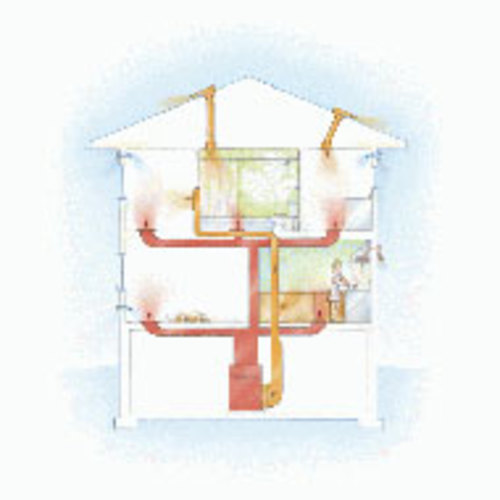
FOR TOP EFFICIENCY, forced-air ducts should be properly sized, leak-free, and located inside a home's conditioned space.
Forced-air systems are extremely versatile
The network of ducts that distributes air around the house can be used for heating, air conditioning, fresh air distribution, dehumidification, and air filtration.
Another plus: forced-air heat is usually cheaper than a hydronic system. Efficient forced-air systems are well designed and carefully installed.
See below for:
ABOUT DUCT LAYOUT
ABOUT DUCT SEALING
ABOUT DUCT TESTING
ABOUT BALANCED SYSTEMS
Key Materials

RIGID GALVANIZED STEEL DUCT is smooth inside and restricts air flow very little. It's important to secure all joints with sheet-metal screws and seal the seams with mastic.
Flex duct is not the best choice
Ducts can be made from galvanized steel, fiberglass duct board, or a flexible, non-metallic material (flex duct). Flex duct is easy to damage during installation, and of the available options it has the highest resistance to airflow so its not the best choice. If it is used, it should be installed so it’s not crushed or pinched. It should be well supported with hangers and as straight as possible so airflow is not impeded.
Design Notes
Don't let square footage determine duct size
A Florida study cited by the U.S. Department of Energy indicates an alarming number of contractors determine duct size solely by square footage of the house or other rules of thumb. In other words, they are flying by the seat of their pants. These systems will never be as efficient as ones designed by the book, and in fact can lead to oversized equipment that runs inefficiently and wastes energy.
Important duct design principles include:
To learn more, see "About Duct Layout," below.
Builder Tips
Kitchen soffits are a great place to hide ducts This keeps them inside the conditioned space while giving something for kitchen cabinets to butt up to. When building soffits, it's important to cover that section of the wall and ceiling with taped drywall to prevent unseen air leaks.
Put ducts in a kitchen soffit
Soffits that fill the space between kitchen upper cabinets and the ceiling are common in both new construction and remodels and are often used to conceal ducts.
Boxed-in soffits can be a design element.
When you can't squeeze ducts between floor joists, box in the ductwork and finish it like a beam, like the ceiling, or with some other treatment.
To ensure that ductwork is installed inside the conditioned spaceInsulated, air-sealed part of a building that is actively heated and/or cooled for occupant comfort. of the home, it's important to maintain the integrity of the home's air barrierBuilding assembly components that work as a system to restrict air flow through the building envelope. Air barriers may or may not act as a vapor barrier. The air barrier can be on the exterior, the interior of the assembly, or both.. The drywall on the ceiling and wall where the soffit will be installed must be hung and taped before the duct is installed or the soffit enclosure is built. Any penetrations through the drywall must be sealed with spray foam or caulk. This assures a clear separation between the walls and the ceiling which can save energy, improve IAQIndoor air quality. Healthfulness of an interior environment; IAQ is affected by such factors as moisture and mold, emissions of volatile organic compounds from paints and finishes, formaldehyde emissions from cabinets, and ventilation effectiveness., and limit the spread of fire.
To learn more, see "More About Duct Layout," below.
The Code
Careful duct sizing calculations are not optional
They are required by code. For example, section M1601.1 of the International Residential Code (IRCInternational Residential Code. The one- and two-family dwelling model building code copyrighted by the International Code Council. The IRC is meant to be a stand-alone code compatible with the three national building codes—the Building Officials and Code Administrators (BOCA) National code, the Southern Building Code Congress International (SBCCI) code and the International Conference of Building Officials (ICBO) code.) requires that "Duct systems serving heating, cooling and ventilation equipment shall be fabricated in accordance with the provisions of this section and ACCA Manual D or other approved methods."
More duct system requirements can be found in Chapter 16 of the IRC.
Duct sealing requirements
The IRC requires all duct seams to be sealed against leakage. These requirements can be found in section N1103.2.2 ("Ducts, air handlers, filter boxes and building cavities used as ducts shall be sealed") and section M1601.3.1 ("Joints of duct systems shall be made substantially airtight by means of tapes, mastics, gasketing or other approved closure systems").
According to section N1103.2.3, "Building framing cavities shall not be used as supply ducts."
Pressure-balancing requirements
Florida was the first state in the country to require new homes with forced-air HVAC(Heating, ventilation, and air conditioning). Collectively, the mechanical systems that heat, ventilate, and cool a building. systems to meet pressure-balancing requirements between rooms. Section 601.4 of the Florida Building Code, which took effect on March 1, 2002, specifies that the pressure difference between the common central space and any room with a closed door except bathrooms and laundry rooms shall be nor more than 2.5 Pascals.
ABOUT FORCED AIR
An affordable choice
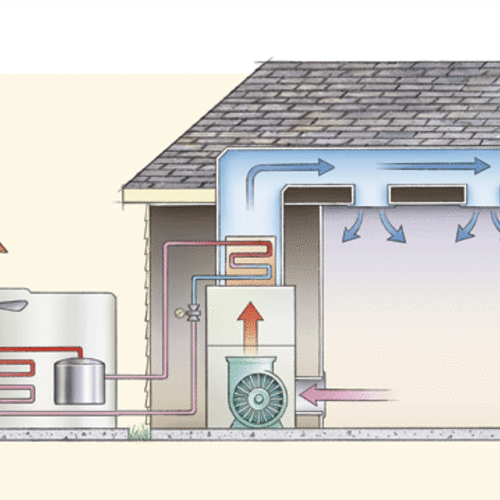
Air can be warmed in a variety of ways — with a hydronic coil from a geothermal heat pumpHeating and cooling system in which specialized refrigerant fluid in a sealed system is alternately evaporated and condensed, changing its state from liquid to vapor by altering its pressure; this phase change allows heat to be transferred into or out of the house. See air-source heat pump and ground-source heat pump. or water heater, by electric resistance coils, by an air-to-air heat pump, or by a furnace that burns natural gas, propane, fuel oil, or firewood. This versatility, along with lower installation costs, makes warm-air furnaces the most common type of heating system in the U.S.
Some homeowners avoid forced-air systems, fearing they will be noisy, create uncomfortable drafts, or spread dust throughout the house. But a well designed and properly installed system should do none of those things.
Ductwork should be part of home design
The key to an efficient system, and a comfortable house, is careful duct design and installation. The two most common problems are routing ducts through an unconditioned space, such as an unheated attic or crawl space, and failing to provide a return-air pathway from each conditioned room to the furnace or air handler. Poorly designed ductwork can result in pressure imbalances within the building envelopeExterior components of a house that provide protection from colder (and warmer) outdoor temperatures and precipitation; includes the house foundation, framed exterior walls, roof or ceiling, and insulation, and air sealing materials., making the house uncomfortable and contributing to moisture problems and high energy bills. Sealing ductwork to prevent air leaks is essential.

ABOUT DUCT LAYOUT
Efficient duct systems are compact
Ducts that run in unconditioned spaces significantly erode performance and waste money. Duct sizes should be the result of careful calculations, not guesswork or rules of thumb. Some basics of good design:
Design by the book. Guides published by the Air Conditioning Contractors of America (ACCA) should be the foundation for sizing ducts. No contractor should specify a system without using the ACCA’s Manual J, which calculates heating and cooling loads, and Manual D, which tells the contractor how to size the ducts. (For more information on this topic, see Saving Energy With Manual J and Manual D.)
A Florida study cited by the U.S. Department of Energy indicates an alarming number of contractors determine duct size solely by square footage of the house or other rules of thumb. In other words, they are flying by the seat of their pants. These systems will never be as efficient as ones designed by the book, and in fact can lead to oversized equipment that runs inefficiently and wastes energy.
Design early. Duct layout depends on floor and wall framing, the location of drop ceilings, the type of insulation installed in an attic or crawl space, and a variety of other design and construction details. The most efficient and most economical systems are likely to be those incorporated into overall house plans early in the game, when there’s still time for the builder, architect, and HVAC(Heating, ventilation, and air conditioning). Collectively, the mechanical systems that heat, ventilate, and cool a building. contractor to collaborate.
Keep supply ducts short and straight. Centrally located air handlers allow supply and returns to be as short as possible, minimizing energy losses and reducing the number of joints that are potential leaks. Ducts with lots of twists and turns slow down airflow, increasing energy losses and lowering the performance of the HVAC system. Tight, well insulated building envelopes with triple-glazed windows allow registers to be located on interior walls with no loss of comfort. Locating registers on interior walls can dramatically shorten duct lengths.
Keep ducts in conditioned spaces. It makes little sense to install ductwork with R-6 insulation in an attic. During the summer, when the air conditioner is struggling to cool the house, the attic temperature will usually be significantly higher than the outdoor temperature, making the system work that much harder. Leaky ductwork makes the problem worse and contributes to a variety of air quality problems.
Ducts and air handlers are best located in areas that are heated and cooled just like the rest of the house. Don't put ducts in exterior walls. That reduces the amount of insulation that can be placed in the wall cavity, and increases the risk of condensation.
Provide a return-air pathway from every conditioned room. The best forced-air systems include a return-air grille connected to return-air ductwork in every conditioned room. If the budget is too tight to allow this option, every bedroom will need a transfer grille or jumper duct connecting the bedroom with a room containing a return-air grille.
Use ducts, not building cavities.
Some builders have used joist bays or other building cavities as supplies or returns. Since these areas are very difficult to seal properly, the use of panned joist bays in supply air systems is no longer allowed by building codes.
ABOUT DUCT SEALING
Leaky ducts do more than waste energy
Supply and return ducts are assembled on site from many individual pieces, and each connection is a potential air leak. Leaky ducts create a number of potentially serious problems in addition to wasting energy dollars. Unhealthy air from an attic or crawl space can be sucked into the system and distributed around the house. Leaks also can contribute to the growth of mold and mildew.
Some HVAC(Heating, ventilation, and air conditioning). Collectively, the mechanical systems that heat, ventilate, and cool a building. contractors argue it's impossible to seal ducts completely, but that attitude arises out of habit rather than logic. After all, plumbers have been installing leak-free pipes for decades. Duct manufacturers are beginning to address duct leakage by marketing new products with sealed seams. Examples include GreenSeam duct from Ductmate (East Monongahela, PA), Green Label duct fittings from Seal-Tite (Hillsboro, OH), and SpirAmir duct from SpirAmir (Dublin, CA).
For detailed duct-sealing instructions, see “Duct Tape and Mastic.”
Mastic. The best material to use for sealing ducts is mastic. Mastic is a gooey, non-hardening material with the consistency of smooth peanut butter. It is spread over duct seams with a paintbrush, trowel, or gloved fingers. Gaps in ductwork or plenums that are over 1/8 in. wide can be sealed with mastic as long as the gap is first reinforced with fiberglass mesh. Sections of galvanized duct should always be joined with sheetmetal screws before seams are sealed with mastic.
Better duct tapes. Although it's widely agreed that the best product for sealing duct seams is mastic, some HVAC installers find it convenient to seal some duct seams with tape. By now, everyone knows that gray hardware-store duct tape fails quickly and should never be installed on ducts. There are three categories of tapes worth considering:
Oriented polypropylene (OPP) tape is a smooth film-backed tape that resembles packing tape. Some brands have a shiny "metallized" plastic finish. Duct joints sealed with OPP should also be clamped. Three brands of OPP duct tape are Intertape Polymer Group's AC698 tape, Shurtape Technologies' DC-181 tape, and Venture Tape's 1599B tape.
Aluminum foil duct tape with acrylic adhesive performed well in test conducted by Lawrence Berkeley National Labortory (LBNL). Brands include Fasson 0800, Fasson 0810, Ideal Seal 587A/B, Shurtape AF100, Tyco Polyken 337, and Venture 1581.
Foil-backed butyl tape is expensive but performs well, according to LBNL testing. A well-known brand is Hardcast Foil-Grip 1402-181BFX.
Duct tightness specifications. Specifications for a forced-air system should include a duct tightness specification. The specification usually requires Duct BlasterCalibrated air-flow measurement system developed to test the airtightness of forced-air duct systems. All outlets for the duct system, except for the one attached to the duct blaster, are sealed off and the system is either pressurized or depressurized; the work needed by the fan to maintain a given pressure difference provides a measure of duct leakage. testing after the duct seams have been sealed with mastic.
One typical specification reads, "Ductwork should be sealed tightly with mastic and pass a level of duct tightness of no more than 5% of the floor area @ 25 Pa. For example, a 1,000-square-foot house can have no more than 50 cfm of leakage."
Another specification reads, "Duct leakage shall not exceed 5% [or 7%, or 10%] of high-speed fan flow."
ABOUT DUCT TESTING
The only way to verify that a duct system is tight is to test the duct system with a duct blower. The 2009 International Residential Code requires all residential duct systems except those located completely within a home's thermal envelope to be tested for tightness.
For more information about measuring duct leakage, see “Duct Leakage Testing.”
ABOUT BALANCED SYSTEMS
Provide a pathway for replacement air
Many forced-air distribution systems create unwanted pressure imbalances within the building envelopeExterior components of a house that provide protection from colder (and warmer) outdoor temperatures and precipitation; includes the house foundation, framed exterior walls, roof or ceiling, and insulation, and air sealing materials. — higher air pressure in some parts of the house, low air pressure in others. This problem can be minimized by providing adequate return ducts to move air back to the air handler or furnace. (For more information, see "Return-Air Problems.")
There are two general types of return systems: a central return, which serves a limited number of rooms, or individual room returns, which are designed to return air from each conditioned room.
Individual air returns are usually quieter and do a better job of minimizing pressure imbalances. But they are also more expensive to install, and they may require a larger blower motor in the air handler to overcome the increased friction of air moving through a larger number of ducts.
Central air returns can be effective, as long as provisions have been made for a free flow of air from each conditioned room to the central return. Leaving a healthy gap beneath interior doors isn’t enough to accomplish this, so transfer grilles or jumper ducts are required.
For a forced-air system to work efficiently, return ducts must be able to move the same volume of air as the supply ducts. The pressure differential between the common central space and any conditioned room with a closed door should be no more than 2.5 Pascals. When a return register can't be provided in every conditioned room, jumper ducts or transfer grilles are good alternatives.
Jumper ducts (also called crossover ducts) connect a bedroom grille with a grille in a common area. As long as there are no doors between the common area and the centrally located return air grille, the jumper duct helps equalize the pressure between the bedroom and the common area. Jumper ducts range in size from 6 inches to 10 inches in diameter.
Transfer grilles generally connect two back-to-back wall-mounted grilles in adjacent rooms. One side of the transfer grille is installed in a bedroom wall, for example, with the other side in a hallway.
Transfer grilles do the same thing as jumper ducts, but without the ductwork. They can incorporate baffles to muffle sound and provide privacy. Site-built transfer grilles, however, are often undersized. A good rule of thumb is to make the grille so it has between 70 and 100 square inches of free area for every 100 cubic feet per minute of supply air that's ducted to the room.
Tamarack Technologies (West Wareham, MA) sells a well designed transfer grille called the Zenon.
Avoid halfway measures. The strategy of undercutting a bedroom door is inadequate, since a gap of 1 inch between the finish floor and a 30-inch-wide door can handle only 47 cfm of return air at a maximum pressure differential of 2.5 Pascals — adequate for only a tiny room measuring about 75 square feet.
Designers should also be cautious about using a stud bay as a duct connecting a high grille in a bedroom wall with a low grille in an adjacent hallway, since a 3 1/2 inch by 15 inch stud cavity can handle only 52 cfm of return air.
Unbalanced HVAC(Heating, ventilation, and air conditioning). Collectively, the mechanical systems that heat, ventilate, and cool a building. systems make a house uncomfortable. Rooms with undersized returns become pressurized, forcing air into wall and ceiling cavities. During the winter, warm interior air can carry moisture into the walls where it condenses on cooler surfaces. This may lead to the growth of mold. A room with a large return-air grille but an inadequate supply-air register can become depressurized, drawing outside air into building cavities.
These problems can be avoided when the volume of air supplied by the furnace is balanced by an equal volume of air being drawn into the return ductwork.
FURTHER RESOURCES
Sizing jumper ducts:
HVAC System Pressure Relief by Paul h. Raymer and Neil Moyer.
Duct sealing retrofit:
Carrier Aeroseal, P.O. Box 4802, Syracuse, NY 13221
Ceiling design elements:
Rooms without Walls by Sarah Susanka
Best Practices Guide for Residential HVAC Retrofits
Related Topics in the Green Building Encyclopedia
Image Credits:
- Christopher Clapp / Fine Homebuilding 107
- Krysta Doerfler / Fine Homebuilding
- Fine Homebuilding 120


Google
Yahoo
Technorati
Facebook
Reddit
Delicious
Digg
StumbleUpon