ABOUT WINDOWS
Choose frames and glazing for energy performance
Windows are among the most complex building components in a house, and at several hundred dollars or more apiece, also among the most expensive. In addition to the important architectural contribution they make, windows have far-reaching energy consequences. Their number, total area, and orientation to the sun can make or break the energy efficiency of a high-performance home.
Window frames do more than hold the glass in place and allow the window to open and close. They are an important part of a window’s overall thermal performance, and the type of frame helps dictate how much maintenance the window will need over its lifetime. Frame materials include wood, fiberglass, vinyl, aluminum, and both vinyl- and aluminum-clad substrates.
Glazing and frame performance are important, but so is the spacer
As the thermal performance of the frame and glazing improves, the performance of the spacer (with thermal effects that can extend out up to more than 2 inches into the glazing) becomes more important. And spacer performance is important in controlling condensation as well. Look to all three elements of a window for high performance.
ABOUT WINDOW MATERIALS
Wood windows require periodic maintenance
Until World War II, almost all residential windows were made from wood. Older wood windows were usually made from rot-resistant wood — often heartwood from slow-growing trees. Wood windows can last for decades, especially if they are protected from the weather and regularly painted. Some newer wood windows, however, are made from materials that rot faster, such as finger-jointed pine.
If your heart is set on wood windows, it’s probably best to choose those that have an vinyl or aluminum cladding. (Once a window has been protected with aluminum cladding, it’s sometimes hard to tell what the sash or frame is made of. While most aluminum-clad windows are actually made of wood, new composite materials sometimes hide behind aluminum or vinyl cladding. When in doubt, ask the manufacturer.)
If you don’t like the look of exterior cladding, design a home with generous roof overhangs and be prepared for a regular maintenance schedule that includes scraping and painting.
Rot-resistant alternatives to wood
In recent decades, window manufacturers have begun using more rot-resistant materials, including aluminum, vinyl, pultruded fiberglass, or some combination of these materials.
Fiberglass and aluminum are likely to be the most durable choices. From an energy perspective, fiberglass is far preferable to aluminum.
Aluminum windows are highly conductive; since they don’t insulate as well as vinyl, wood, or fiberglass frames, they are rarely appropriate for an energy-efficient house. (Remember, just because a window has aluminum cladding doesn’t mean that the window has aluminum frames. In most cases, aluminum-clad windows are made of wood.)
Foam-filled fiberglass frames perform better than other materials. Foam-filled vinyl frames are a close second, followed by wood frames. Some manufacturers offer composite frames made from a variety of materials; if these include a thermal break, they can perform well.
ABOUT WINDOW GLASS
Single glazing is a very poor insulator, with an R-value of about 1 (equivalent to U-1). Increasing the number of panes in a window improves the insulating value of the window, so clear double glazing has an R-value of about 2 (equivalent to U-0.5), and clear triple glazing has an R-value of about 3 (equivalent to U-0.33). The values for double or triple glazing can be further improved by including one or two low-e coatings and an inert gas fill between the panes. The best double-glazed windows have a whole-window U-factor of about 0.27, while the best triple-glazed windows have a whole-window U-factor of about 0.17. Triple glazing has been the standard for residential building in Sweden for many years and recently became mandatory in Germany. (For more information on glazing, see “All About Glazing Options.”)
With the possible exception of Hawaii, windows installed in any U.S. state should always have at least double glazing. Triple glazing costs significantly more and only makes sense for colder climates unless a house is facing a very noisy location and needs acoustic isolation.
In addition to saving energy and reducing noise transmission, triple-glazed windows increase comfort by raising the temperature of a room’s coldest surfaces in winter. When windows are warmer, the body radiates less heat toward them and feels more comfortable.
Canadian manufacturers are more likely to offer triple glazing than their American counterparts, but more and more U.S. window manufacturers are joining in:
- Alpen Windows (Serious Energy)
- Alside
- Comfort Line
- Great Lakes Windows
- Marvin Windows
- Paramount Windows
- Schuco USA
- Vinyl Kraft
- Weather Shield
- For more information, see “Choosing Triple-Glazed Windows.”Inert gas fills. In the 1960s and 1970s, most double-glazed, sealed and insulated glazing units had air between the panes. Such units are now called “clear double glazing.” Substituting a less conductive, more viscous gas like argon or krypton for the air between the panes results in better thermal performance (a lower U-factor), and argon- or krypton-filled glazing units are now standard in colder areas of the U.S.The optimal space between the panes of argon-filled glazing units is 1/2 inch. Increasing or decreasing the thickness of this space degrades performance. For krypton, the optimal space is thinner — only 3/8 inch — so krypton, the more expensive gas, is usually reserved for applications where total glazing unit thickness must be minimized.
Low-e glazing. A low-e coating is a thin, nearly invisible metallic coating on glass that lowers the emissivity of the glass. The effect of the coating is to lower a window’s U-factor, improving its performance as a thermal insulator. Low-e windows make sense in every U.S. climate, and the cost of upgrading a window to low-e glazing is a cost-effective, energy-saving investment from Florida to California to Alaska to Maine.
There are at least two major categories of low-e coatings: soft-coat low-e (also known as vacuum-deposition or sputtered low-e) and hard-coat low-e (also known as pyrolytic low-e). Within each category, different formulations are possible. Spectrally selective low-e coatings are formulated to achieve a low SHGC.
Which type of low-e coating has been applied by the glazing manufacturer is not important as long as the window’s NFRC label verifies that the window’s U-factor and SHGC are appropriate for the window’s purpose.
A low-e window designed for the south wall of a passive solar house should have a low U-factor coupled with a high SHGC. As long as you shop “by the numbers,” you’ll get the window you need.
Window films. Several manufacturers sell window films that can be applied to the inside of an existing window pane. Because their main purpose is to reduce solar heat gain, they are used mostly in warmer areas where air conditioning is a major expense.
Window films are unlikely to endure for the life of the window. Typical warranties last for five years.
Although window films can be a useful strategy to address a problem in an existing house, they are unnecessary in new construction. New windows can be ordered with low-solar-gain glazing, negating the need for a retrofit film.
ABOUT WINDOW RATINGS
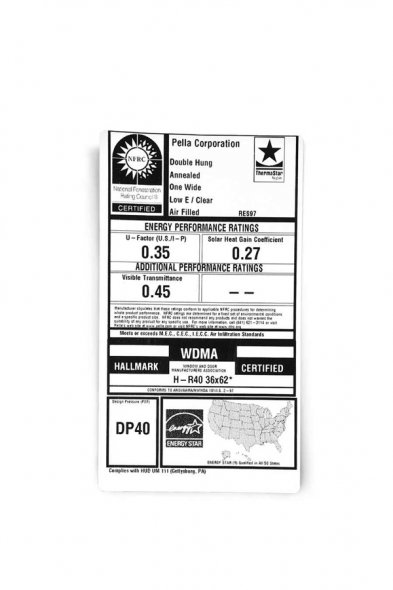
There is no one-size-fits-all standard for choosing the glass, or glazing, in windows. The most appropriate glass for a house in the Southwest won’t be the best choice for a house in Maine. Glass on a home’s north side should have different characteristics than south-facing glass. Tuning glass for specific applications is an important part of passive solar design.
The National Fenestration Rating Council (NFRC) rates windows on three criteria: U-factor, SHGC, and visual transmittance (VT). Look for the NFRC label on rated windows (www.nfrc.org).
U-factor measures how much heat is transmitted through the glass. The U-factor is the inverse of R-value. The lower the U-factor, the more efficiently the glass blocks the passage of heat. In all climates, windows with a low U-factor perform better than windows with a high U-factor. The EPA’s Energy Star guidelines vary by region. In northern climates, an Energy Star–rated window must have a maximum U-factor of 0.35, the equivalent of an R-2.8 insulated wall.

Solar heat gain coefficient (SHGC) is the fraction of solar radiation admitted through a window, expressed as a number between 0 and 1. Lower numbers mean less of the sun’s heat is transmitted through the glass. The lower the SHGC, the greater the shading ability of the glazing.
Visual transmittance (VT) is the fraction of visible light energy that makes it through the window glass. The higher the fraction, the more visible light will reach into the room. Maximizing VT while getting the right combination of U-factor and SHGC, particularly with low-e coatings, can be challenging. All three properties must be considered and balanced to evaluate window performance.
NFRC ratings for U-factor and SHGC are whole-window ratings, not glass-only ratings.
ABOUT CHOOSING WINDOWS
Shop for your specific climate
Specifying glazing can be daunting. But a few principles will steer you in the right direction.
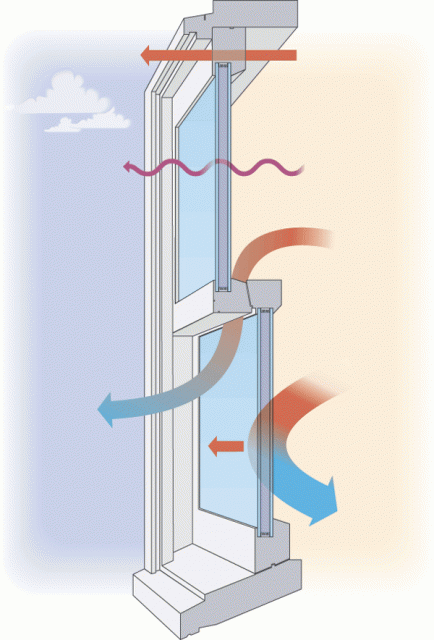
In all climates, windows with a low U-factor perform better than windows with a high U-factor. The Energy Star window program has set a low bar for cold-climate windows. To obtain an Energy Star label, these windows must have a maximum U-factor of 0.35. But windows with dramatically better performance are commercially available. Thermotech Windows (www.thermotechwindows.com) sells triple-glazed casement windows with a U-factor of 0.17.
High-performance windows exceed Energy Star
Builders of energy-efficient homes should look for lower U-factors than Energy Star maximum values, ideally in the teens or twenties. Increasingly, designers of cold-climate homes are improving window U-factors by switching from double glazing to triple glazing.
Different windows for different walls
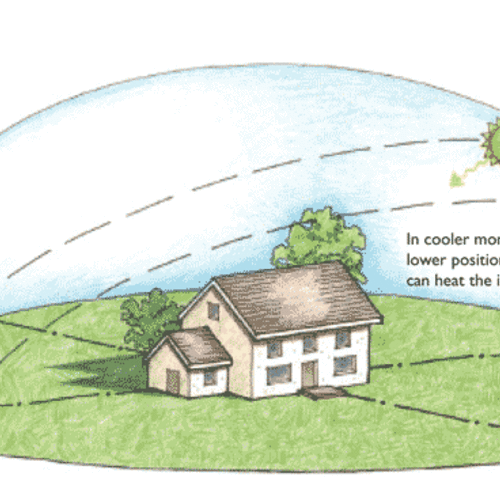
Designers of passive solar homes need to specify orientation-specific glazing. In a colder or less mild climate, south-facing windows need high-solar-gain glazing, while west-facing windows need low-solar-gain glazing. The SHGC of north windows doesn’t matter much. When it comes to east windows, climate determines which type of glazing makes sense. In regions of North America where air conditioning is rarely used, high-solar-gain glazing is probably a good choice for east windows, since solar heat is welcome on cool mornings. In warmer regions, east windows, which like west windows are hard to shade, should probably have low-solar-gain glazing.
Protect south-facing windows with a roof overhang designed to shade them in summer while allowing the winter sun to enter the house.
In a warmer areas, choosing glazing with an extremely low SHGC — especially for east and west windows — will significantly lower air-conditioning loads. Look for windows with SHGCs that are significantly lower than the Energy Star standard of 0.40.
Cold-climate builders should specify insulated glazing with warm-edge spacers
Glazing spacers are visible at the perimeter of double-glazing units; they maintain the necessary distance between the panes and provide the edge seal. Traditional aluminum edge spacers are the weak thermal link in most double-glazing units. Glazing spacers with a thermal break are called warm-edge spacers, but these cost a little more than basic aluminum spacers and so aren’t used by many window manufacturers.
Manufacturers of warm-edge spacers include BayForm, which makes the Thermal Edge spacer; Cardinal, which makes the XL Edge spacer; Edgetech, which makes the Super Spacer; Inex Spacer Industries; PPG, which makes the Intercept spacer; and Truseal Technologies, which makes the Swiggle Seal spacer.
Anyone who is ordering windows should be able to verify the type of glazing spacer used by consulting a representative from the window manufacturer or glazing supplier.
FURTHER RESOURCES
Efficient Window Collaborative:
Window Selection Tool that compares the potential energy savings by performance characteristic in different parts of the country. Also, extensive background information on window design.
National Renewable Energy Laboratory:
“Passive Solar Design for the Home”
Book: Residential Windows: A Guide to New Technology and Energy Performance, 3rd Edition, Carmody et al )
Buildingscience.com
Singing the “blues” in the key of “low-e”
National Park Service:
Green Building Advisor:
Choosing Triple-Glazed Windows
Installing Windows In a Foam-Sheathed Wall
Windows That Perform Better Than Walls
Bird’s-Eye View

Image Credits: Jefferson Kolle/Inspired House
Windows must be installed and sealed properly
Windows can make a major contribution to energy conservation and comfort. Today’s windows are available in a wide range of materials. Glazing choices affect how much light they transmit, how much of the sun’s heat they allow in interior spaces, and how well they prevent the flow of heat. Modern doors offer similar choices in construction and performance. But a high-tech window or door won’t give you what you paid for if it isn’t installed properly.
See below for:
Key Materials

Image Credits: Joseph Kugielsky/Fine Homebuilding #166
A window needs a durable frame and appropriate glazing
Frames and sash. Pultruded fiberglass and aluminum are both rot-resistant materials that stand up to the elements better than wood. But because aluminum conducts heat freely, it is a poor choice for sash and window frames. Like fiberglass and aluminum, vinyl is a rot-resistant material; however, many green builders avoid using it because of the environmental issues raised by the manufacture of PVC. Vinyl is probably less resistant to damage by ultraviolet light than fiberglass. To learn more, see “About Frames and Sash” below.
Glazing. Almost all new windows installed in the U.S. include double glazing, but it varies widely in performance. Some types have a relatively high insulating value, while others leak heat readily. Similarly, some allow a high percentage of the sun’s heat into the house, while others don’t. In colder areas, triple-glazed windows will help keep the indoors comfortable and lower energy bills. To learn more, see “About Window Glazing” below.
Design Notes

Image Credits: Brian Pontolilo/Fine Homebuilding
It can be a challenge to balance durability, performance and looks
The best energy performers in the spectrum of window- frame materials are foam-filled fiberglass and foam-filled vinyl, followed by wood. However, the slender aesthetic of aluminum appeals to many designers, provoking a conflict between thermal performance and looks. Some designers choose thermally broken aluminum frames, which perform better than aluminum frames without thermal breaks. Fiberglass muntins are very close in width to metal ones.
The vinyl window debate. Designers of affordable housing often face the PVC conundrum: Vinyl windows perform well thermally and are inexpensive, but they are frowned upon by the green building community because of the issues associated with PVC production. Unfortunately, there are no easy (or inexpensive) solutions to this challenge.
The aesthetic of wood windows is perennially popular. The only drawbacks are maintenance and – if maintenance is neglected, as it frequently is – durability. Wood windows, particularly in severe climates or sunny exposures, need to be repainted every few years or they will deteriorate rapidly. Clad windows – that is, wood windows that are wrapped on the exterior with vinyl or metal (usually steel or aluminum, less frequently bronze) are the answer. They are more expensive than non-clad wood windows, but the additional investment will pay off in reduced maintenance costs. A variation on this theme is a vinyl or fiberglass window frame that is clad with wood on the inside.
Casements are better than sliders. Windows are available in a variety of styles, including double-hung, single-hung, horizontal sliders, and casements. Casement windows should be the first choice for an energy-efficient home. Because the cam lock on a casement window pulls the sash tightly against the weatherstripping, a well-built casement will have less air leakage than the best available double-hung window.
Specify different window sizes for different orientations. In an energy-efficient home, it’s common to specify different glazing for different orientations. One drawback to orientation-specific glazing is that it’s possible for window installers to accidentally put a south window on the north side of the house. To prevent this error, a designer can specify differently sized windows depending on the orientation. Builders can’t install the wrong window if it doesn’t fit in the rough opening.
Builder Tips
Durable Window Installation Means Letting the Water Drain out
Rule #1 is to keep as much water out as possible. Rule #2 is to let the leaks drain out.
Well-flashed window heads are the first line of defense.
Sloped sills, backdams and pan flashing direct water out.
There are many choices in sill pan flashing; in this video, Mike Guertin shows how to install flexible peel-and-stick pan flashing.
The Code
Read the code, then the instructions
IRC provisions related to flashing and installation of windows and exterior glass doors can be found in Section 613. All windows and doors must be installed according to manufacturers’ instructions and be tested, labeled and installed to meet the design wind loads specified in Table 301.2(4).
Bedroom egress windows must be within 44 inches of the floor and have an operable portion at least 20 inches wide and 24 inches high (310.1.2, 310.1.3) with a net opening of at least 5.7 square feet (310.1.1). Egress windows with grade-level access can have a net opening of 5.0 square feet (310.1.1X).
Operating windows that are more than 6 feet above grade must be installed a minimum of 24 inches above the finished floor or be protected by window guards meeting ASTM F2006 or F2090 (613.2). Window guards must open or be removable from inside the room without keys, tools, or special knowledge (310.4).
Window performance is covered in section 1101.5. Windows and doors lacking a U-factor or solar heat gain coefficient (SHGC) rating from an accredited independent laboratory should be assigned the default values in tables 1101.5(1) and 1105(3), respectively. A climate zone map used for fenestration requirements can be found in Table and Figure 1101.2.
##OTHER CONSIDERATIONS
Window replacement isn’t the best place to start in energy upgrades. When planning energy improvements to an existing house, replacing windows should show up toward the bottom of the list. It almost always makes sense to improve an existing home’s air tightness and add insulation to the attic and basement. Replacing an old furnace or refrigerator can also be cost-effective. But if the windows work well, it’s usually best to put replacing windows lower on the list. In a cold climate, the best way to improve single-glazed windows is to install exterior storm windows with low-e glass.
PAN FLASHING OPTIONS
How you install windows is even more important than which ones you buy. Allowing water that leaks in to drain out is central to durable window installations.
For more information on this topic, see Installing Windows In a Foam-Sheathed Wall.
GBA has published an 8-part video series on methods for flashing windows. Here is a link to the first episode in the series: Window Sills That Won’t Rot.
GREEN TRADE-OFFS
The best-looking windows don’t always perform the best
Because the edge spacers separating the panes of double-pane windows are usually made of aluminum, they don’t perform nearly as well as the gas fill between the panes of glass. Windows with true divided lights look the most like old-fashioned double-hung windows, but they leak more heat than windows with undivided panes.
Windows with warm-edge spacers perform better than windows with aluminum spacers. The best windows for performance are casement-style windows with warm-edge spacers and no divided lights.
The best-performing windows don’t always look the best
Not all low-e coatings are created equal. They each distort the proportions of different visible wavelengths making it through the glass resulting in some windows looking “blue” or “red.” This can make wall colors appear slightly different than intended on the interior or give the windows a hue or tinted reflection on the exterior. People really vary in their sensitivity to this effect so the best thing to do is to have your customers tune into the issue BEFORE they select and you order the window package. For more information on this topic, see FURTHER RESOURCES.
COMPARE WARRANTIES
Most new windows perform well, and warranty claims are rare. But because warranty coverage varies among manufacturers, it makes sense to read the fine print.
Many window makers have experienced premature failures in the past few decades, however rare. Even major manufacturers have had problems with rot, distorted casement sashes, and condensation between the panes of insulated glazing units.
When selecting windows, it’s always wise to compare warranties. The bigger the manufacturer and the better the warranty, the greater the chance that a manufacturer will stand behind its products and resolve disputes. Most big window manufacturers warrant window glass for 10 years and the frames and hardware for 20.
HISTORIC WINDOW REPLACEMENT ISN’T AN OXYMORON
Many window manufacturers offer historic retrofits (as illustrated in this display by Marvin Windows) that will be more likely to pass the historic commission’s review panel.

Andersen’s Woodwright series of replacement windows features wood jamb liners and traditional sash details that blend gracefully into a historic house.
THE RIGHT GLAZING CAN BE HARD TO FIND
In the U.S., it is much easier to buy low-solar-gain glazing than high-solar-gain glazing. Although high-solar-gain, low-e glazing is available from all major manufacturers of insulated glazing, U.S. window makers rarely offer it. The reason is simple: It’s easier for window manufacturers to stock and sell windows with one kind of glazing from Canada to the Mexican border than to offer glazing choices. Most low-e windows sold in the U.S. have a low SHGC, in the range of 0.27 to 0.35.
Designers of passive solar homes should allow adequate lead times for special-order glazing for south windows.
Good choices for south-facing glazing include the following types of low-e double glazing:
- Cardinal LoE-178 #2 (0.59 SHGC)
- Cardinal LoE-178 #3 (0.63 SHGC)
- Pilkington Energy Advantage (0.73 SHGC)
- PPG Sungate 500 (0.71 SHGC)
- Heat Mirror 88 (0.58 SHGC)
Ask your window rep which types of low-e glazing are offered.
HIGH-PERFORMANCE COLD-CLIMATE WINDOWS
The best performing cold-climate windows are manufactured in Europe, although some energy experts maintain that Canadian fiberglass-frame windows with triple-glazing can match the performance of the best European windows.
High-performance windows are particularly important for Passivhaus builders. In the U.S., some Passivhaus builders insist on using German windows. At least four brands of German windows — Internorm, Optiwin, Pazen, and Unilux — are now being distributed in the U.S. and Canada.
More information on German windows and Passivhaus window standards can be found in a GBA article, “Passivhaus Windows.”
GOOD COLD-CLIMATE WINDOWS PERFORM BETTER THAN WALLS
Although many designers still consider windows to be “energy holes,” it’s actually possible for triple-glazed cold-climate windows to gain more energy than they lose.
To learn more, see “Windows That Perform Better Than Walls.”
WHAT ABOUT SKYLIGHTS?
The GBA Encyclopedia addresses skylights and roof windows in a separate article, “Skylights.”
GREEN POINTS:
LEED for Homes Window choice influences thermal performance, potentially affecting 3 to 5 points in EA1 (Energy & Atmosphere), EA2, and/or EA3.
NGBS Under Chapter 7, “Energy Efficiency”: up to 12 points (prescriptive path) based on thermal properties and climate (703.3.1).


36 Comments
Windows
Great information about windows, but you should take aluminum out of the mix. Will not pass energy codes.
European thermal break technology
Steve,
You're quite right that almost all aluminum-framed residential windows sold in the U.S. are thermal disasters, because of the conductivity of aluminum. Aluminum's high conductivity raises the whole-window U-factor, making it difficult for such windows to meet new stricter code requirements.
However, the technology exists to manufacture aluminum-framed windows with integral thermal breaks. This lowers the window's U-factor substantially. Such thermal-break technology is in wide use in Europe. A few U.S. window manufacturers, including Keystone Industries of New Castle, Penn., are using European thermal-break technology to manufacture energy-efficient aluminum window extrusions in the U.S. So far, however, this technology has shown up mostly in commercial rather than residential applications.
U.S. manufacturers of residential windows will probably find it easier (and cheaper) to use vinyl or fiberglass extrusions rather than aluminum extrusions with thermal breaks. However, the decision is economic rather than technical.
Correction on storm wqindow recomendation
Your statement "The best way to improve single-glazed windows is to install exterior storm windows with low-e glass" is a climate specific recommendation that needs to be clarified. In a southern, hot-humid climate, soft coat low-e glass will not be effective if it is exposed to moisture and as storm windows are required to be ventilated, the moisture in the air (hot-humid remember) will cause a clouded view as the silver tarnishes from esposure to this moisture.
Yes, it's a cold-climate recommendation
Michael,
You're quite right that low-e storm windows make more sense in cold climates than a hot climate; thanks for the clarification.
I'm a little confused, however, concerning your mention of soft-coat low-e coatings in a discussion of storm windows. Low-e storm windows are ALWAYS manufactured using the hard-coat (pyrolytic) method, not the soft-coat (sputtered) method.
Extruded Aluminum frames?
I am confused about your view that Aluminum framed windows are unlikely to achieve Energy Star compliant U-factors. Just to mention (3) of my favorites: Marvin claims a U-factor of .32 for their Clad Ultimate DH with insulating glass/LowE II withArgon;
Marvin makes wood windows
Harry,
The Marvin window you mentioned -- the Marvin clad Ultimate double-hung -- is a wood window. The sash and frame material are both wood. The exterior of the window is protected by very thin aluminum sheet metal -- in other words, it is clad wood.
Wood windows (including clad wood windows) have better thermal performance characteristics than aluminum-framed windows.
Window Films
I've had varying successes with window films, but never any reliable enough to recommend to clients. Some films, while marketed as 'spectrum neutral' still cast a reddish or greenish haze on interior walls. Others vary in quality such that separate windows covered with the 'same' film appear different. My recommendation is always, despite the cost, it is highly preferential to go with windows specially glazed or filmed by the manufacturer.
Installation
Just to add this topic, installation is key (like any product). I've been called into a number of homes with good windows and homeowners complaining of draftiness/condesation around the windows. Running a blower door test confirms that it is not the window, but the lack of air sealing around it. In lieu of the blower door, pulling off the interior trim often reveals wide gaps between the rough frame and window jamb.
VT
I am looking at installing Serious Windows in my home, but am concerned about the VT of .38. Does anyone know if that is a problem?
VT of 0.38
Suzanne,
You might want to read more about visual transmittance in "Passivhaus Windows." Robert Clarke, the former owner of Alpen Glass who now works for Serious Energy, said that any window with a VT below 0.40 “would not be ethical to sell as clear glass.”
I agree with you — 0.38 is quite low. Most people will notice the darkening affect of 0.38. You would probably be happier with double or triple glass.
installing inline fiberglass windows
We are installing triple pane casement (a few fixed and awning) inline fiberglass windows in a new home in Virginia. 6 inch walls with wall board returns inside- Harde Board Outside.
Inline does not provide many details on installation. Any suggestions on how to best install them?
thanks Sam
Sam, who's your builder?
Sam,
A good builder should not be asking an elementary question like, "How do I install a window?"
Of course many builders don't know how to do it right, and building-defect litigation lawyers have gotten rich by taking on wet-wall cases related to sloppy window installation. But by now, books and reams of magazine articles have been written, as well as an ASTM standard (ASTM E2112). In many areas of the country, training is offered in meeting ASTM E2112 requirements.
If your builder doesn't know most of what I have just shared, you may want to find a different builder.
High v. Low SHGC
We have two houses, one in Arcata, CA (no cooling days) and one in Sacramento, CA (cooling and heating days). My analysis indicates that High SHGC glass beats Low SHGC for both locations.
This is obvious for Arcata, but surprising for Sac. Although the RESFEN (LBL computer code for energy calcs) suggests that LOW SGHC is a better way to go for Sac, this result does not appear to square with our energy bills (much different than suggested by RESFEN). Combine that with solar electric panels to offset the electricity bill in summer and High SHGC in Sac is by far a better way to go for us.
Typical seasonal energy use per month:
Season QTY COST/UNIT COST
Natural Gas (Therms) Winter 90 $0.91 $81.9
Electricty (KWH) Winter 700 $0.122 $85.4
TOTAL 167.3
Natural Gas (Therms) Summer 18 $0.91 $16.38
Electricty (KWH) Summer 900 $0.122 $109.8
$126.18
Glass blocks vs. windows
I live in central Florida and am planning some Master bathroom modifications. The question is whether glass blocks can offer the same level of energy efficiency as do the best windows? The area where I am considering installing a window or glass blocks, does not receive direct sunlight. I am more concerned about the cold temperatures in the winter months allowing my bathroom to become rather chilly. We have just been in the midst of a 2-3 week severe cold spell (For central Florida) where the temperatures have been as low as 28 degrees. I would like to add either glass blocks or a window in order to bring in more outside light.
Any assistance would be greatly appreciated.
Thanks.
Glass block U-factor
Gil Disla,
The IECC notes that the default U-factor for glass blocks is 0.60 (http://www.energycodes.info/Code%20Q%20and%20A.htm). According to the Oregon Residential Energy Code, the default U-factor for glass blocks is 0.51 (http://www.oregon.gov/ENERGY/CONS/Codes/docs/resfaq.pdf).
In either case, these are not very good U-factors. For good winter performance, you really want a window with a U-factor that is 0.35 or lower. (If you lived up north, I'd say 0.20 or lower). So, if energy efficiency determines your choice, it's better to go with a good low-e double-glazed window rather than glass block.
extra costs of 6.5 inch walls
Lowes said the additional cost of windows for a 6.5 inch wall vs a 4.5 inch wall would run 40 or 50 dollars per window. Does anyone know of anyway to lower that cost with different manufacturers or construction techniques?
Response to Ray
Ray,
Sure. Buy the cheaper windows and build your own jamb extensions. Or use interior drywall returns.
If these terms are unfamiliar to you, perhaps you should speak to a finish carpenter -- or ask further questions on our Q&A page.
proper window flashing in masonry wall
How to flash a replacement window in existing brick/concrete block wall? I canot seem to find any detail on this subject. Tks
Response to Andrei
Andrei,
Your question is too complicated to answer in a few sentences in an online forum.
If you are uncertain about window-flashing details, I suggest you hire a competent contractor to install and flash your windows.
Best coastal windows
Help, my sister has 5 estimates for windows and she still very confused. She lives in Capitola, CA near the ocean (Santa Cruz area). Winter just around the corner and she needs to know what are the best windows for that area. She has about 15 windows to replace. I need your advise before she actually places her order and makes a mistake.
Response to Martha
Martha,
There is no such thing as "the best window."
Most green builders choose different glazing options for different orientations. While south windows usually require high-solar-gain glazing, especially in colder climates, the SHGC of north windows is almost irrelevant. While triple-glazed windows usually provide more comfort for occupants than double-glazed windows, their high price often scares people away.
Is your sister's budget $200 per window or $1,800 per window? How wide are your overhangs? How cold does it get in winter? Does your sister have air conditioning? How many windows face south? west? north? east?
window installation into wood siding
My sister Martha sent me your website, I'm so glad. We live by the ocean, have a house build in the 30's with 3/4" wood siding(no insulation in walls) facing east/west. We need to replace all windows and we would like to maintain as much window as possible. We are considering new construction. the estimates we are varing greatly for labor. One contractor state the proper way to install the windows is to pull back the clad board siding so the insulation paper can be properly positioned for sealant. This will be very labor intense. Our siding is very old and removing the nails can cause damage to the siding and possible replacement of some wood. This contractor states he has had to repair many windows because of improper installation. This contractor is the only one who has given this method of installation and it makes sense to me. We are very confused as to what to expect in an installation and if there is an alternative.I feel other window company are going to use a retro-fit method and will minimize of outdoor vision.
We would like to stay with a $10,000 budget for 16 windows and 1 glass siding door. The lowest weather temp is about 40's and high of 85 degrees.
Delia Jimenez sister of Martha
Response to Delia Jimenez
Delia Jimenez,
Unfortunately, it's impossible for me to assess the bids of your window replacement contractors over the Internet.
I suggest that you ask all of the contractors you have contacted for references. Call up some past customers of these contractors and ask if they are satisfied with their work.
In general, carefully flashing a window is better than inserting a replacement window into the existing opening. But just because a contractor says he will do a good job, is no guaranty that he actually will.
Good luck.
Windows and fresh air
A coffin looks comfortable. It too is sealed against air penetration. I take exception to the concept that "reducing air infiltration from window almost always make good sense." If the window size, placement or condition is improper then this statement has merit. If the house was properly designed and the window are well built and maintained, fresh air is not your main enemy. We need lots of it and all over the house. It should be gotten their passively and with little additional cost or material to be sustainable. Cheap tricks and easy fix are not always the answer.
Response to Roy E. McAfee
Roy E. McAfee,
Sorry, I disagree. No one wants a leaky window. What you want is a window that seals up tight when it's closed, and can be opened for fresh air when you want it open.
Maybe in San Diego or Honolulu, you might be able to get away with a leaky window. But not in Vermont. When the temperature is below zero and the wind is blowing, air infiltration is not your friend. It is uncomfortable to occupants and it's expensive -- because air leaks mean you are wasting energy.
window films
I have been exclusively an independent window film dealer/installing contractor for over 36 years. While most installations address excess solar heat gain, furnishings protection, or excess glare there are now films with emissivity as low as 0.07. Films are now rated by the NFRC for performance, and many manufacturers' warranties are robust. It distresses me to read advice in this forum that suggests that a VLT lower than .40 represents less than a "clear" window. While residential windows are rarely filmed with films darker than .15 VLT, .25 to .40 are quite common and yield good SHGCs and happy customers. Equally distressing are general commentary disparaging uniformity and quality of these window films-- my 36 years working with all manner of these films has been marked by generally high quality robust products continually being made even better.
Window Futility
It is pretty obvious that windows represent a thermal hole in the wall, that is not resolved by more panes, coatings or plastic films.
Why aren't insulated shutters considered as a viable alternative?
Closing a shutter, during the night and / or temperature extremes, is a simple solution.
Response to Jet Graphics
Jet,
GBA has several articles on window quilts, the post practical type of interior insulated "shutter." For example, see:
Plastic Film Kits, Insulated Shades, and Interior Storm Windows
High-Performance Insulated Shades
Optimal gap for Krypton is larger than for Argon?
This data seems to suggest that optimal gap for Argon triple-pane with low-e coatings is 14.5mm and Krypton is 18mm. Perhaps other factors such as cost and structure of window lead to thinner Krypton windows (and they still perform better than Argon).
http://windows.lbl.gov/adv_Sys/hi_R_insert/GapWidths.html
Response to Jerry Chwang
Jerry,
As far as I understand it, window designers sometimes prefer to design windows with narrower gaps. This type of window won't perform very well with air or argon. But krypton works fairly well under these circumstances, with a narrow gap -- much better than argon -- which is why it is the gas chosen for this type of window.
Krypton is also extremely expensive, which is why it is rarely used for any window other than windows with narrow gaps.
That said, it seems that you are right that an optimized krypton gap would be fairly large. Such a krypton-filled gap would also be very, very expensive.
Here is a link to a web page with more information: "Krypton shares many qualities with its fellow noble gas argon, except that it’s an even better insulator, albeit more expensive to produce. When cost and functionality are considered, argon is a more efficient thermal barrier per dollar spent, especially in the larger ½-inch (11mm to 13mm) gaps between double-paned windows. Krypton is more commonly used in the tighter ¼-inch to 3/8-inch (6mm to 9mm) gaps within triple-paned windows."
Response to Martin's response
Yes, the smaller widths that you mention are my understanding for Krypton vs. Argon as well, yet many European windows I have been looking at use larger gaps of 16mm and 18mm. Some are even much larger at 24mm.
I haven't heard a good reason why this is the case either, as it seems like more cost for gas, higher chance of convection, higher wood frame structural costs possibly, etc.
visible transmittance
Hi, Im trying to buy windows for my colorado home, and Im trying to understand nfrc ratings. Im using this post for guidance http://homeimprovement5.webnode.com/colorado/
but I can’t understand what kind of visible transmittance numbers I need for them. Any advice for a Boulder location?
Response to Polina Lee
Polina,
Visible transmittance has no effect on window performance -- only on aesthetics. In your climate, you can choose any VT you want.
A high VT is always better than a low VT, unless you are the type of person who prefers dark caves and dim nightclubs to sunlight, or unless you live in a very sunny climate and are worried about glare.
Here is a link to an article with more information: All About Glazing Options.
In that article, I wrote, "A high VT is better than a low VT, unless there is reason to believe that glare will be a problem. Windows with a low VT are less likely to cause glare than windows with a high VT. Every time you add another layer of glazing to a window, the VT goes down. When the VT drops below 0.40, everything seen through the window begins to look a little gray."
visible transmittance
Ok, I guess a lower visible transmittance is what I need. Thank you so much for clearing that up for me. I was searching fora while, and it seems every answer was too darn technical. Tx
VLT and window film
First, I'm a little late to this thread, but I wanted to respond to the statement that Visible Light Transmission (VLT) has no impact on window performance. Visible light is responsible for approximately 50% of the solar heat gain through the glass. Increasing visible light transmission will increase solar heat gain.
Visible light is also responsible for 25% or more of sun damage and fading. The premature loss of furniture, flooring etc is a waste of resources, time and energy. .
Finally, particularly as we age, controlling or avoiding glare is an essential component of occupant comfort and like a good pair of sun glasses, lower VLT for many will actually improve the view.
Second, there are many quality window films on the market with color rendering equal to or better than many of the manufacturer's tints. With commercial warranties in the 10 to 15 year range and lifetime residential warranties, films are an excellent option for upgrading the performance of builder's grade windows, particularly in cooling climates. Carefully chosen, they are reversible, should a new homeowners concerns for fading and glare not match that of the original purchaser. And, unlike coatings between the glass, should film fail prematurely, it is easy to replace!
Response to Joan Schiff
Joan,
Your statement about the relationship between visible light transmission and SHGC is inaccurate and misleading.
Anyone who wants to know the SHGC of a window should check the NFRC label and read the SHGC rating. That's the only number that matters if you want to know the SHGC.
With new metallic coatings and spectrally selective coatings, it is no longer true that there is a direct and linear correlation between SHGC and visible transmittance (VT). Two windows with the exact same VT rating can have quite different SHGC ratings (due to the presence or absence of a spectrally selective coating).
Log in or create an account to post a comment.
Sign up Log in