
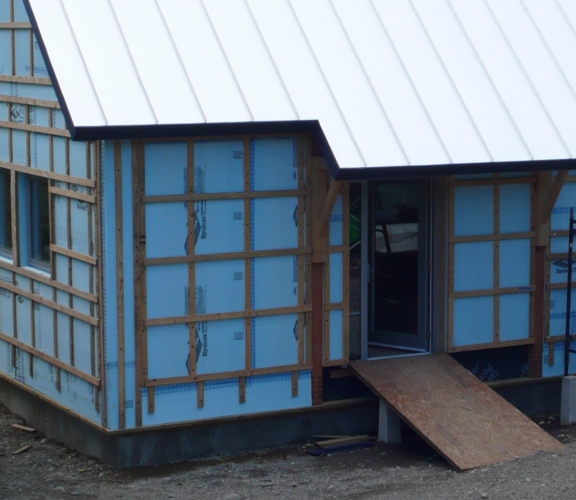
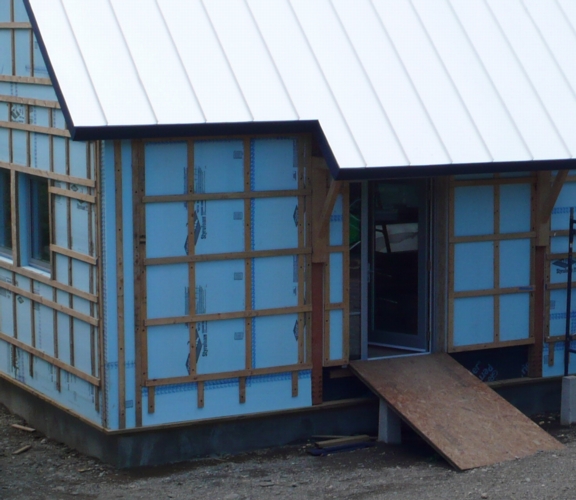
Image Credit: Bensonwood
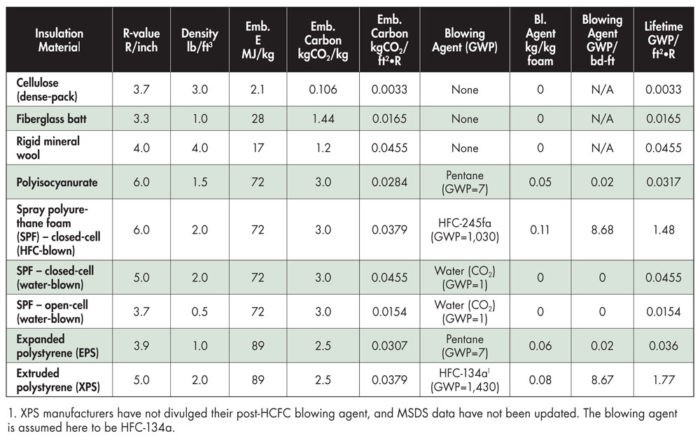
Image Credit: Bensonwood Assumptions used in calculating the payback period for the lifetime GWP of different insulation materials
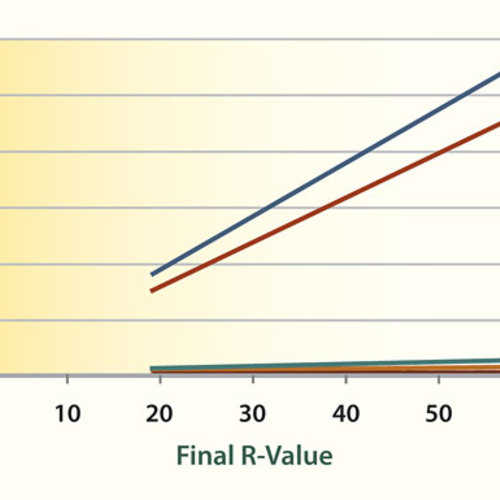
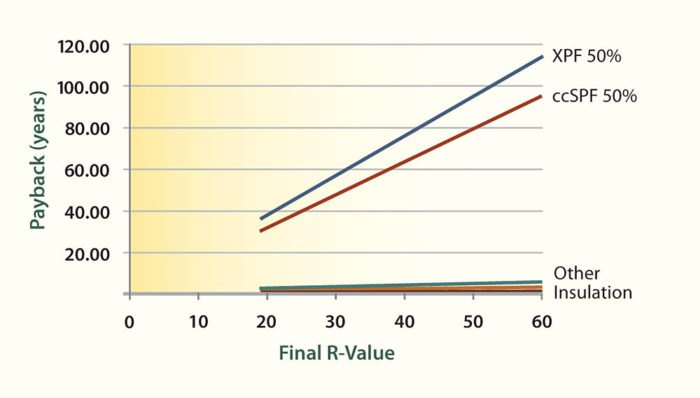
Image Credit: Environmental Building News, June 2010 The lifetime GWP payback of extruded polystyrene (XPS) and standard closed-cell spray polyurethane foam (SPF), both of which are produced with HFC blowing agents (assuming 50% leaks out over the life of the insulation), compared with other insulation materials.
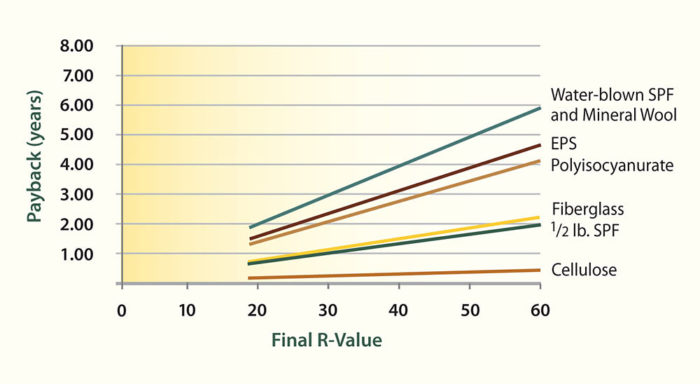
Image Credit: Environmental Building News, June 2010 The lifetime GWP payback of various non-HFC insulation materials shown at a scale allowing comparison. In this analysis, closed-cell, water-blown SPF and rigid mineral wool are nearly identical, so those graphs cannot be distinguished.
Image Credit: Environmental Building News, June 2010
More Energy Solutions


Can insulation materials, which we use to save energy and help prevent climate change, cause greenhouse gas emissions? Yes, in two ways.
First, it takes energy to produce and ship these materials—which we refer to as “embodied energy”—and using fossil fuels for these energy needs releases carbon dioxide (our most significant greenhouse gas). So in a sense, all insulation materials have embodied global warming potential (GWP).
Second, two of our common insulation materials are made with hydrofluorocarbon (HFC) blowing agents that are very potent greenhouse gases. Extruded polystyrene (XPS), best known by the brands Dow Styrofoam (“blueboard”) and Owens Corning Foamular (“pinkboard”), insulates to R-5 per inch and is made with HFC-134a, which has a GWP of 1,430—meaning that it’s 1,430 times as potent a greenhouse gas as carbon dioxide.
(I have to note here that I’m not 100% sure that XPS is made with HFC-134a; manufacturers are unwilling to divulge the exact blowing agents they use, saying the information is proprietary, and material safety data sheets have not been updated yet to reflect the new blowing agents that were required as of January 1, 2010. But various hints in technical literature have led me to believe that this is the blowing agent being used.)
The other insulation material made with a high-GWP blowing agent is closed-cell spray polyurethane foam (SPF). This insulation material is sprayed into building cavities, onto a foundation walls, or onto roofs, and it insulates to about R-6 per inch. Most, but not all, closed-cell SPF is made with HFC-245fa, which has a GWP of 1,030. Some closed-cell SPF is water-blown, thus avoiding this concern, though the vast majority is HFC-blown. Open-cell (low-density) SPF, such as Icynene, is all water-blown, so has a very low GWP.
Lifetime GWP
A blowing agent with a high GWP is only problematic if that chemical leaks out over time and, unfortunately, not much is known about how quickly this occurs. Some researchers, such as L.D. Danny Harvey, Ph.D., of the University of Toronto (who first raised the concern about the high GWP of foam insulation materials in a technical article a few years ago), has assumed that a large majority of the blowing agent leaks out over time, but based on conversations with technical experts in the industry, our analysis in Environmental Building News adopts a more conservative assumption that only 50% leaks out over the life of the insulation—which could be 50 years or 500 years.
When we combine these two sources (embodied GWP and GWP related to the blowing agent used) for an insulation material, we arrive at the “lifetime GWP” of these materials. For insulation materials made with HFC blowing agents, the vast majority of the total GWP comes from the blowing agent. See the table for the assumptions we used in the EBN article.
Payback of lifetime GWP
If we then calculate how much energy a given amount of insulation will save over its life (which depends on where the house is located and how efficient the heating system is) we can calculate the “payback” of the lifetime GWP in the insulation. In other words, this is the length of time it will take for the energy savings from the insulation to pay back the greenhouse gas emissions that will result from the use of that insulation.
With the help of John Straube and Daniel Bergey of Building Science Corporation in Westford, Massachusetts, we calculated the paybacks for adding different amounts of these insulation materials. This is reported in the June issue of Environmental Building News for those who want to see the analysis in more detail. We looked at adding R-5 increments of insulation to a 2×6 wall system insulated with dense-pack cellulose (whole-wall R-value of 14 for the starting wall). The energy model assumed the building is in a moderately cold Boston climate. This is shown in the two charts.
The good news is that, except for XPS and HFC-blown SPF, the payback for the lifetime GWP of insulation materials is very low. If you add four inches of polyisocyanurate (R-25) to the 2×6 wall, for example, (R-39 total) the lifetime GWP payback for that added polyiso insulation would only be 2.7 years. Even if you go all the way to a final R-60 for the wall system (adding 7.5 inches of polyiso), the payback would be only slightly over four years.
By comparison, if it’s XPS you’re adding to the 2×6 wall, the payback for that added insulation is much longer. Adding one inch of XPS has a 36-year payback. With two inches, the payback jumps to 46 years, and with four inches, 65 years. To go all the way to a final R-value of R-60 (adding about 9 inches of XPS) would have a payback of over 110 years. For SPF, the paybacks will be similar, though somewhat lower.
Bottom Line – Avoid XPS and SPF
So what does all this mean? These differences are dramatic enough that, even if our assumptions are off by a significant factor, we can draw some general conclusions about sensible choices.
If we’re building highly insulated buildings and doing so in part to mitigate global warming, we should use insulation materials other than XPS or SPF—at least until these insulation materials are produced with blowing agents that have far lower GWP. (Low-GWP blowing agents, such as hydrofluoroolefins, HFOs, are likely to be available from Honeywell and DuPont in the next few years, though it is unknown how quickly XPS and SPF manufacturers could convert to these or other compounds.)
There are lots of good alternatives. Now that polyisocyanurate (a common foil-faced rigid insulation material sold under such tradenames as Thermax, ACFoam, and Rmax) is made with pentane as a blowing agent, its GWP is very low (the GPW of pentane is about 7). Expanded polystyrene (EPS or beadboard) is also made using pentane as a blowing agent. Open-cell SPF, such as Icynene, uses water as a blowing agent. Fiberglass, mineral wool, and cellulose do not use blowing agents at all. Note that XPS and closed-cell SPF offer some excellent performance properties (controlling moisture migration and airflow through the building envelope), so if we are substituting a different material, we have to address these building science issues carefully.
The bottom line is that when we insulate our homes so that they will use less energy and thus help to mitigate climate change, we should be careful about which materials we use. Providing high levels of insulation with XPS or closed-cell SPF will counteract a lot of that well-meaning effort.
To get a more complete understanding of this issue and for a checklist of alternatives to XPS and closed-cell SPF, check out the June, 2010 issue of Environmental Building News (to access this article, a log-in is required–$12.95 per week or $199 per year).
I invite you to share comments on this blog. Will this information affect your choices of insulation materials?
Alex Wilson is the executive editor of Environmental Building News and founder of BuildingGreen, LLC. To keep up with his latest articles and musings, you can sign up for his Twitter feeds.
Weekly Newsletter
Get building science and energy efficiency advice, plus special offers, in your inbox.



52 Comments
Cellulose is so much more green
Cellulose is a greener insulation product acording to your info by an order of magnitude.
Why do building scientists push foam????
I like foam too... but am leaning toward soy based water blown.... and any recycled foam I can get which there is plenty available from commercial reroofing disposal men.
Thanks for tackling this
Alex,
Thanks for tackling this subject.
Can you share some of the manufacturers or brands of closed cell foam that use water blowing agents? I haven't been able to find any.
The reality is soy based foams are not necessarily better
As Alex points out the permisity of some of these high GWP foams is very attractive from a building science perspective in some applications.
It is unclear if soy based foams (ie foams that use soy oil as a feedstock in place of petroleum) have much positive impact at all, possibly none. I am setting aside the question of blowing agents.
Current research has shown that using food based agricultural products as fuel feedstock has caused major land use changes that has increased global warming. The EPAs new rules for classification take into consideration both the lifecycle production related global warming impacts of biofuel production and indirect inducement of land use changes that significantly add to global warming (this is caused by pulling fallow land back into production and deforestation to put new land into agricultural production in developing countries like Brazil). This type of holistic approach is appropriate for food based feedstocks used for insulation as well. Both a standard lifecycle approach and indirect impacts of land use need to be considered to fully understand the global warming impact of food based feedstock in insulation.
Plus most of the soy based products I am aware of only use soy as part of their feedstock and it does not displace oil as the principal feedstock. But again displacement is not necessarily a positive thing.
see article in annual reviews of Ecology, Evolution, and Systematics
http://arjournals.annualreviews.org/doi/abs/10.1146/annurev-ecolsys-102209-144720
GWP of Cellulose?
Interesting post, although it would be even more insightful to compare GWP of foams with other insulation materials such as cellulose. A clear disadvantage of the latter versus foam is that wall cavities grow substantially in thickness, which becomes a significant challenge in superinsulated retrofits and new construction in dense urban areas.
Has EBN conducted similar GWP analysis of cellulose? If yes, please share the results.
Thanks.
GWP of cellulose
The GWP of cellulose results from the embodied energy of producing and transporting cellulose. That information is shown in the charts. In the first chart, the cellulose line hugs the bottom of the graph; in the second I've changed the scale so that the non-HFC insulation materials can be compared. (To see these graphs you have to click on the thumbnail images at the bottom, or click on the house photo then click the forward arrow to see the additional images.)
This analysis does not directly account for the GWP impacts of thicker walls, per se; I'm not sure how you would do that.
an alternative to insulated walls
would be building without insulation.
it can be done, and elegantly at that...
http://bruteforcecollaborative.wordpress.com/2010/02/12/das-kybernetische-prinzip-the-cybernetic-principle/
Cemintitious spray foam
Thanks you for the analysis Alex. I am curious as to your thoughts on cementitious spray foam such as air krete, composed of inert materials. Reading the promotional material, seems like a reasonable alternative, although not the highest performance at R 3.9 per inch and limited availability.
On cementitions foams
I have long liked Air Krete, though there are a couple problems: first, if it isn't installed just right there can be significant problems; and second, the cured foam is fairly friable, meaning it can disintegrate fairly easily and may not be appropriate for applications that are exposed to a lot of vibration (such as a building along a busy roadway). Last I checked, the manufacturer had (to their credit) resisted the temptation to add an organic polymer to solve the friability problem, hoping to keep it 100% inorganic and fire resistant.
If I were in the product development field today, I think I'd be focusing on "foamed ceramic" insulation materials. I believe there is huge potential here--essentially producing a "beadboard" insulation made of fused expanded ceramic beads. Such a material a) would be totally firesafe (zero flame-spread and zero smoke-developed) without the use of flame retardants; b) would be highly durable; c) would insulate reasonably well (it would be great if such a material could achieve R-4 per inch); d) would exhibit reasonable permeability to allow wall cavities to dry; e) would be moisture-resistant and not prone to decay; and f) would have enough compressive strength to work in below-grade and even sub-slab applications. I saw prototype materials along these lines (expanded inorganic beads) 15 years ago and suspect that someone is working on a product like this. I can't wait.
Is there a magic zero GWP polyiso blowing agent?
Alex,
I just stumbled upon Atlas Roofing's website where they are claiming that their "Energy Shield" polyiso foam board offers zero GWP. Below is a quote taken from the Energy Shield product page:
"Energy Shield offers several “green” qualities, including zero Ozone Delpetion Potential (ODP) and zero Global Warming Poteential (GWP) due to Atlas Blowing Agent Technology.
(Note to Atlas, typos do not generally add credibility to bold marketing claims)
Check out the claim for yourself: http://www.atlasroofing.com/tabbed.php?section_url=15
According to your article the blowing agent used for polyiso is pentane which has GWP of 7. Perhaps Energy Shield has a magic "proprietary" blowing agent, but it reeks of greenwash to me. I will drop them an email and see what's up.
Thanks for another exceptional article.
On the GWP of pentane
I believe that because the GWP of pentane and related hydrocarbons is so close to zero (7 really is pretty low), manufacturers have always considered it insignificant. Water-blown SPF, for example, actually has CO2 as the blowing agent (CO2 derived from H2O--I think that's how the chemistry works), so that GWP would be 1 for that blowing agent. From the numbers we came up with on payback, as long as the GWP of the blowing agent is less than 10 or 20, I don't think there's much to worry about. At that level, the GWP of the embodied energy is on the same order of magnitude--and energy savings quickly pays back this environmental impact.
Foam Glass
Alex,
The "foamed ceramic" product you describe is already available (in Europe). It's foam glass. One of the more popular versions of foam glass is foam glass gravel for below grade applications. It has just about all the properties you describe: firesafe, durable, low thermal-conductivity, moisture resistant, and good compressive strength. And, for comparable R-values, it's about equal on cost with XPS insulation. I bet it will be available in the U.S. in the next 24 months.
For an example, check out http://www.millcell.com/en/millcell
FoamGlas
John,
Pittsburgh-Corning has made Foamglas (trademarked name) for years, and I am a fan of the product. It's marketed in the U.S. for industrial applications (insulating steam pipes and such), but not so much for building insulation, though the company has promoted it to some extend as a roof insulation for use with green roofs. I'd love to see either P-C's or someone else's foamed-glass product marketed actively here. The "foamed ceramic) product I envision is a little different: lighter weight, more the look and feel of EPS (though not as spongy), and lower-cost. Pipe dream? Perhaps, but one can hope!
millcell insulation
U - value: 0,15 for 16cm is that equal to R-1 per inch? Not so good is it?
adkjac's math
U=0.15 is R-38.
16cm = 6.3"
R-38/6.3" = R-6/inch, which isn't too shabby.
Millcell R-value
Adkjac,
I'm not sure where you got the U-value of 0.15 for 16cm. It's not correct. The Millcell website claims a thermal conductivity of 0.0753W/mK for the product once it's compressed...that's R-1.9/inch.
http://www.millcell.com/en/specifications/properties/
Recycled Cotton Insulation
Alex,
This is a great article. Thank you.
I wish you had included UltraTouch Cotton Insulation as well. Did you include that in your research?
UltraTouch cotton
Steve,
I did not include cotton, because I didn't have good embodied energy data on it. Having recently toured the UltraTouch factory near Phoenix, though, I would guess that the embodied energy (and thus lifetime GWP) would be somewhere between that of cellulose and fiberglass: higher than cellulose but lower than FG. That's just a guess, though. There certainly is no halocarbon blowing agent. -Alex
Millicell Gamma Radiation
On its web page, Millicell lists absorption of radiation among its properties. In terms of undesirable stuff like gamma rays, I gather this is indeed a good thing, and seems partly function of mass. I'm not going to start seeking out products based on this feature yet, though. Depleted uranium is excellent at blocking gamma radiation , for example, but might face marketing challenges....
LCA
The proper method of comparison of insulating materials is the Life Cycle Assessment for each insulation type, brand and installation method. Before the LCA can be done the Product Category Rules need to be agreed on and an inventory of components built. This work is in progress and until it's done, all comparison in forums like this, in the popular press and in marketing literature is pure opinion and conjecture.
Since we're offering opinions, mine is that spray foam is the most effective insulation on the planet because even an average SPF job will be well air sealed and the foam will perform for generations over a wide temperature range without settling or delaminating. SPF does not rely on caulking or tape to perfect the air seal, instead it is essentially glue that we foam up. If you've ever been to a jobsite where SPF is being sprayed you'll understand how it adheres.
There are better uses for recycled newspapers. There are better uses for recycled cotton. All air permeable insulation leaks energy by leaking air, and moisture-laden air traveling through or within an assembly leads to condensation which is the leading cause of building failures. It makes no sense to use air permeable insulation in our buildings if we're really serious about reducing energy demand.
There will soon be zero-GWP blowing agents available for medium and high density foam, but quite honestly, they will be incidental in the total scheme of things. If we reduce the energy demand of our buildings, we'll reduce the massive use of fossil fuels required to provide our requisite heating and cooling, and the offset carbon emissions will go a long way to justifying the very small amount of blowing agent that's actually present in medium density SPF (closed-cell). For the purists in our midst, the argument should be to eliminate all refrigerated cooling systems if we're dead set on reducing GWP gasses. After all, we had no AC in our buildings 60 years ago and we got along pretty well. OK....we want our comfort, so let's build the most efficient buildings possible, and that's most effectively and predictably done using spray foam insulation and air sealing.
Low Density foam like Demilec's Sealection 500 and Sealection Agribalance are so-called "water-blown" foams and have no GWP. Agribalance uses some Castor Oil based polyol which is not in our food chain, and has a very high R-Value for a low density foam of 4.45 per inch. Combined with its ability to air seal (air impermeable in accordance ASTM E-283 and ASTM E-2178) and insulate even behind pipes, wires, irregular spaces, tiny cracks, gaps and voids in the framing, this is perhaps the most intelligent choice available to the building community.
Just a note to the Author, Icynene is the name of a Canadian spray foam manufacturer, not a type of SPF. The proper terms for SPF and some of their synonyms are:
Low Density Spray Polyurethane Foam (Proper)
Open Cell Foam
Half-Pound Foam
Water Blown Foam
Semi Rigid Foam
Medium Density Spray Polyurethane Foam (Proper)
Closed-Cell Foam
Two-Pound Foam
Rigid Foam
High Density Spray Polyurethane Foam (Proper)
Roofing Foam
Closed-Cell Foam
2.5 - 3 Pound Foam
Rigid Foam
I live on a farm and have sheep eating the grass in my pasture. The lowest embodied energy that I can think of would be to shear the sheep with manual clippers (ouch!) and stuff the wool in the walls, but would that be the wisest choice based on wool's high air permeability rate? We'll get the LCA work done in a year or two and thereafter we'll more accurately be able to compare insulations, and until then I stand by my opinion that SPF makes more sense than any other commercially available insulation. By the way, think about who builds our homes.....young men in a hurry, right? Do they always get air permeable insulation perfectly aligned on all 6 sides? With spray foam it doesn't matter, the foam will flow to the nooks and crannies and the air seal will be far superior to any other system.
Lastly, please pay attention to flame retardants used in various insulation types. SPF does not use penta-brominated diphenyl ether (PBDE) Ask the EPS manufacturers about theirs.
Bad SPF Assumptions
Mac, I'm also a fan of SPF in it's various forms ... for the right SITUATION and with the right INSTALLATION. However, you make some big assumptions about SPF and in particular it's ability to be a cure-all when installed by "young men in a hurry."
Here's a link to a real-world field study of foam and it's problems with air-sealing based on faulty installation (based on fact not opinion): http://tinyurl.com/2765qph
Foam, like any product, is only as good as it's installers and, as they found in the article, can be more difficult than other options if it has to be corrected retroactively. Be cautious about declaring any single product the ultimate answer across the board.
Effects of Global Warming
I am very pleased to see that Cellulose Insulation appears to be the best choice for the most cost effective and environmentally friendly type of insulation in your charts. I have been using Wall Spray Cellulose Insulation in our walls for last 25 years. I selected it for its recycled qualities along with the ability to build custom sized batts in every wall. I know the "installed" R value is superior to other batt insulations. Along with our air sealant work, air tight drywall approach and Cellulose in the walls, we are building a durable high efficient house that will last for years to come.
http://www.globalwarming360.net/
Response to Andy Ault
Andy Ault,
Great link -- thanks for sharing it. It's an eye-opener. (However, it's not a field study; just a blog entry.)
This got me a little angry
So over at http://www.buildingscience.com XPS is recommended for various applications.
Late last year I fitted exterior XPS to a few walls of my home. My aim was to be environmentally friendly. If the GWP payback is as bad as it appears by this article I feel defrauded (by Owens Corning).
In a retrofit of my home last year I used fiber faced polyiso, foil faced polyiso, and XPS, each in different places carefully considering the best material for the job. The XPS appeared best for the job in some cases.
So I did a little Googling of XPS and HFC-134a here is the top link:
http://www.arap.org/docs/xps_insulation.pdf
This report implies that using HFC-134a instead of C02 is overall a better energy payback (even after it says that HFC-134a has GWP of x1300 that of C02).
Indeed I recall researching this myself before I decided to use XPS.
So we have (at least) two reports:
http://www.buildinggreen.com/auth/article.cfm/2010/6/1/Avoiding-the-Global-Warming-Impact-of-Insulation/ (the link this article was based on)
and
http://www.arap.org/docs/xps_insulation.pdf (an industry report -- by an employee of Dow Chemical)
So what is one to believe?
Could the report by an employee of Dow Chemical (makers of Blue Board XPS) could be biased or defective?
So I guess that at some point I will have to sit down and do the calculations myself, or at least try to validate both sets of opposing calculations and look for the descrepancy.
Of course finding out the exact blowing agent used, and the amount of blowing agent may not be easy.
Payback isn't the best metric.
Alex, this is interesting information, but payback isn't the most relevant metric to use. Since the blowing agents are released slowly while at the same time the building is reducing the output of other GHGs, it's the net GHG flow that matters. How much GWP do they produce each year, and how much do they offset? Did you look at that?
This is analogous to the irrelevance of payback when borrowing money for an energy efficient home. If the buyer isn't plunking down all the money at once, cash flow is what matters, not payback. Same thing here. And with the urgency that James Hansen ascribes to climate change, I think we should be more concerned with the immediate effects, not what happens over a lifetime of 50 to 500 years.
That said, I personally think peak oil is a more immediate problem, and we need to do whatever we can to reduce our energy consumption. And I mean reduce, not just become more efficient (http://hub.am/b8ocnN).
On "payback"
Allison,
I agree that payback usually isn't a good metric when evaluating energy improvements--it might not be the best way to explain what I was trying to do in addressing global warming impacts of insulation either, though I think the issues are somewhat different. What I was trying to do was present how many years of energy savings will be required for a given amount of insulation to compensate for (or break even on) the greenhouse gas emissions of the insulation itself. It's a complicated issue, and I'm looking for other ways to present this information.
Ah, but it is the same...
Alex,
I think it really is the same issue - lifetime payback vs. short term net flow. I think I agree with Mac Sheldon here, that your results (and I must admit I haven't seen the full report) are speculative because you don't have enough data and you're using the wrong metric. (I don't, however, agree with Sheldon about SPF being a panacea.)
You give payback periods of 36, 46, 65, and 110 years for XPS, but what really matters is how much GWP does it produce in the first year compared to the GWP it offsets, then how much in the second year, the third year... To get those results, you have to know the offgassing profiles for the various products. It's easy to calculate the amount of GWP that's offset by the energy savings, but without having those offgassing data, you can say there MIGHT be a problem here. Or maybe there's not.
If a builder uses XPS or closed cell SPF and the energy savings that result from that choice have a net result of lowering GWP, it's a good choice. Without those data, however, the best we can say is that we don't know. When you say "Bottom Line – Avoid XPS and SPF," I believe you've gone too far. You're basing that conclusion on the assumptions you've made and the wrong choice of a metric.
Ah, but it is not the same...
Allison,
Actually, Allison, it isn't always the same.
I'll take an extreme example to illustrate my point. Imagine an insulation that releases 100% of its blowing agent during its first year of service. Let's imagine that the GWP of the released blowing agent is twice as much as the reduction in GWP achieved by the insulation during its first year of service.
So the net GWP during the first year isn't any good, because during the first year you do more harm than good.
However, if the building lasts 50 years, and there is no further release of any blowing agent, then all of the energy savings that accrue over the next 49 years are a net benefit. So the balance during Year 2 (and Year 3, and Year 4, and Year 5...) is entirely different from the balance during Year 1.
You're right, of course...
Martin, you're absolutely right. The rate of offgassing usually does vary, with a lot of it happening in the early stages, so each year doesn't stand alone. As I said, I haven't seen the full report, but based on my read of what Alex said above, it looks like they assumed that half of the blowing agent is released over a period of 50 to 500 years. What number they chose for the release period, he doesn't say here. Whether or not they assumed uniform releases spread evenly over the entire period, I don't know either.
It appears, though, that Alex is saying to avoid XPS and SPF simply because of the long payback periods. What I'm saying is that that recommendation is not warranted because of the assumptions and lack of data about offgassing. Perhaps the full report contains crucial information that would change my mind, but if so, why isn't that info in this article?
In the meantime, I'm not going to stop recommending XPS and SPF.
Here's the skinny...
This report needs to be retracted. If not retracted, it should have a disclaimer at the top warning readers that it is just an exercise in simulation with no power to yield conclusions. It's not science, although it looks like it is. The conclusions are not defensible. Here's my analysis:
http://hub.am/an7fDi
Published Paper on blowing agents in SPF and XPS
I would like to contribute this link to a scientific paper written by Dr. Danny Harvey from the University of Toronto. I think Alex's report reaches similar conclusions and presents the material in a much more approachable manner. Note: Dr. Harvey's paper was published in "Buildings and Environment"
Net Climatic Impact of Solid Foam Insulation Produced with Halocarbon and non-Halocarbon Blowing Agents. 2007. Buildings and Environment 42(8): 2860-2879.
For a free version of the paper go to this link:
faculty.geog.utoronto.ca/Harvey/Harvey/papers/Harvey%20%282007c,%20BAE,%20Climatic%20Impact%20of%20Insulation%29.pdf
note: you need to add :http:// to the front of the link
Just read Dr Harvey's paper (in link 1 post above)
Dr Harvey's paper is very detailed and credible and worth a read, at least the abstract and final page or two if you are short on time.
A couple of sentences that I think gives a breif flavor:
"The small additional savings in heating energy emissions using halocarbon blowing agents is swamped by the larger impact of leakage of the blowing agent. Thus, non-halocarbon blowing
agents are again better from a climate point of view."
The paper is vastly more detailed.
This directly contradicts an industry (and likely biased) report:
http://www.arap.org/docs/xps_insulation.pdf
If pentane is used rather than HFC-134a there would be a huge improvement.
So while the report in this blog may not be as detailed as Dr Harvey's report the conclusions appear to me (for what I think are typical use cases for XPS) to be similar.
Response to "Here's the Skinny"
Allison,
Riddle me this, if we were having this discussion 2 decades ago and we were discussing CFCs instead of HFCs and ODP instead of GWP could I count on you to again dismiss basic facts and put peak oil before the ozone layer? I appreciate your critique and I enjoy reading your blog, but calling for retraction when there is no evidence of scientific misconduct or serious errors seems seems a bit laughable to me.
Luke Morton over at Another Green Building Blog (http://passivmaus.blogspot.com/search?q=ghg) has a Spray Foam Refrigerant Carbon Calculator that might be fun to play around with using different assumptions. https://spreadsheets.google.com/ccc?key=0AuTFnDouZs3TdDZEUHRVQkt6SGd0eXNpUWc5VGRUZ2c&hl=en
Perhaps no actual conflict?
Allison, you've taken a strong stance, and it's definitely a provocative one! I'll have to admit that the accusation of misconduct is a little strong, but that's besides the point.
Reading through your criticism of Alex's math and method, and your alternative method, I was a little confused. I was confused because I don't see the different metrics being actually any different in outcome. Go ahead and annualize the projected global warming impacts... If I'm thinking about the math right, you start off with a huge GWP penalty upon first application, and then a slow offgassing thereafter (I'm thinking of ccFoam). So, as Martin also imagined, you start off with a huge debt that you have to pay off from the beginning.
BUT, imagine that the debt magically doesn't occur until year 20 of the ccFoam application. It still doesn't change the amount of debt that you ultimately have to pay off.
Doing a "cash flow" analysis of this stuff changes absolutely nothing, and is a perfectly valid method of analysis.
Unlike cash flows, there are no tax rebates on GWP interest, and there is no discount rate. GWP releases at year 0 are equivalent to GWP emissions at year 50.
So, what I'm wondering is-- if you pursued the cash flow method that you described, then would the outcome be any different than Alex's?
I know that ultimately you had some other misgivings about the message that Alex and others were articulating, but I'll leave those be.
I've had to be very careful myself about how to articulate the ideas within this article to my colleagues, lest they believe that ccFoam and XPS are now 'evil' and environmentally atrocious.
Anything we can do to encourage the marketplace of spray foam suppliers to give a product that is more of what we want it to be, while being less of what we don't want it sounds like an eminently worthwhile thing to do.
Lastly, for all those reading this-- I appreciate Skylar's posting of my blog and associated spreadsheet. All errors contained within are mine-- and I think I've unlocked it so that you can make changes freely. Many of the assumptions are actually open questions to folks with more expertise than mine.
SPFA Response
I recently recieved a copy of the response from SFPA to Building Green and their reply. Thought it should be posted on your website.
2010-08-31 [Source: Building Green]
The Spray Polyurethane Foam Alliance (SPFA) is a trade association representing the spray polyurethane insulation and roofing industries, including contractors, suppliers, distributors, and consultants. Several of our members have brought to our attention your article "Avoiding the Global Warming Impact on Insulation," published in the June 2010 issue of Environmental Building News. This article inaccurately targets the high global warming potential (GWP) of blowing agents used by closed-cell spray polyurethane foam (SPF) and extruded polystyrene (XPS) relative to other insulation products, and provides insulation material recommendations based on flawed analyses. SPFA believes the assumptions, analyses, and statements are inaccurate and damaging to the SPF industry.
SPFA considers evaluating the environmental impact of building products to be a valuable and required step in the material selection process. However, this evaluation must be done using established analytical methods. Our industry believes that the analyses used in this article need refinement in several areas to accurately characterize and compare the environmental impact of the different insulation products. Specifically, the analysis is deficient in the following six areas:
We detail our concerns regarding each of these topics below, and suggest improvements for the authors to consider.
Richard S. Duncan, Ph.D., P.E.
Technical Director, Spray Polyurethane Foam Association
Editor's response:
We commend the SPF industry for efforts to address environmental characteristics of polyurethane foam and for providing in-depth responses to our June article. Our responses to the specific points mentioned above are interspersed (in italics) in the detailed discussion below.
Detailed Discussion
Below is a detailed discussion addressing each of SPFA's six concerns with the referenced article "Avoiding the Global Warming Impact on Insulation, " as published in Environmental Building News, June 1, 2010.
SPFA Point #1: Amount of HFC-245fa blowing agent in SPF is overstated
The amount of blowing agent used in closed-cell SPF was mistakenly assumed to be two times higher than is actually used in practice. The Harvey paper assumes that HFC blowing agents comprise 12% of the weight of closed-cell SPF. The fact is blowing agents make up about 12% of the B-side (polyol) component. When SPF is manufactured on the jobsite, it is combined with an equal amount of A-side (MDI) to create the finished foam. This 1:1 field mixture of the A-side and B-side reduces the amount of blowing agent by a factor of two, so the blowing agent is approximately 6% of the weight of the finished foam, not 12% assumed by the Harvey study. The analysis should be re-done considering this information, or the payback term should be reduced by a factor of two.
EBN response to Point #1
In writing about the greenhouse gas emissions from SPF and XPS we relied on the best data we had available to us at the time (including the peer-reviewed Harvey paper), but we welcome newer or better data from SPFA and other sources on the exact quantity of HFC blowing agent in SPF as well as more precise estimates of offgassing rates of that blowing agent—something not addressed in your comments. We are also seeking this data from one of the leading manufacturers of blowing agents.
SPFA Point #2: Embodied GWP assumptions may be incomplete or inaccurate
The embodied GWP reported by ICE for the different insulation products in Table 2 may not be accurate or complete and may not follow standard practice. It is important to compare the environmental impact of different materials only when they have undergone a thorough life-cycle analysis (LCA) or life-cycle inventory (LCI).
There are established LCA protocols that must be followed for all products (per ISO 14040/14025) for the results to be meaningful and comparable. These ISO protocols define the boundary for the LCA, such as cradle-to-grave or cradle-to-gate, and include all aspects of producing the product such as the environmental impact of raw material extraction, transportation, and processing, as well as production of the final product. In addition, these protocols establish a functional unit for each product and require an independent review by industry experts. In addition, there is a Product Category Rule for insulation materials established by the ISO that defines the proper boundaries and functional unit for characterizing the environmental impact of all insulation products.
It is not clear from Table 2, or from the analysis in this paper, that the ISO standards were consistently followed for every material. If these standards were not followed, then their environmental impacts cannot be compared.
The spray foam industry, through SPFA and an independent service provider, is undertaking an industry-wide cradle-to-grave LCA to incorporate not only the embodied energy required to make, transport and install SPF, but to also consider the building energy saved during the use phase and proper disposal of the product. We believe that the results will show the GWP impact of energy saved will be 30 to 100 times that of the GWP impact to manufacture SPF. When completed within the next 12-18 months, the SPF industry LCA should provide thorough evidence to challenge many of the statements and conclusion in this article.
Finally, there are several existing LCAs developed for SPF. A summary example of an LCA for the embodied energy of several insulation materials, including SPF made with HCFC-141b blowing agent, is shown in "Eco-Efficiency Analysis of Insulation Products," by BASF in 2006. This work, using the ISO protocol, should be included or referenced in the article.
EBN response to point #2
We agree about the importance of in-depth LCA data, and we welcome that data as we evaluate the environmental attributes of building materials. Such information often isn't available, however. In lieu of more rigorous LCA and LCI data on insulation materials, we relied on what we consider to be the best, freely available, academic information on embodied energy—that from the Inventory of Carbon and Energy (ICE) from the Sustainable Energy Research Team at the University of Bath, U.K., Department of Mechanical Engineering.
We do not accept that the lack of more comprehensive LCA or LCI data on a material, however, is justification to hold off on making decisions about use of that material or alternatives. While more rigorous analysis may show some differences from the embodied energy assumptions we used in this analysis, we believe that the ICE data we used is in the right ballpark.
SPFA Point #3: Sole consideration of SPF as a secondary or additional insulation over a baseline R-value unfairly biases the conclusions of the study
Considering foam plastics only as a secondary or additional insulation unfairly positions them at a disadvantage in the analysis by dramatically reducing energy savings and increasing the payback period for these products.
The relationship between conductive energy loss of a building and its envelope R-value is inherently non-linear, as shown in Figure 1. The example in this figure it is assumed that the uninsulated wall has an R-value of 1. At this R-value, the energy loss of the wall is assumed to be 100%. If a continuous R-13 primary insulation is added, the energy loss from the insulated wall will be reduced by about 86% of its uninsulated value. If an additional R-6 of ‘secondary' insulation is added to the wall with R-13 of primary insulation, an additional 4% energy savings will be realized.
In this paper, it was assumed that a fibrous insulation was the primary insulation, and that foam plastic was the secondary insulation. This assumption greatly reduces any energy savings benefit from the foam plastic. If R-6 of foam plastics was considered as the primary insulation, and a fibrous R-13 was considered as a secondary insulation, the R-6 foam plastic would be credited with about 75% of the savings and the R-13 fibrous insulation with about 17%. The assumption of primary versus secondary position can have a significant effect on the energy savings used to calculate payback in this paper.
Moreover, foam plastics are routinely used as the only insulation in many buildings. For example, XPS insulated sheathing is used along with SPF as an external continuous insulation over walls and low-sloped roofs. SPF is often used as the only cavity insulation in many framed structures. SPF in combination with fibrous insulations is a far less common application than using SPF insulation alone.
To make this analysis more representative and to compare all products on an equal basis, all insulations should be considered alone as the primary insulation.
EBN response to Point #3
Your point about analyzing SPF solely as an added (or secondary) insulation material is a reasonable one. When SPF (or XPS) is the only insulation material being used in a particular wall system or other application, or if the energy savings from this foam insulation is considered primary, then the speed at which the global warming potential from the HFC emissions will be "paid back" from the energy savings resulting from that insulation is far more rapid; I did not make that clear enough in my article, which I regret. The example we used—that of a 2x6 wall insulated with cellulose with added foam insulation—admittedly is a more common construction detail when XPS is added than when SPF is added. We hope to present greater clarity in future coverage of this issue.
SPFA Point #4: GWP impact of fourth-generation blowing agents not fully reported
Fourth-generation blowing agents for SPF, with significant reductions in GWP, are not fully reported. During the past two decades, blowing-agent manufacturers have worked diligently to reduce the environmental impact of these chemicals in regard to ozone depletion and greenhouse gas production. A brief summary of this development is provided in Table 1.
Three major chemical companies have recently announced the impending launch of fourth generation of SPF blowing agents within the next 1–2 years—see "HFO-1234ze(E) Commercial Status, And HFO LGWP Advancements," Bowman, J. and Williams, D, (Honeywell); "Investigation Of New Low GWP Blowing Agent AFA-L1 For PUR/PIR," Chen, B., Costa, J., Bonnet, P. (Arkema); and "Development Program Update For Low GWP Foam Expansion Agent," Loh, G., Creazzo, J., Robin, M. (DuPont), all presented at the Polyurethanes 2009 Technical Conference.
These fourth generation materials have zero ODP and GWP in the range of 6 to 15, representing a GWP reduction of more than 150 times current values reported in this paper. These fourth-generation blowing agents were not included in Table 1 of the article, and should be added in fairness to future of these materials. We believe the continuing evolution of SPF blowing agents should be considered and discussed.
EBN response to Point #4
In our article, we did state that as fourth-generation blowing agents come into use, "the argument for avoiding SPF and XPS on the basis of lifetime GWP will largely disappear." Our information, like yours, points to hydrofluoroolefins (HFOs) as the likely replacement blowing agents, at least for the polyurethane insulation. With XPS, Europe has already switched to a fourth-generation, non-ODP, low-GDP blowing agent: carbon dioxide (from water). However, the XPS industry has decided that for the North American market, an R-5-per-inch insulation material is needed, rather than requiring designers and builders to increase the thickness of R-4-per-inch XPS (as is available in Europe today).
It also bears repeating just how much improvement has been made over the past 15 years by the insulation industry in phasing out the highest-ODP CFC blowing agents—which also had far higher GWP values than the current HFC blowing agents. The industry deserves a lot of credit for these improvements, and the environmental community and government agencies may share some fault for not making a bigger issue of the GWP properties of alternative blowing agents being considered—because the priority was given to dealing with ozone depletion.
SPFA Point #5: Air sealing properties of foam plastics ignored
The U.S. Department of Energy states air leakage can account for 20%–40% of a building's heating and cooling costs. In the analysis, the effects of energy loss from air leakage were ignored. Foam plastics are air-impermeable, minimizing air leakage and convection effects found in fibrous insulations. Most foam plastics are moisture resistant, and, unlike fibrous insulations, are not degraded by moisture content.
Moreover, SPF expands during installation to seal cracks and gaps in the building envelope. When used with proper sealing around windows and doors, SPF can provide complete air barrier system for most buildings. Fibrous insulations are inherently air permeable and will need an additional air barrier system installed to perform equivalently to SPF. To account for the air sealing benefits, the analysis should have considered SPF to have an additional 20%–40% energy savings, or the embodied energy of the added air barrier system for fibrous insulation should have been included for these products.
EBN response to Point #5
I in our analysis we assumed that in a highly insulated building—which our article was focused on—airtightness will be a priority no matter what the insulation material used, so that additional benefit from SPF's (superb) air-sealing should not be factored in. Remember, our analysis focused on highly insulated buildings—those approaching net-zero-energy or Passive House performance. In typical construction practices, the levels of insulation provided and the GWP issues associated with SFP and XPS are much smaller.
SPFA Point #6: Inaccurate statements regarding quality, chemical safety and off-gassing of SPF
High-pressure SPF must be installed by a professional installer. Installers undergo many hours of training on chemical safety, equipment operation and material application. Pumps and heaters, using automated controls, are used to dispense and mix SPF chemicals under precisely controlled pressures and temperatures. With proper training and modern equipment, it is very difficult to apply SPF materials improperly. An experienced installer can easily control the thickness of closed-cell SPF to within ¼" to ½". It is more difficult to control the thickness of open-cell foam—where a thickness control of 1" to 2" is typical.
SPF formulations contain flame retardants for added safety in the event of a fire. However, they do not contain hexabromocyclododecane (HBCD), polybrominated diphenyl ether (PBDE), or tetrabromobisphenol A (TBBPA), chemicals that have been the focus of concern by the U.S. Environmental Protection Agency in recent years. SPF products typically use phosphate-based, chlorinated flame retardants such as TCPP (tris (1-chloro-2-propyl) phosphate), TEP (triethyl phosphate) and TDCPP (tris(1,3-dichloro-2-propyl) phosphate).
Any exposure concerns to chemicals in liquid or aerosolized form during the application of high-pressure SPF are addressed through the use of proper personal protective equipment (PPE). Those in the immediate vicinity of application are trained on the requirements and proper use of PPE such as eye, skin and respiratory protection. Shortly after application, the components react to form the final insulation material, which is highly inert and presents little hazard to anyone who comes in contact with it. As an added precaution, it is also common practice to not allow re-occupancy until 24 hours after SPF is installed. In addition, studies have shown that SPF does not release toxic gases or leach harmful chemicals into the soil. Cured SPF materials are routinely encountered and handled safely, and enhance everyday life. More information on safe application of SPF can be found at http://www.spraypolyurethane.com
In terms of offgassing, SPF is not known to emit any significant levels of volatile organic compounds (VOCs). All Canadian SPF products must be tested to assure low VOC levels to be compliant with Canadian building codes. These same SPF formulations are used in the U.S. Several U.S. SPF manufacturers have voluntarily evaluated and registered their products with the GreenGuard Environmental Institute to assure that VOCs are below safe levels.
EBN response to Point #6
While it is certainly true that the rigorous training SPF installers receive is very important and helps to ensure quality installations, which comprise to majority of installations, suggesting that "it is very difficult to apply SPF materials improperly" may be overstating the reality. We have been hearing more and more anecdotal reports of problem SPF installations in which shrinkage or other problems occur. We believe that most of these problems stem from formulations and materials selected, ironically, for environmental reasons—such as use of soy oil in the polyol component of the foam or use of water-blown (CO2 blowing agent) formulations. I believe that SPFA is trying to address these installation problems, but there may still be some chemistry issues to work out with the newer materials.
As for flame retardants, it is true that SPF does not contain brominated compounds, which are most commonly targeted by health and environmental advocates. There are also concerns with chlorinated flame retardants, however, including TCPP. We look forward to a time when halogenated flame retardants are entirely removed from foam insulation materials.
We agree that when properly installed, VOC offgassing from SPF should be negligible. As long as proper protective gear is worn during installation (as SPFA advocates) and building occupants keep out for 24 hours, indoor air quality problems should be rare—and limited to people with extreme chemical sensitivity.
SPFA Summary of Points 1–6
If the issues above are properly addressed, we believe that the payback term for SPF will be dramatically reduced. While a complete re-evaluation of the payback is needed, the reduction of the payback term can be approximated as follows if points 1, 3, and 5 are properly addressed:
• (1) Amount of HFC-245fa blowing agent 0.5 factor
• (3) Secondary vs. primary insulation (4% savings to 75% savings = 19x) 0.05 factor
• (5) Air sealing properties included (30% average savings) 0.70 factor
• 36 year payback (1" of SPF) x 0.5 x 0.05 x 0.70 = 0.63 years actual payback
EBN response to SPFA summary
Regarding your summary calculations that reduce the 36-year payback we calculated to seven and a half months (0.63 years), we're not in agreement that the SPF should be considered primary (point 3), but we agree that it isn't fair to consider it solely a secondary insulation material either. I would like to have LCA experts weigh in on this question. We are also not in agreement that in a highly insulated enclosure system, SPF can be given credit for 30% energy savings due to air sealing—though that is a reasonable assumption for standard (leaky) construction.
That said, many of your points are well taken. Thank you for taking the time to provide this in-depth response. Our goal at EBN is to improve the environmental performance of buildings, and dialogue such as this will do a lot in moving the discussion forward. I believe that we share the overall goal of reducing the environmental impacts of buildings and the importance of insulation in achieving that goal.
EPS
It would be important to note here that EPS is not mentioned in this discussion next to XPS. While they are both polystyrene products, their manufacture is quite different. The method of expanding eps beads utilizes steam, a physical rather than chemically intense process. The main challenge as far as GWP for EPS is in pentane released and in fire retardants. Some foam fabricators are able collect and reuse pentane from EPS manufacture. EPS is the main insulating component in SIPs, ICFs, some exterior trim moldings for stucco, and some sheet foam products. EPS has proven to be an effective component of these assemblies in LCCA comparisons with other wall assemblies.
Expansion of Ozone Treaty
Alex,
Any thoughts on what the impact the expansion of Ozone Treaty, as mentioned in the New York Times, would have on this conversation?
Ironic
I find it ironic that most people that have the luxury of deciding which foam or insulation they are using on their new house will most likely drive up to see the progress of their home in a Suburban or Hummer. And most construction workers who are blowing or installing the insulation will drive away in their Ford Diesel dually truck. I appreciate your article and the concern that it raises when it comes to building materials, specifically insulation, and it is a start, but let's keep the big picture in mind. That being said let's keep bringing these pieces to the forefront. Small steps do matter when they are added up. Cheers!
Carly S.
GWP confirmed by Dow
Great article and a real eye opener for me. Thank you.
Since this article has made me stop using Dow's XPS and there was a little ambiguity as to whether HFC-134a was being used, I talked directly with Dow. Similar to the author's results they won't divulge the blowing agent but did confirm the GWP100 to be 1300 so identical in terms of net impact. I posted the entire reply on my blog: http://leedreno.blogspot.com/2011/03/insulation-manufacturer-follow-up.html
Also @ Carly S. Don't underestimate the significance of some of these choices. I used a DIY spray foam: Touch n' Foam professional to insulate a 10' x 10' wall 2" thick. That small area probably resulted in green houses gases released that were equivalent to a years worth of driving.
Great Article
This is a fantastic article, although a bit depressing. Here I was, in a blissful world where all spray foam insulation and pink board was well and good.
I’m a little confused on some points though.
“two of our common insulation materials are made with hydrofluorocarbon (HFC) blowing agents that are very potent greenhouse gases…Most, but not all, closed-cell SPF is made with HFC-245fa, which has a GWP of 1,030.”
Okay wait. So is the actual spray foam material containing the HFC? Or is the spray agent what has the HFC? I’m assuming the HFC is the BLOWING AGENT, right?
“Note that XPS and closed-cell SPF offer some excellent performance properties (controlling moisture migration and airflow through the building envelope), so if we are substituting a different material, we have to address these building science issues carefully.”
What options do we have to prevent moisture migration without using XPS or closed-cell SPF? Find a water-blown closed-cell SPF supplier?
Response to Jay Sheth
Jay,
Q. "So is the actual spray foam material containing the HFC?"
A. The HFCs in question are the blowing agents, which are gases. This gases remain in the finished product (the cured foam) as tiny bubbles in the material. The problem is that a portion of these gases diffuse through the material and evaporate over time, damaging the planet's atmosphere.
Q. "What options do we have to prevent moisture migration without using XPS or closed-cell SPF?"
A. Most builders use XPS or spray foam as insulation materials or air barriers. Their possible function to prevent moisture migration is only secondary or tertiary. If your main purpose is to prevent moisture migration, there may be other products that could work for you -- for example, a peel-and-stick rubberized asphalt membrane. The actual product you need depends on the application, of course.
Postcards from the trenches of Maine
Great and informative article. Thank you. I must say this is a great website and have enjoyed the solid, knowledgable information I get here. I'm a environmental professional in Maine. http://www.gotbadair.com I run a small company that helps homeowners find solutions to their moiture and airflow issues that inherently can lead to mold and other potentially harmful air quality issues.
I have to make a comment about this comment in the article.... "Note that XPS and closed-cell SPF offer some excellent performance properties (controlling moisture migration and airflow through the building envelope), so if we are substituting a different material, we have to address these building science issues carefully." I would have worded this a little differently seeing on a weekly basis what closed-cell SPF does to some homes. Out here in the trenches your techniques of application might not quite meet the original standards. In the last 3 years I have seen a growth in my business from homeowner who have had closed-cell SPF installed in their homes. I do believe based on theory and proper application the closed-cell SPF would help with moisture and air flow, however, here in the trenches not everything always goes right.
Wet crawlspaces with no encapsulation to eliminate or reduce moisture prior to application of SPF. Basements without proper application of SPF experiencing structural rot of the sill plate and major wicking of moisture into the home causing floors to buckle. Very ill client from a bad application of SPF, possible not cured properly, test still out. Unconditioned Attic where SPF was applied 3 years ago to the soffit area to supposedly eliminate "ice dams" the client was told. They installed a ridge vent for ventilation....no intake. Now a attic full of mold and rot under the SPF, assuming it was poor application and the moisture was trapped between the foam and sheeting in several areas.
I have also seen it work well for several clients. But the company those clients used is a highly rated one here in the area that I actually have personally watched during application. In Maine there are alot of "building experts" who have taken a two day class to become "certified". There are no requirements in Maine for a business to be licensed or professionally certified when it comes to the construction industry. There are many good reputable companies, however, there are many more not. Just looking to make a buck from a unsuspecting customer who trust their knowledge. The SPF companies here in Maine are growing. It's the newest craze and Mainers just want to stay warm and save money.
I would like to see more education and training for the applicators of these products on why it's important that the way you apply these products is as important as what they do to improve energy efficiency.
To Mac Sheldon..
"By the way, think about who builds our homes.....young men in a hurry, right? Do they always get air permeable insulation perfectly aligned on all 6 sides? With spray foam it doesn't matter, the foam will flow to the nooks and crannies and the air seal will be far superior to any other system."
But it does matter...and I've seen first hand how application is not as easy as "young men in a hurry"
just expecting it to flow into nooks and crannies....it doesn't always.
Bad SPF Assumptions by Andy Ault, CLC
Thanks Andy I missed this comment. Your right on the money it's all about installation here in the trenches of Maine.
Environmental professional
Martin, thank you for your
Martin, thank you for your response.
I had another question though. I was under the assumption that closed cell spray foam and XPS also prevent condensation build up. Is this true? If so, how would one go about preventing condensation without using those two materials?
Response to Jay Sheth
Jay,
Condensation occurs whenever warm, moist air encounters a cold surface. To reduce the risk of condensation, one needs to take steps to assure than there is no possibility for warm, moist air to encounter a cold surface.
A wide range of surfaces can allow condensation, ranging from the interior surface of wall sheathing in winter, the exterior surface of interior polyethylene in summer, air conditioning ducts in summer, and single-glazed windows in winter. The best measures to prevent condensation on these surfaces will vary depending on the surface and the circumstances.
Possible remedies vary widely, ranging from lowering the indoor humidity in winter (often by increasing the ventilation rate), warming up the windows (by switching from single glazing to double or triple glazing), or sealing air leaks. In some cases, the use of rigid foam or spray foam can also be one element of a remedy.
Some important advantages of foam over cellulose & fiberglass
Why do building scientists push foam?
1) Foam seals air leaks. Cellulose and fiberglass do not. A house may lose 40% of it's heat through air leaks. All the little air leaks in your house combined are like leaving your front door open all winter. See Bruce Harley's Insulate and Weatherize for a very good discussion of why air sealing can be as important or more important than insulation and R-value. Example: I tore out fiberglass insulation from my sill/band joist in my basement that had dirt throughout from all the places cold air from outside went right through the batts, and replaced it with rigid foam after sealing service penetrations and the band joist with spray foam.
2) Fiberglass and cellulose allow moist air to penetrate them and have that moisture condense inside the insulation. Closed-cell foams do not. Damp insulation loses much of it's R-value and can also hold moisture against wood to promote wood rot. For some purposes such as insulating a cathedral ceiling, air permeable insulations like fiberglass or cellulose should NEVER be used unless it is underneath rigid foam or some other air impermeable insulation to keep the first condensing surface above 50° even in the coldest months. See Building Science Digest BSI-043 "Don't Be Dense" . http://www.buildingscience.com/documents/insights/bsi-043-dont-be-dense
3) Closed-cell foams may have a stabilized R-value of 6 or 7, about double fiberglass and cellulose. If you want to insulate existing construction you don't have the option to build your walls twice as thick. Example: this high R-value per inch of foam means I can install Super-Tuff R polyiso rigid foam 3 inches deep within my attic rafters and add a fourth inch across the rafters to sharply reduce thermal bridging and get R-value well over 20. In a few years when my roof is replaced, another couple inches of rigid foam insulation can be added as sheathing for a total R-value near 40 in an old house. With all seams and edges sealed with spray foam, there is no way for moist air to reach the sheathing and rafters and cause condensation and moisture problems. You cannot achieve most of this in an existing home with either cellulose or fiberglass. See Building Science Digest BSD-102 "Understanding Attic Ventilation" for more on ways to address both moisture problems and energy efficiency/air sealing at the same time. http://www.buildingscience.com/documents/digests/bsd-102-understanding-attic-ventilation
R-value only measures the heat loss through conduction, R-value doesn't tell you anything about heat loss through air leaks around (or through) the insulation. Heat flows through conduction, convection and radiation. Cellulose and fiberglass only solve heat loss through conduction. Foam solves heat loss through both conduction and convection. So depending on the circumstances, the real paybacks from spray foam vs cellulose or fiberglass may not be captured by comparing R-value alone.
That's why I hope spray foam manufacturers will be quick to adopt low-GWP blowing agents like the HFOs this article mentions are being developed by Honeywell and DuPont. The information in this article about HFC-blown SPF makes me reluctant to recommend that anyone blow thick layers of closed-cell spray foam unless it is water-blown. In cases like my attic, closed-cell spray foam would fill the space between the rafters so much more easily than cutting rigid foam and sealing the edges with spray foam.
Response to Lee Hill
Lee,
One of your statements isn't true: "R-value only measures the heat loss through conduction."
In fact, R-value tests measure heat flow through all three heat transfer mechanisms (conduction, convection, and radiation). Learn more here: Understanding R-Value.
Cellulose, maybe Green, but
Cellulose, maybe Green, but it is far from being a QUALITY and Rounded Insulation. If you do a long range Cost Analysis the winner today is EPS, Expanded Polystyrene Foam, period.
Avoiding the Global Warming Impact of Insulation...
Hello Alex, what has transpired since this article? Any updates, news?
Global warming inpact of insulation
Robert,
There has been no change yet, but trials are being done with a new class of blowing agents, hydrofluoroolefins (HFOs) that will eliminate this concern. My understanding is that we will start seeing HFOs being used in SPF as soon as next year. I'm not sure of the timing with XPS, but suspect it will be similar.
Update please on Global Warming Impact of XPS, etc.?
Could we have an update on this important issue? It is 2018, several years since less damaging blowing agents were promised. Have these been adopted by the US insulation manufacturers? Are these "improved" types of insulation now available?
Response to Jan Fillinger
The most recent information I have on the US phasedown schedule has a Jan 2020 deadline for insulation in refrigerators, etc., and a Jan 2021 deadline for XPS foam. There was no specific deadline for spray foam. However, the spray foam industry has made better progress than the XPS industry: both demelac and Lapolla have "HFO" foams avaialble with negligible global warming potential. And they are better foams in other ways too--you can apply a thicker layer in one application. So reports are that you can specify it and get it for little extra cost, and maybe even lower cost in some applications. For applications that would use XPS, you to have to choose polyiso or EPS to avoid high GWP. You can spec Neopor EPS, which is graphite-infused for a better R-value, if you want the ~R-5/inch of XPS instead of the ~R-4/inch of EPS.
But, there has been a series of battles in the courts over these rules. The latest news is see is that Honeywell is trying to appeal to the supreme court .
Log in or create an account to post a comment.
Sign up Log in