
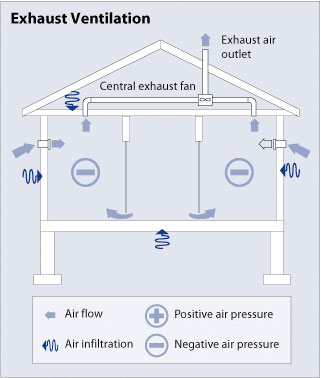
Image Credit: energysavers.gov
More Energy Solutions


The first question I usually get when I start talking about insulating and buttoning-up houses is, “Won’t my house be too tight?” It’s a very logical question.
Tight houses need fresh air
As we make houses tighter, less air flows through them. With less circulation, pollutants in the house can build up. These pollutants can include carbon dioxide from our breathing, smoke from burning our toast, volatile organic compounds (VOCs) from cleaning materials and furnishings, moisture (which isn’t a pollutant itself, but causes mold and other problems), and, yes, even bathroom deodorizers that often contain harmful chemicals. Without as much fresh air getting in to dilute those pollutants and replenish the oxygen we need, aren’t we going to suffocate? Shouldn’t the house be left leaky?
The concern is right on—that a tight house without enough fresh air is a bad thing. But the solution—to keep the house leaky—is wrong.
There are several problems with the idea of relying on a leaky building envelope to ensure adequate fresh air in a house.
Leaky houses costs you money and waste energy
In a typical house, air leakage can account for 25-40% of the total heat loss of the house. If we increase insulation levels and put in better windows but leave the house leaky, the fraction of total heat loss coming from air leakage increases. Cold air leaking in means dollars leaking out. To make matters worse, the rate of air leakage is highest when the energy impact of that leakage is the greatest—when it’s very cold or very windy.
Air leaks can cause moisture problems
When warm air leaks out through cracks and gaps in your building envelope during the winter, that air cools off and may reach the “dew point.” This is the temperature at which water vapor (a constituent of all air) can condense into liquid water.
The dew point depends on the temperature as well as the relative humidity—the higher the relative humidity the higher the temperature at which the dew point will be reached. When condensation occurs within your walls or ceiling, stuff gets wet.
Mold can grow—potentially making you sick—and cellulosic materials like wood can rot.
You can’t rely on air leaks to be reliable
The strategy of keeping your house intentionally leaky can’t even be relied on to provide fresh air. Air movement through a building envelope depends not only on the envelope leakiness, but also on the “pressure differential” across the envelope. When it’s windy, there’s a pressure differential—on the upwind side fresh air is pushed in through those gaps in the house, and on the downwind side stale house air is sucked out. And when it’s really cold outside, the “stack effect” pushes warm air out through the envelope high in the house and sucks in outside air near ground level.
The problem is that there isn’t always one of these situations to create that pressure differential we need for fresh air. On a day without much wind during the spring and fall months, when it’s not that much colder outside than in, the differences in pressure won’t be enough to cause much air exchange—even with a quite leaky envelope, so you won’t be ensuring fresh air.
Tighter houses are better houses
My answer to the question of how tight we should make our houses is “really, really tight.” But we also need to provide mechanical ventilation. With a ventilation system—which can be as simple as the continuous or intermittent operation of quiet bathroom fans with intentional air inlets, to a whole-house ventilation system—you will be sure of getting the fresh air you need. With an extremely airtight envelope and a mechanical ventilation system that controls exactly where and how much air is brought in and exhausted, you get the quantity of fresh air you need, you deliver that fresh air where it’s needed, and you get it consistently, whether it’s windy or not and no matter the outside temperature.
“Whole-house” ventilation is most effective because the fresh air is delivered exactly where it’s intended (bedrooms and living room, for example) and stale air is exhausted from the places pollutants are most likely to be produced (typically bathrooms and kitchens).
With whole-house ventilation, you can also capture heat from the outgoing air stream and transfer it to the incoming fresh air. This is accomplished with a “heat-recovery ventilator” or “air-to-air heat exchanger.” This strategy makes a great deal of sense in cold climates, such as ours, though it does increase cost.
FURTHER RESOURCES
#
Green Primer:
Can Houses be “Too Insulated ” or “Too Tight”?
Green Building Encyclopedia article:
Air Leaks Waste Energy and Rot Houses
Ventilation Choices: Three Ways to Keep Indoor Air Clean
Blogs:
Heating a Tight, Well-Insulated House
What’s the Most Cost-Effective Way to Bring Fresh Air into a Tight House?
Tight Houses: A Good Idea (and Code Requirement)
Passivhaus Homes are Extremely Tight and Energy-Efficient
Weekly Newsletter
Get building science and energy efficiency advice, plus special offers, in your inbox.




13 Comments
Really,Really Tight .....ACH50?
Alex.."really, really tight" is not a standard that can be measured and verified.
If you were in charge...what value would you choose as a minimum standard?
Do HRV's not make sense in Mixed or Hot Climates?
You could say .."Gee, I can only recover 50 or 60% of the Energy in a hot climate"
or you could say "WOW!! I can recover 50 or 60% of the Energy!!"
Enclosure System of Choice?
I enjoyed reading your blog post and agree that that proper answer is not to intentionally allow leaks in the shell. I was curious, though, what your enclosure system of choice would be and what recommended R-value you would suggest. (ie. Structural Insulated Panels, conventionally framed walls, built up roof system, etc.). We often apply a vented built up roof system with an R30. Ventilation is still key, as you mention.
Amy Good
http://www.lancotf.com
good article, sound like alot
good article, sound like alot of the same information we have been getting from the buidingscience institute and EEBA! great to see more articles like this. we are in the process of certifying a Remodel LEED for Homes house that tested out at .5 ACH 50 ( .5 air changes at 50 pascals pressure with blower door ) this was a great example of what can be done when the contractors pay attention to the detail. the home has a HRV for mechanical ventilation, and the really cool thing is this is a remodel of a home that a builder had done a very poor job of air sealing, insuulation, or any other items when it was built. now we control the air leakage, HVAC is easlier to manage, the home is healthier and more durrable, all from some attention to the details!
Air tight is too tight?
I have plans to build a house made from 6 1/2 " polyurethane panels. We want to make the house as sealed as possible. I understand fresh air and I appreciated the ventilation diagram, is there a recommended air conditioner/ air filter that is energy star efficient that would take care of our concerns?
Airtight with 6-1/2-inch polyurethane panels
If you do a good job sealing between the polyurethane panels (I assume these are SIPs) and depending on where you're located, I think you'll want a "balanced" ventilation system with heat recovery. In other words, use a heat-recovery ventilator (air-to-air heat exchanger) with one fan that brings fresh air in and a second fan the pulls stale air out (and a heat exchanger between). Both the air supply and outlet registers should be ducted and put exactly where they are needed. Unless you have particular problems that call for filtration, that may not be needed. As for air conditioning (cooling), if you in a moderate or cool climate with such a well-insulated envelope, your cooling load will be very small, so you could probably put a small cooling coil in the air supply duct to deliver cooling with the fresh air. Talk with a good HVAC engineer in your area about this strategy. -Alex
Great post, Alex
Thanks for posting this. Would you mind if I were to put a link to this in my Living in Comfort and Joy blog at http://nicolettet.wordpress.com I have blog fairly frequently about indoor air quality and energy efficient building envelopes, and your post is both knowledgeable and accessible.
Feel free to link to this blog
Nicolette,
You are welcome to put links to any of my posts in your own blog. A new Energy Solutions blog is posted weekly--usually on Tuesday. -Alex
Tad Duby LEED Remodel...Question
Hello Tad,
That is an excellent ACH ... especially for a remodel...
Can you give a little bit of detail on how you created your Primary air barrier.
Controling air leakage is priceless.
JB
You got a link on Living in Comfort and Joy
Thank you Alex. I added a link for your blog to my sustainability blogroll at http://nicolettet.wordpress.com
Tight?
Well, we do this every day, of every week, of every month.
I just tell people be sure NOT to burn the bacon.
Tight
Spray Foam installations Nationwide, that is.
[email protected]
How Tight is Too Tight
What a load of horse manure. To build a technical argument around the assumption that every builder and age that went before didn't know what they were doing is no argument at all. The last point that new and tight is better is a self perpetuating argument (like if you don't believe me, just ask me.) I have seen too many efficient radiator systems scraped in favor of the inefficiency of force air simple because all the "leaks" in the windows above the radiators had been block and cold spots created. Check with the CDC and get their estimates on the rate of healthy air exchange before you perpetual the isolation from our natural environment that plagues modern world.
How tight is too tight?
Roy,
To get the natural environment inside, how many windows do you recommend we leave out of the enclosure? Do you recommend a minimum number of wall cracks for adequate ventilation?
Tight is right. You must ventilate as well--and not through wall or window defects.
Log in or create an account to post a comment.
Sign up Log in