
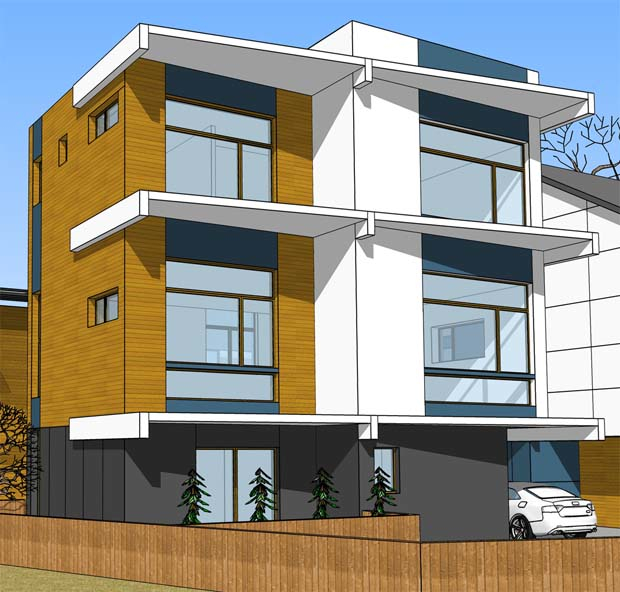
Image Credit: Dwell Development
More Green Building News


A Seattle developer has sold what he thinks is the first built-on-spec Passivhaus building in Washington state. And the sale bodes well for builders specializing in these extremely efficient designs.
The 2,000-sq. ft. house, built on an infill lot at 3153 S. Oregon Street, is located in Seattle’s Columbia City area, in a cluster of 15 homes built by Dwell Development. Unit 13, as it’s called, was sold last November during the framing stage. A recent blower-door test confirmed that the house meets the Passivhaus airtightness standard of no more than 0.6 air changes per hour at 50 pascals of pressure (ach50).
Still under construction, the house has 14-inch-thick double-stud walls (R-45) that will be filled with cellulose insulation. It also has an R-70 roof and triple-pane windows manufactured by Intus. The water-resistive barrier is Tremco EnviroDri. (For more specs, use the link for the Brute Force Collaborative website below.)
The incremental cost was only $35,000
Anthony Maschmedt, the developer, says he’s certain the house is the first spec Passivhaus in Washington State, and fairly certain it’s the first on an infill lot anywhere in the Pacific Northwest. The Columbia City area is on Seattle’s light-rail line and only a five-minute train ride from the city’s downtown.
The house sold for $535,000. Other houses in the Dwell development range in cost from the high $300,000s to the upper $400,000s, Maschmedt said. Features that should allow the house to become Passivhaus-certified at the close of construction added about $35,000 to the price tag.
Dwell builds between 15 and 20 homes per year. The company is building a total of 42 in Columbia City, including an additional two that will be built to the Passivhaus standard.
Unit 13 is the first Passivhaus building that Dwell has constructed. The design team included architect Julian Weber, Passivhaus consultant Brute Force Collaborative, and Tadashi Shiga, of Evergreen Certified.
The house sold quickly, and for a good price
What makes the project particularly encouraging to Maschmedt is that super-efficient homes are being snatched up by buyers even though they cost more than conventionally built homes. He says his houses typically are sold long before they’re finished.
“There’s a huge demand for it,” Maschmedt said. “Our homes are already selling for a premium compared to the competition.” He said another builder in the same community built a conventional, 1,500-sq. ft. home and had it on the market by 178 days before selling it for $305,000. Dwell built a house of the same size, had it on the market for “zero days,” and sold it for $420,000.
“When the economy went down and people were struggling to sell, our homes continued to sell because people who were buying in a down economy were doing their homework and wanted value,” he said.
Nothing made that clearer to Maschmedt than comparing his sales results with those of his fellow developer, someone he says is delivering a “good product.”
“We’re selling ours with zero market days for $120,000 more than he’s selling his for,” he said. “That’s for the same size house on the same street. I would love to make Passive our new standard, and that’s what we’re trying to do — to make Passivhaus our standard spec,” Maschmedt said. “Every home we do. That’s my goal.”
Weekly Newsletter
Get building science and energy efficiency advice, plus special offers, in your inbox.
One Comment
Good for him and nice looking
Good for him and nice looking project!
Unfortunately, paying 100 000$ more for a house because it is built to passivhaus standards is only possible for well fortuned families. How long does 100K$ need to recoup even if 0 energy was required for heating/cooling the building ??
From my very limited ( timewise and knowledgewise ) experience with Passivhaus/green projects,
i can sense that 2 lines of owners are going to exist in paralell:
1- well fortuned families that want to show everybody they have a passivhaus, they might care or not about it being green.
2- smart people using their calculator and purchasing homes with an added green value in term of energy consumption VS additional investment
Unfortunately, for most builders/designers/architects ...the 1st group is where the $$$ is and it is what will be pushed for now by most.
Same situation as the first batch of hybrids and EV cars.
a 50 000$ VOLT ( that's what they sell for here for now ) doesn't represent a really smart investment
as far as $$$ is involved. ( just like most 30K$+ hybrids do )
Now if you have the wallet, and wish to live greener, then all the merit is for you!! :)
my 0.25kw/h
Log in or create an account to post a comment.
Sign up Log in