Insulation Choices
The Right Choice Depends on the Job at Hand
Batts/BlanketsBatts are readily available, are inexpensive, and can be installed without special equipment. Cost: Low | Blown-In/Loose FillLoose-fill insulation can be blown into attics or dense-packed into framing cavities. Cost: Low | Rigid Foam BoardRigid foam is frequently used to insulate foundations and the exterior or interior of walls or roofs. Cost: Moderate | Spray FoamSpray foam seals air leaks as it provides an excellent layer of insulation. Cost: High |
ABOUT INSULATION CHOICES
Insulation cuts pollution and fossil-fuel demand
Insulation is one of the most important components of any environmentally responsible building because it reduces energy consumption and therefore pollution. More insulation means less coal is burned at the power plant, and less gas or oil is burned in a furnace.
In fact, with good design and appropriate levels of insulation, you can minimize (or even eliminate) the need for central heating and cooling in many buildings. This principle is demonstrated in all superinsulated buildings, including PassivHausA residential building construction standard requiring very low levels of air leakage, very high levels of insulation, and windows with a very low U-factor. Developed in the early 1990s by Bo Adamson and Wolfgang Feist, the standard is now promoted by the Passivhaus Institut in Darmstadt, Germany. To meet the standard, a home must have an infiltration rate no greater than 0.60 AC/H @ 50 pascals, a maximum annual heating energy use of 15 kWh per square meter (4,755 Btu per square foot), a maximum annual cooling energy use of 15 kWh per square meter (1.39 kWh per square foot), and maximum source energy use for all purposes of 120 kWh per square meter (11.1 kWh per square foot). The standard recommends, but does not require, a maximum design heating load of 10 W per square meter and windows with a maximum U-factor of 0.14. The Passivhaus standard was developed for buildings in central and northern Europe; efforts are underway to clarify the best techniques to achieve the standard for buildings in hot climates. buildings.
In this sense, any insulation material is a “green” product. Green builders need to focus on choosing which insulation is greener or better for a particular application. A few considerations include:
When choosing an insulation material, consider how it will work with the rest of the wall, roof, and floor system—and also consider what additional functions, such as air sealing, the material might serve. Some types of insulation stop air movement and reduce heat flow while shedding water and allowing drying (the four functions of the building enclosure).
Here are a few issues to consider when pairing insulation materials and structural elements for maximum efficiency:
Life-cycle considerations
Because different types of insulation are made from different raw materials and are manufactured using different methods, their environmental impacts vary. These life-cycle impacts should be considered along with factors such as R-valueMeasure of resistance to heat flow; the higher the R-value, the lower the heat loss. The inverse of U-factor.
, air-sealing ability, and cost.
Installation—a 4% mistake yields a 50% penalty
Poorly installed insulation will not achieve the energy savings that its rated R-value would suggest. A California study concluded that a 4% void in fiberglass batts resulted in a 50% decrease in insulation effectiveness.
Structural partners
The type of structural framing also affects the performance of insulation. Steel studs conduct heat much more readily than wood studs, so they create thermal bridgingHeat flow that occurs across more conductive components in an otherwise well-insulated material, resulting in disproportionately significant heat loss. For example, steel studs in an insulated wall dramatically reduce the overall energy performance of the wall, because of thermal bridging through the steel.
that can bypass insulation installed in the cavities. The U.S. Department of Energy recommends that buildings with steel framing include exterior insulative sheathingMaterial, usually plywood or oriented strand board (OSB), but sometimes wooden boards, installed on the exterior of wall studs, rafters, or roof trusses; siding or roofing installed on the sheathing—sometimes over strapping to create a rainscreen.
in all U.S. climates.
Strengths and Weaknesses
BATTS / BLANKETS
Fiberglass batts are inexpensive and can be installed without special equipment. However, fiberglass batts do little to slow air leakage; to perform well, they must be installed in conjunction with a very well-detailed air barrierBuilding assembly components that work as a system to restrict air flow through the building envelope. Air barriers may or may not act as a vapor barrier. The air barrier can be on the exterior, the interior of the assembly, or both.. Unaddressed air leaks in fiberglass-insulated walls can easily lead to condensation and moisture problems.
Cotton batts are less likely to irritate the skin of insulation workers than fiberglass batts. However, they cost considerably more than fiberglass and have many of the same drawbacks that fiberglass batts do. They are also more difficult to install than fiberglass batts.
BLOWN-IN / LOOSE FILL
Blown-in cellulose is the first choice of many green builders for insulating walls, flat ceilings, and sloped ceilings. Because cellulose insulationThermal insulation made from recycled newspaper or other wastepaper; often treated with borates for fire and insect protection. is made from recycled newspaper, its manufacture has little negative environmental impact (in fact, there may be a positive environmental impact). Cellulose is inexpensive and better than fiberglass batts at reducing air infiltration. One disadvantage of cellulose: it doesn't respond well to moisture. When cellulose is exposed to a roof or plumbing leak, it becomes soggy and repulsive. Because cellulose is able to absorb and hold a lot of water, detection of roof or plumbing leaks may be delayed.
Blown-in fiberglass does a better job of filling nooks and crannies than fiberglass batts, and therefore performs better. To most green installers, however, chopped glass fibers are less environmentally benign than recycled newspaper.
RIGID FOAM SHEATHING
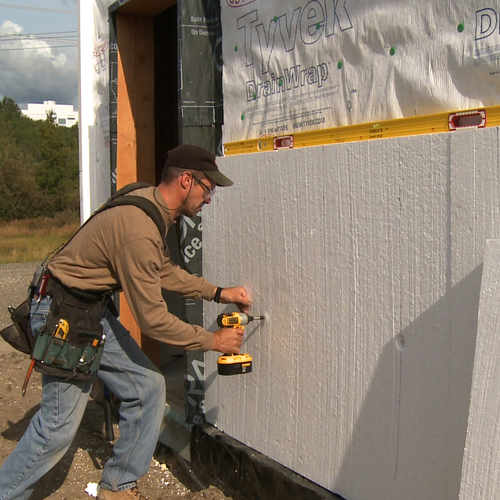
Rigid foam insulation is a more effective air barrier than batts, blankets, or blown-in insulation, especially if the seams between sheets are carefully sealed with caulk or tape.
Expanded polystyrene (EPSExpanded polystyrene. Type of rigid foam insulation that, unlike extruded polystyrene (XPS), does not contain ozone-depleting HCFCs. EPS frequently has a high recycled content. Its vapor permeability is higher and its R-value lower than XPS insulation. EPS insulation is classified by type: Type I is lowest in density and strength and Type X is highest.) is a versatile insulation that can be used below grade, on walls, or on roofs. EPS is less expensive than XPSExtruded polystyrene. Highly insulating, water-resistant rigid foam insulation that is widely used above and below grade, such as on exterior walls and underneath concrete floor slabs. In North America, XPS is made with ozone-depleting HCFC-142b. XPS has higher density and R-value and lower vapor permeability than EPS rigid insulation. or polyisoPolyisocyanurate foam is usually sold with aluminum foil facings. With an R-value of 6 to 6.5 per inch, it is the best insulator and most expensive of the three types of rigid foam. Foil-faced polyisocyanurate is almost impermeable to water vapor; a 1-in.-thick foil-faced board has a permeance of 0.05 perm. While polyisocyanurate was formerly manufactured using HCFCs as blowing agents, U.S. manufacturers have now switched to pentane. Pentane does not damage the earth’s ozone layer, although it may contribute to smog. . If the correct density is chosen for the application, EPS is not affected by moisture.
Extruded polystyrene (XPS) shares many of the strengths of EPS. However, it is stronger, denser, smoother, more water-resistant, and has a higher R-valueMeasure of resistance to heat flow; the higher the R-value, the lower the heat loss. The inverse of U-factor. per inch (R-5 for XPS versus R-3.8 for EPS). It also costs more than EPS.
Polyisocyanurate has the highest R-value per inch (R-6.5 to R-6.8) of any rigid insulation. Its blowing agent is environmentally benign, and it is free of the brominated flame-retardant chemicals that taint polystyrene. However, polyiso easily absorbs water, so it can't be used below grade.
SPRAY FOAMS
Closed-cell spray polyurethane foam performs better than any other insulation. It has a high R-value per inch (R-6.2 to R-6.5), it's impervious to moisture, and it's an effective vapor retarder. It is also an excellent air barrier. Closed-cell spray polyurethane foam can be used under slabs, on below-grade or above-grade walls, in ceilings, or even as roofing. It is also the most expensive residential insulation available.
Open-cell spray polyurethane foam has some but not all of the virtues of closed-cell foam. Like closed-cell foam, open-cell foam creates an effective air barrier. However, open-cell foam has an R-value of about R-3.6 per inch—much less than that of closed-cell. Unlike closed-cell foam, open-cell foam absorbs and holds water. It is also vapor-permeable, which can be a virtue or a drawback, depending on the application. Open-cell spray foam costs less than closed-cell foam.
Further Resources
Building Science Corp.
Guide to Insulating Sheathing by Joseph Lstiburek and Peter Baker
Fine Homebuilding
“Save Energy With Rigid-Foam Insulation” by Rick Arnold
Environmental Building News
“Revisiting Rigid Foam Insulation and Ozone”
“Insulation: Thermal Performance Is Just the Beginning”
Related Topics in the Green Building Encyclopedia
Image Credits:
- Bonded Logic
- Can-Cell Industries, Inc.
- CertainTeed


Yahoo
Technorati
Google
Facebook
Delicious
Digg
StumbleUpon
Reddit
Comments