
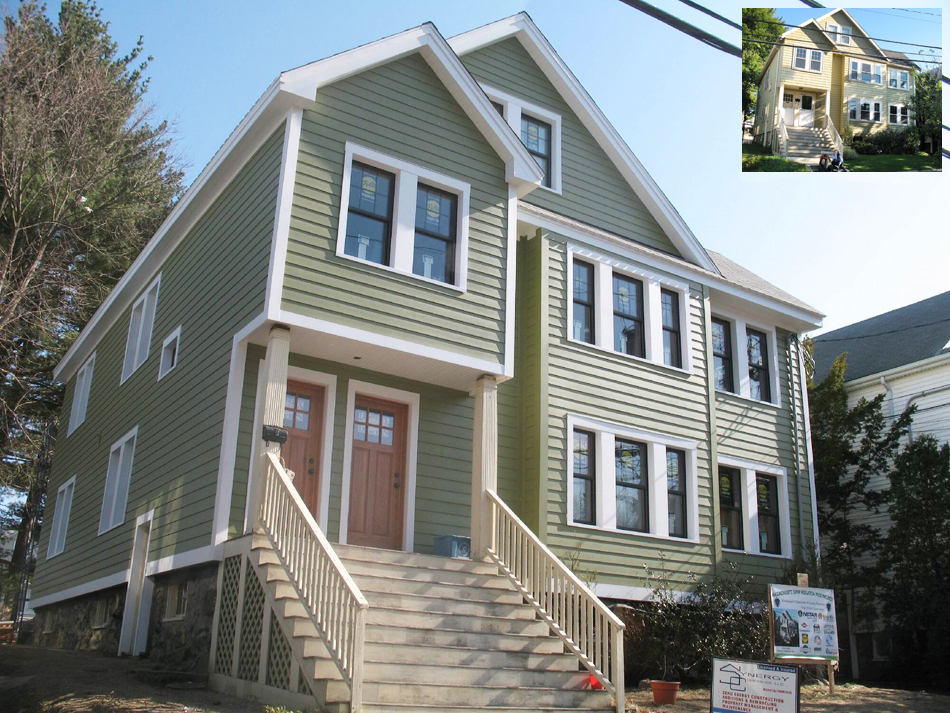
Image Credit: Alex Cheimets
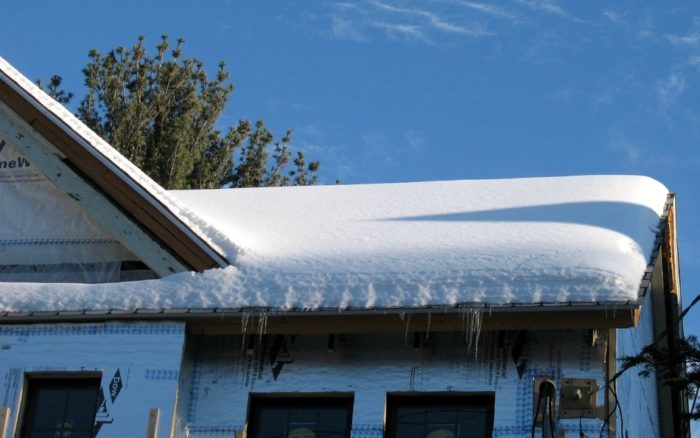
Image Credit: Alex Cheimets SNOW ON THE ROOF IS A GOOD THING. It proves that the new insulation does exactly what it should—it keeps the heat inside the house.
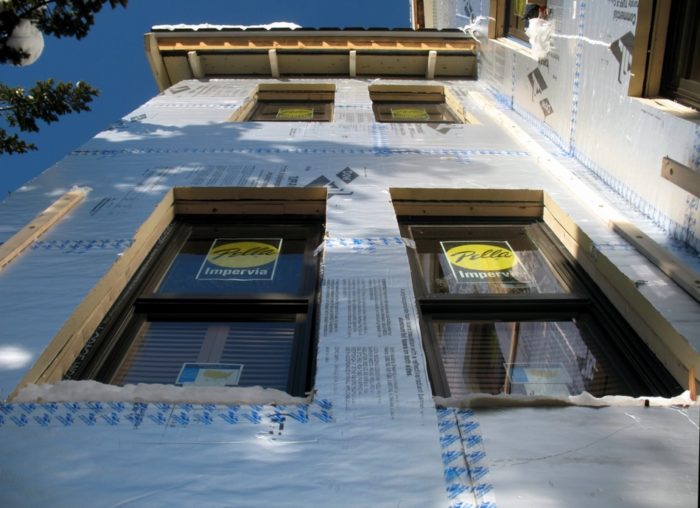
Image Credit: Alex Cheimets LIKE A GOOD WINTER COAT, the foam sheathing leaves very little exposed to the elements. The windows are already flashed and taped to a layer of house wrap, so the taped seams on the foam are just one more line of defense against weather. The house was noticeably more comfortable by this stage of the project.
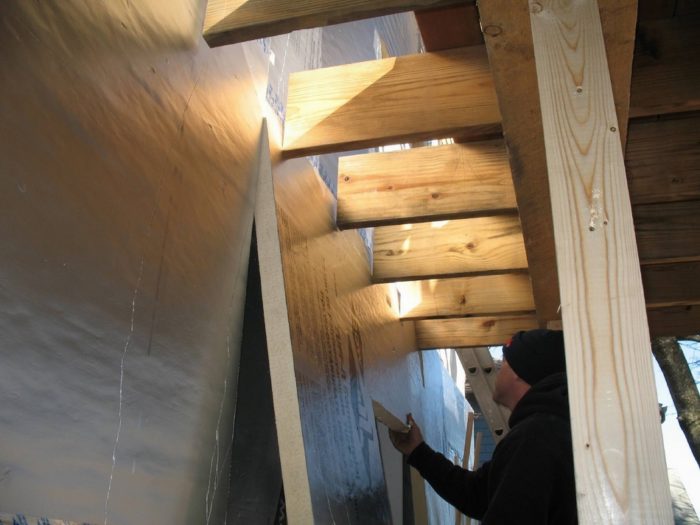
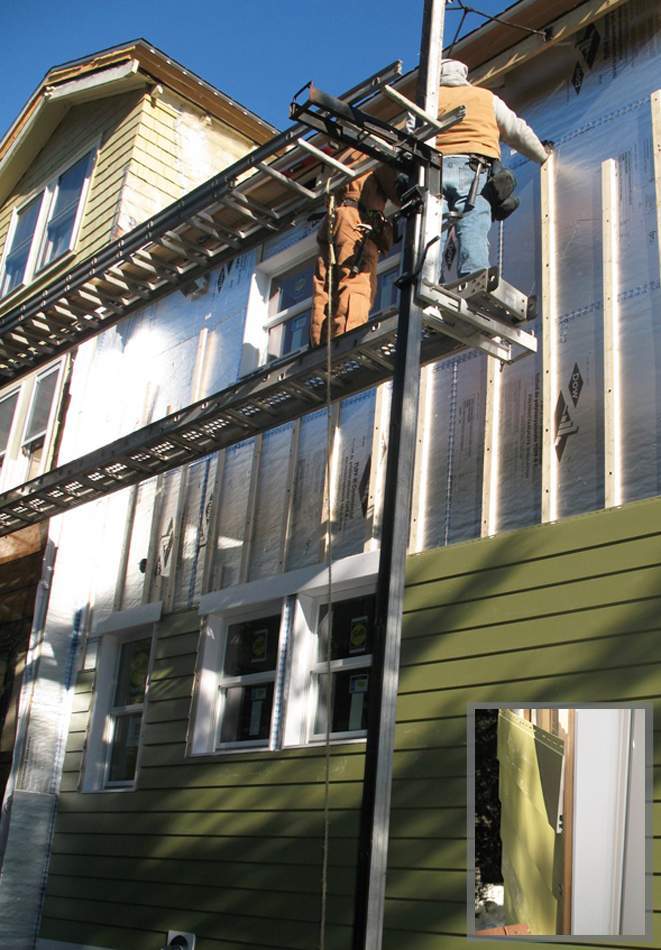
Image Credit: Alex Cheimets SEPARATING THE DECK CAN SAVE ENERGY. The goal of covering the whole house with insulating sheathing is to prevent all possible thermal bridging, and the deck is no exception. Synergy Companies Construction carefully trimmed the framing and reconnected it after the foam boards were in place.
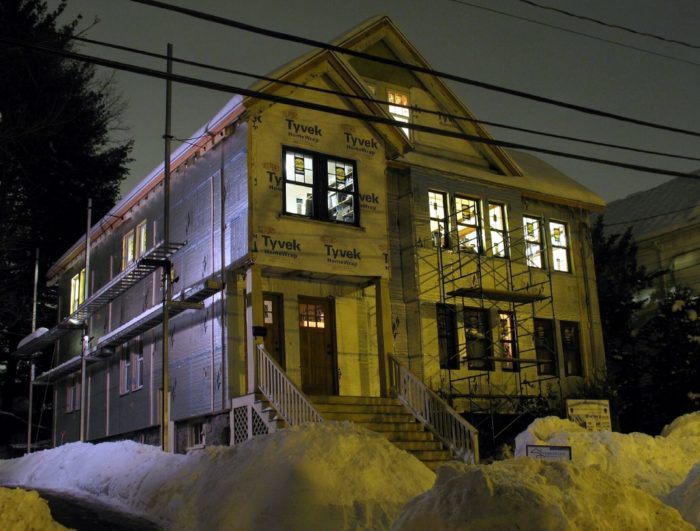
Image Credit: Alex Cheimets HARD TO MISS—EVEN AT NIGHT. Homeowner Alex Cheimets liked the warm glow of the foil-faced foam at night so much that he wished he could skip the siding. With the house wrap on and the foam installation almost done, it's time to get ready for the new clapboards.
Image Credit: Alex Cheimets DURABLE DETAILS. The space created by furring strips under the new siding should help drain away any moisture that finds its way into the wall assembly. The clapboard siding is made of prefinished cellular PVC with an integral blind fastening system that doesn't offer much chance for water to enter in the first place.
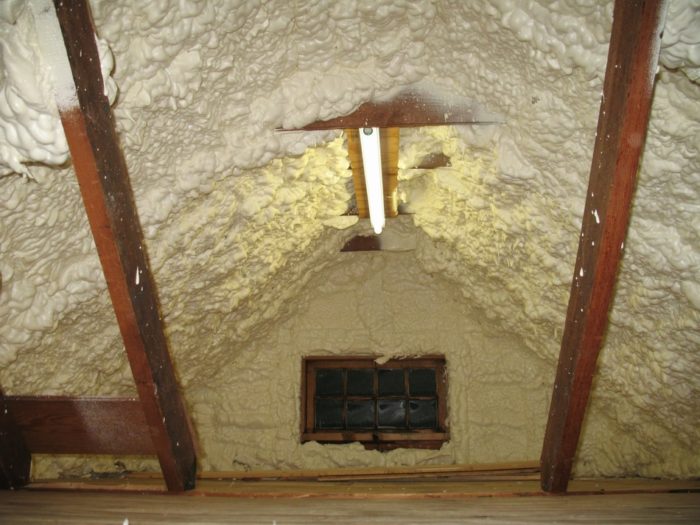
Image Credit: Alex Cheimets COMPLETELY COVERED. After the contractors pulled bags and bags of dirty, poorly installed fiberglass batts from the accessible portions of the attic, the insulation installers completely filled every rafter bay with Icynene, a low-density, open-cell spray foam.
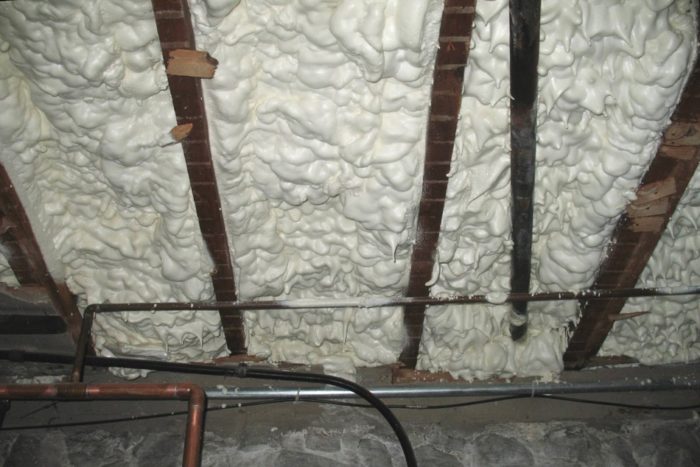
Image Credit: Alex Cheimets AN ACCEPTABLE COMPROMISE? To effectively isolate the basement from the living space above, the contractors had to tear down tons of plaster from the ceiling and meticulously fill every nook and cranny with spray foam-insulation. Building Science Corporation had advised against this, hoping that homeowner Alex Cheimets would include the basement in the insulated and conditioned space of the home to harness residual heat from the boiler. Alex is prepared to keep an eye on the home's performance and reconsider this option in the future.
Image Credit: Alex Cheimets
A vintage home gets a 21st-century energy overhaul
What started out as a relatively straightforward re-siding project on this 80-year-old duplex in Arlington, Mass., ultimately evolved into part of an ambitious superinsulation pilot program for the Massachusetts Department of Energy Resources (DOER) and the regional utility company, NSTAR.
Upon contacting the state for technical advice, homeowner Alex Cheimets learned that the DOER was in the middle of developing standards for net-zero-energy buildings and agreed to include his home in the research. The state brought NSTAR into the project. NSTAR brought in Building Science Corp.
to conduct a study of the building and make recommendations on the overall design and details of the insulation retrofit. Explaining that the project would serve as a model for broader reaching energy-efficiency programs, Alex convinced several sponsors
to donate most of the materials, including the rigid foam (Dow), spray foam (Anderson Insulation), roofing (Atlas), and siding (NuCedar). This brought the budget closer to what Alex had initially set out to spend. The hope is that lessons learned on this retrofit could help lower the cost on similar projects in the future.
Save energy before making energy
Rather than adding complex heating systems or renewable energy sources, this project focused on keeping the actual demand for energy to a minimum. More than just minimizing disturbance of the existing home, adding insulation to the exterior would effectively reduce thermal bridging through the framing. Plus, with 2×4 walls (already filled with cellulose insulation), there was no other reasonable way to get the R-values they needed.
Lots of rigid foam
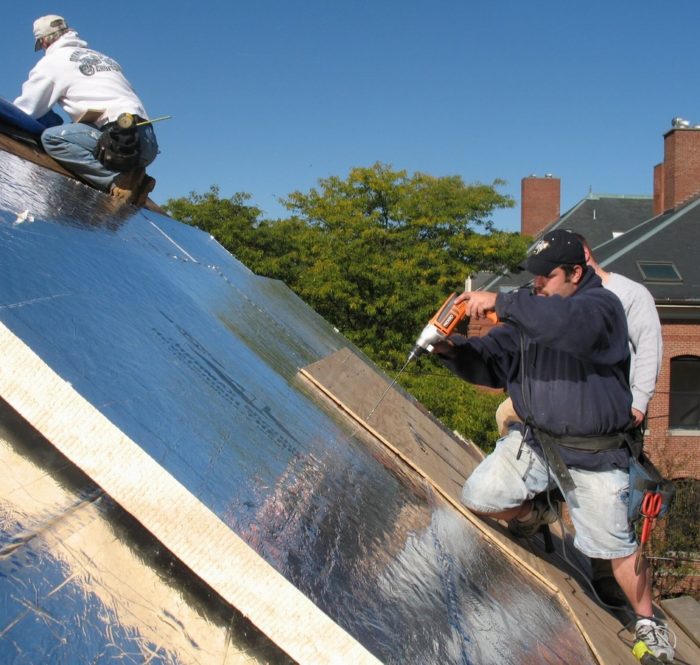
Contractors from Synergy Companies Construction started by stripping the roof. Then they applied two layers of 3-in. foil-faced polyisocyanurate foam, a layer of plywood sheathing, a self-adhesive roofing underlayment, and asphalt shingles. Alex chose the shingles for their durability (50-plus years) and their light, heat-reflecting color.
After the roof was complete and the double-pane, fiberglass-framed windows were in, the crew covered the exterior walls with four inches of rigid foam (2 layers of 2-inch) and taped all the seams. Of course air and weather sealing are just as important as insulation in a project like this, so Synergy meticulously caulked and flashed all windows and doors before the foam went on. Regardless of the choice to replace the existing windows, the new flashing was essential because superinsulated walls dry much more slowly than old, leaky walls.
Furring strips screwed through the sufficiently dense foam provided a sturdy substrate for the new, prefinished cellular PVC clapboards. It did take a fair amount of shimming and tweaking to get everything straight, however.
Adjusting the plan
Even though exterior insulation was deemed the best option for most of this remodel, there were some exceptions. The energy consultants at Building Science felt that the ideal way to address the basement was to insulate the interior surface of the foundation, in order to recapture losses from the mechanical equipment and distribution system during the heating season. The project was already many times larger and more complicated than originally planned, and after careful consideration, Alex Cheimets decided that this was one place where he was comfortable scaling back. The good news is that his choice to isolate the space by installing between 4 and 8 inches of open-cell spray foam on the basement ceiling does not prevent him from insulating the walls in the future, should he reconsider.
The same low-density spray foam used below the living space would also give the roof some additional resistance to heat loss (and gain). After stripping a good deal of poorly installed fiberglass from most of the attic, the insulation contractors filled the empty rafter bays completely with foam. This was especially important for bridging the gap where the walls meet the roof.
Additional measures
Although preventing moisture, air, and heat from moving through the building envelope was the main priority, it wasn’t the only one. New heat-recovery ventilators (HRVs) in each apartment ensure that these now-supertight spaces will have good air to breathe. To further the goal of energy efficiency, Alex converted all the lighting in his apartment to CFLs and switched to an on-demand, gas-fired hot-water heater. One old steam boiler still provides all of the heat for his place, and his downstairs neighbor chose to keep her entire heat and hot water system intact for now. Alex plans to consider upgrading to a more efficient boiler after evaluating a year’s worth of energy data.
With several severe winter storms and a steady flow of reporters, government officials, and product reps, Synergy was still able to wrap up the whole project in about six months. This was far from its first experience with deep energy retrofits, and it only emphasized the company’s desire to be a continuing force in environmentally responsible construction.
Measuring success
During the project, Alex had a revelation that should be an inspiration to energy-conscious builders everywhere: “Seemed a shame to rig the house with the best insulation known to man but yet have no idea how much energy the house was using or saving.” Data-logging equipment from Onset Computer now tracks his home’s indoor and outdoor temperatures and humidity levels. Two neighbors volunteered to install similar systems in their conventionally insulated homes to collect comparative information. Daily measurements of fuel consumption made by an ultrasonic sensor (from VisiTank) fastened to Alex’s oil tank round out the set of data needed to accurately evaluate the home’s performance.
For more information on post-retrofit energy use at this house, see Massachusetts Superinsulation Project Reveals Impressive Results.
Weekly Newsletter
Get building science and energy efficiency advice, plus special offers, in your inbox.
Lessons Learned
Once the ball got rolling, Alex quickly realized that compromises were necessary to keep the project moving— particularly in material choices. If he had had his way, he would have taken more time to evaluate the sustainability and resource efficiency of everything that went into the home.
Exterior retrofits make sense
It depends on the conditions of the particular home, but the consensus seems to be that exterior insulation is the smartest way to boost energy efficiency of existing homes. Other than what Alex describes as a "week of hell" during the basement and attic demolition, the interior remained reasonably undisturbed during the entire process. The place was drafty and cold at times, but that's hardly unexpected when tearing into a house in the middle of a New England winter.
Overachieving doesn't always pay off
Building Science Corp. had specified 4-in. rigid insulation on the roof, but when Alex found out that 6-in. foam was available, he told Synergy, and they decided to go for it. A box of broken, 10-in. screws, a new set of impact drivers, and a week's worth of frustration later, they wonder if it was worth it. In the end, the roof worked out well, but the extra effort and cost were hard to justify.
General Specs and Team
| Location: | Arlington, MA |
|---|---|
| Bedrooms: | 6 |
| Bathrooms: | 3 |
| Living Space: | 3000 |
| Cost: | 33 |
| Additional Notes: | Completed: March 2009 |
Builder/contractor: Synergy Companies Construction, LLC
Energy consultant: Building Science Corporation
Construction
Basement: ceiling insulated with 4" to 8" of low-density spray polyurethane foam (Icynene)
Walls: existing cellulose-filled 2x4 studs; 4-in. of foil-faced polyisocyanurate foam outside of sheathing (R-39)
Windows: fiberglass frame, double-pane, argon-filled, low-e (U-factor: 0.33, SHGC: 0.29, Pella Impervia)
Roof: rafter bays filled with low-density spray foam (Icynene); 6-in. foil-faced polyisocyanurate foam outside sheathing; seams staggered and taped (R-59 total)
Further resources
Mass. Dept. of Energy Resources (DOER) and NSTAR plan to use information gathered from this insulation retrofit to help Massachusetts residents greatly improve the energy efficiency of their homes.
A detailed journal of the project and a complete list of sponsors can be found at Alex Cheimets' blog: superinsulating.blogspot.com
Energy
- All lighting converted to CFLs in unit 2
- Aggressive insulation strategies
Energy Specs
Heating/cooling: oil-fired steam boiler in each unit
Water heating: main boiler in unit 1; on-demand gas water heater in unit 2 (200,000 Btu, Rheem)
Annual energy use: To come
Water Efficiency
- Low-flow toilets and showerheads
Indoor Air Quality
- (2) HRVs (Fantech)
- CO sensors on every floor
- Basement ceiling is foamed/sealed to isolate moisture from living areas
- Interior basement access doors converted to exterior insulated doors with weather seals
Green Materials and Resource Efficiency
- Extra materials donated or reused on other projects
- Retained as much of the original structure as possible



22 Comments
Attic use and venting,
What was the use of the attic space? I assume it was not ventilated.
Attic use and venting
Attic is 60% living space with 3 bedrooms and a bathroom. The balance are crawl spaces. The attic is not ventilated. At the risk of mis-stating the consultant's report.......they recommend a "compact roof" which is unventilated. They also recommend that all barriers be on the same plane (water, vapor, insulation) meaning on or under the roof.
Furring Strips
Alex, I have been looking at your blog.
This photo of the icicle seems wrong...it looks like the furring strips are in the wrong place...creating a cold channel between the outsulation and the weather barrier...and there apears to be no furring strip between the siding and the outsulation.
http://4.bp.blogspot.com/_krzeS_nEpwk/SccUu4q3xMI/AAAAAAAAAxs/zihmaPHR5F4/s1600-h/813+Arlington+Mar+14.jpg
Warm moist air from the house may be leaking into the channel..condensing and freezing.
oops
Alex, I see the drainscreen furring strip now. It was out of frame on my screen.. so I had to pan to the right to see it.
Did you use any kind of insect screen at the bottom of the drainage channel?
iso on exterior
Do you see any issues with the iso on the exterior as a vapor barrier? Wouldn't this trap moisture in the cellulose and create a problem eventually even though cellulose is tolerant to moisture? i assume the principle is the assembly will dry to the inside??
Re: iso on exterior
Mark, this seems to be a question that many people are concerned with, as is evident in many of the [discussions](https://www.greenbuildingadvisor.com/search/node/vapor%20barrier) on our website. If you browse through the [building enclosure overview](https://www.greenbuildingadvisor.com/green-basics/good-building-enclosure-does-four-things-if-your-enclosure-isnt-good-it-isnt-green) in our Green Basics section you wiil find plenty of useful information. This envelope of this particular project closely resembles work Building Science Corp. did in [one of their own buildings](http://www.buildingscience.com/documents/case-studies/081103_MA_Concord_Retrofit_Case_Study.pdf). The principles of how the wall assembly works are covered [here](http://www.buildingscience.com/documents/primers/plonearticlemultipage.2006-11-14.1183847686/section-2-the-basic-cold-climate-house?full_view=1).
Answers from Alex
John, There is a plastic insect screen at the bottom of the wall assembly.
Mark, the thickness of the polyiso insulation is such that the vapor barrier will be too warm for the vapor to condense. As Rob indicated, this is Building Science Corp's SOP. That said, this was the issue that kept me awake at night the most, and I'm not using that phrase as an expression. Awake! That said, I discussed this concern with the Mass Dept of Energy Resources, and other green developers and energy modelers and they all agreed with the BSC design. And so here we are.
What about the Network of cavities?
Alex,
I understand the outsulation concept for new construction where you can create an almost perfect air barrier from the inside to the outside. It seems like the spray foam at the underside of the roof deck will take care of things in your attic..but what about the walls? How did you achieve an almost perfect air barrier in the existing walls? What were the blower door results?
The icicle photo from your blog is still a little disconcerting. It looks like the ice is forming between the sheathing and the WRB not between the WRB and the outsulation.
Did you ever confirm the source of the icicle?
Agreed that the outsulation in theory will keep the WRB "warm enough"... but what about the network of cavities between the polyiso panels?
What keeps cold outside air out of those cavities?
I know that the panels are taped on the face..what about all the edges near windows and at the top and bottom of the wall? Why is this any different than The SIP failure problem in Juneau Alaska?
What's your biggest concern?
John, maybe Alex will have something more to add, but what are you most worried is going to happen? I don't see how Alex's insulation compares to the SIP problem you mentioned. With the multiple drainage planes, even if there were some leaks, most of the moisuture would find its way downward out of the assembly. Also, there's no OSB (or other moisture sensitive materials) in a place where moisture would be trapped as in the SIP roof scenario. Alex also pointed out that, even if he hadn't replaced the windows, he still would have pulled all of the old windows to re-flash and air seal them to work with the new wall assembly.
What me worry?
I know..I worry too much and ask too many questions... Jeneau Alaska is an extreme climate and an extreme example and the fact that this project does not involve OSB is a good thing.
My understanding is that the Jeneau SIP failures were do to air leakage and moisture accumulation.
The network of cavities between the sip panels was not a large area... but large enough to cause damage.
The Icicle photo from Alex's Blog made me wonder if the Walls were airtight.
Perhaps the icicle is the result of improper flashing or a plumbing leak..but what if is not?
Was there a plumbing leak? Alex..did you find a plumbing leak?Or did warm moist air from the basement or house find its way to an interface with a cold crevice between the panels or a cold zone between the panels and the existing wall?
It is not clear to me from the article or the Blog if any measures were taken to make the walls airtight before the tyvek and Polyiso were installed.
If the walls are airtight ..and if the icicle is the result of a plumbing leak..then I have no concerns.
Great Blog
Alex, I really enjoyed your blog.
http://superinsulating.blogspot.com/
Thank you for documenting your project and your thoughts.
More Blog Questions
Alex,
Concerning the photo from December 2008
http://4.bp.blogspot.com/_krzeS_nEpwk/SeP_yYBN7iI/AAAAAAAAA0k/p65IX2I44Bk/s1600-h/351+Arlington+Dec+22.jpg
Was the 4 inches of rigid foam in place when that photo was taken?
Concerning the basement photos:
http://4.bp.blogspot.com/_krzeS_nEpwk/SeKtbFSD-NI/AAAAAAAAAz0/jUOXUcco4aQ/s1600-h/861+Arlington+Apr+12.jpg
Why did you choose to not spray foam on the underside of the floor joists and encapsulate the joists like you did in the attic?
Concerning the HRV in the basement: Why is there no insulation on the duct that supplies the fresh preheated air to the house? It seems to me like you are "exchanging" the heat with the basement that you just paid to recover.
SIPs Original Built and SIPs retrofit
Thanks for posting and look forward to reading the details. I built a SIPs home in 2004 It is an Urban in-fill, two-family, "green", SIPs & Universal Design - Age-in-Place home. Now I have to buy an additional home at a new job location to live in during the work-week. I am "Spoiled" by SIPs construction and thought I would have to build again to get what I crave. Now seeing that retrofitting is possible - I can look at normal houses on the market and dream of changing them.
OF course training the construction crew is often the toughest part.
Very Late Answers
Sorry guys for these late answers. I did not know this was continuing.
Answers to Mr. Brooks:
1) Icicle
The icicle was another one of those sleepless night issues until I realized that it was located where the outdoor water spigot once was and would return. The old spigot was cut off during construction, and the inner valve was 99.8% closed. That 0.2% formed the icicle until the pipe extension and new spigot were attached. Problem solved.
2) Cavities beween Polyiso Panels
Fine! Another thing to keep me awake! :-) Actually firring strips lock down the panels squeezing out the air between panels. The taped seams makes air entry difficult, but the fasteners and firring strips eliminates venting between the panels. Beyond this explanation, I'm not qualified to answer.
3) Air tight walls.
The walls inside are plaster on lathe. Not airtight. The other walls are polyiso on tyvek on sheathing. There is no inner vapor barrier. The foil faced on the Polyiso is the outer vapor barrier.
4) Moisture Management Windows and Doors
All the windows and doors have been reflashed. The window (jam, frame?) boxy thing extends from the current window out and manages the water out. The reality is that I'm relying on the skills of the contractor and the background work of the consultants.
5A) Foaming Photos: Attic
In the photo referenced, the 6" roof insulation was already installed, but the crawl space window in the photo was to be removed so the 4" of exterior polyiso was not yet installed on this particular outer wall.
5B) Basement foaming
The foaming was mostly, though not entirely, used to seal leaks, so encapsulating the beams was not necessary. Further, encapsulation would have had problems of burying water lines and wiring, and reducing head room.
6) HRV Ducting Insulation in Basement
That is an excellent question, and you have a great eye. You're good. Sitting at my computer, I think we would want:
-pre-HRV incoming air to be through an un-insulated duct (basement is warmer than air)
-post-HRV incoming air to be hmmm. Not sure
-pre-HRV outgoing air to be in insulated duct (air is warmer than basement)
-post-HRV outgoing air to be un-insulated (unimportant).
Perhaps the other issue is simply convection, losing heat to the basement through the duct, so everything should be insulated. I'll bring the question up with the contractors.
Energy Use Results
So where are the results? Can you post the data that shows what the improvements have actually been?
Alex, would you advice on similar but different setup ?
Due to a limited height of attic (and other factors), I am installing 2 layers of seams-taped 3" polyiso boards on the floor of the attic (midwest, vented roof). It looks like I can get a better deal / better quality polyiso if I go with foil-based polyiso (vs. fiber-faced), but I am concerned with multiple vapor barriers that foil would create (I also use ZIP roofing panels as the roof decking which is also a vapor barrier.
Do you think I could just puncture little holes (like using fork) in foil and that would eliminate vapor barrier ?
Any ideas ?
Thanks in advance.
Alex
Stop by our Q&A
Alex L.,
Have you used our [Q&A forum](/community/317) before? Not that Alex C. won't have a great answer for you, but you'll have a good chance of getting several great responses there.
Acoustics
Sealing the house with all that spray foam surely decreased the sound transfer from outside and from mechanical equipment in the basement. Somebody should get a sound pressure level meter and check the outside vs inside noise level and compare it to the neighbor's houses. Make some noise outside, like jam a broom stick against the car horn while you take measurements.
Wow, that a lot of petroleum!
With the asphalt roofing, the polyiso, closed cell spray foam, the rigid styrene, the PVC siding, and the fiberglass window frames, sure seems like your supporting foreign oil, not reducing our dependence on it. Burning coal is bad, but wrapping our buildings up tight in a bunch of inorganic materials seems like trouble ahead to me, in more ways then one. Just my two cents....
What about cellulose
With the extent of time an materials involved, it seems like the interior could have had another wall built on the exterior wall and then blown with cellulose. I am sure that would have been less expense and provided a much greener project. With this method you can make the R-value as high as you want.
detail at bottom of wall
When you add 2 layers of 2-inch board insulation to the outside of 2-x-4 framing, what prevents atmospheric moisture or wind-driven rain from wicking up into the wall assembly at the cut ends of the insulation at the bottom?
Response to Diane Blitzer
Diane,
Usually, metal flashing. This video shows how:
https://www.greenbuildingadvisor.com/video-how-install-rigid-foam-insulation-outside-house
Log in or create an account to post a comment.
Sign up Log in