Q&A Spotlight

Q&A Spotlight: Basement-to-Living-Space Moisture Problems

Posted on October 8, 2010 by Scott Gibson

Scott Razzino has an all-too-familiar problem. The basement of his 1,100-sq.-ft. home in Atlanta is chronically damp. He's installed a 65-pint dehumidifier, which must be emptied every day. Surely, he wonders in this Q&A post, there must be a better way to tackle the problem.

Should Insulated Concrete Forms be Air-Sealed?

Posted on October 4, 2010 by Scott Gibson

Roger Lin is planning to use insulated concrete forms in a house he hopes will meet the PassivhausA residential building construction standard requiring very low levels of air leakage, very high levels of insulation, and windows with a very low U-factor. Developed in the early 1990s by Bo Adamson and Wolfgang Feist, the standard is now promoted by the Passivhaus Institut in Darmstadt, Germany. To meet the standard, a home must have an infiltration rate no greater than 0.60 AC/H @ 50 pascals, a maximum annual heating energy use of 15 kWh per square meter (4,755 Btu per square foot), a maximum annual cooling energy use of 15 kWh per square meter (1.39 kWh per square foot), and maximum source energy use for all purposes of 120 kWh per square meter (11.1 kWh per square foot). The standard recommends, but does not require, a maximum design heating load of 10 W per square meter and windows with a maximum U-factor of 0.14. The Passivhaus standard was developed for buildings in central and northern Europe; efforts are underway to clarify the best techniques to achieve the standard for buildings in hot climates. standard of 0.6 air changes per hour at 50 Pascals (ACH50). ICFs are rigid foam building blocks stacked like Legos and then filled with concrete.

Lin has been told by ICF manufacturers they won't need air-sealing, but he's not so sure.

Building an Energy-Efficient Home on a Budget

Posted on September 27, 2010 by Scott Gibson

John Holscher has done enough research to know there are many ways of building and insulating an energy-efficient home. Options include double-stud walls, 2x6 walls with rigid foam on the exterior, and structural insulated panels.

Now he has to figure out which one makes the most sense for his Cape-style home in New England.

"So many options, so little time," he writes in his Q&A post.

Choosing Equipment for a Whole-House Ventilation System

Posted on September 20, 2010 by Scott Gibson

Tight, super-insulated houses need some kind of mechanical ventilation to keep indoor air healthy. Installing exhaust fans in the kitchen and bathrooms is the simplest option. More often, energy-efficient builders install either a heat-recovery ventilator (HRV(HRV). Balanced ventilation system in which most of the heat from outgoing exhaust air is transferred to incoming fresh air via an air-to-air heat exchanger; a similar device, an energy-recovery ventilator, also transfers water vapor. HRVs recover 50% to 80% of the heat in exhausted air. In hot climates, the function is reversed so that the cooler inside air reduces the temperature of the incoming hot air. ) or an energy-recovery ventilator (ERV(ERV). The part of a balanced ventilation system that captures water vapor and heat from one airstream to condition another. In cold climates, water vapor captured from the outgoing airstream by ERVs can humidify incoming air. In hot-humid climates, ERVs can help maintain (but not reduce) the interior relative humidity as outside air is conditioned by the ERV.).

Is Tripolymer Spray Foam Insulation a Healthy Choice?

Posted on September 13, 2010 by Scott Gibson

When builders talk about spray-foam insulation, we assume they're referring to a two-part polyurethane compound. But not always, as a recent Q&A demonstrates.

Amanda Cordano launched an interesting but inconclusive conversation when she asked for advice on "Tripolymer product," which had been told was a green product with no health risks.

Green Home Appraisal Woes

Posted on September 7, 2010 by Scott Gibson

Passive solar designs that include generous amounts of insulation can save homeowners a great deal of money in operating costs over the life of the house. But getting banks to approve loans that reflect somewhat higher construction costs can be a struggle, sometimes forcing builders to dial back their plans and deliver a less efficient house.

This dilemma was at the heart of a question from a green builder and the topic of this week's Q&A Spotlight.

How To Combine Board and Batten Siding With Exterior Rigid Foam?

Posted on September 1, 2010 by Scott Gibson

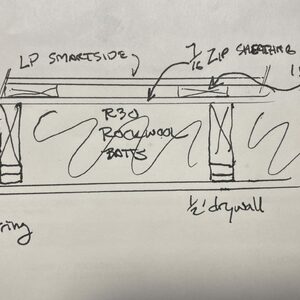
Claire Remsberg, an architect in the Rocky Mountain region, is working on a house where the main goals are to limit thermal bridgingHeat flow that occurs across more conductive components in an otherwise well-insulated material, resulting in disproportionately significant heat loss. For example, steel studs in an insulated wall dramatically reduce the overall energy performance of the wall, because of thermal bridging through the steel. through the 2x6 wood frame and to beef up wall R-values. Plans call for vertical wood siding over a layer of rigid foam insulation.

If that sounds more or less straightforward, the details are not. The contractor has limited experience working with rigid exterior insulation, Remsberg writes, and has concerns that installing siding directly over the foam may not be a great idea.

Can You Heat a House with Air Ducts in a Concrete Floor?

Posted on August 30, 2010 by Scott Gibson

Concrete floors with high thermal massHeavy, high-heat-capacity material that can absorb and store a significant amount of heat; used in passive solar heating to keep the house warm at night. are often at the heart of passive solar designs. The density of concrete helps it store thermal energy and helps to reduce uncomfortable swings in indoor temperatures.

Slabs collect some heat from the sun through south-facing windows, often supplemented by radiant-floor heating systems that use a network of embedded plastic tubing to circulate hot water.

Is Bubble Wrap Duct Insulation a Good Idea?

Posted on August 23, 2010 by Scott Gibson

Lora's question seemed innocent enough, but it was enough to touch off a war of words and prove that building science isn't always as dryly academic as you might guess. It can, in fact, get downright cantankerous.

Lora's HVAC(Heating, ventilation, and air conditioning). Collectively, the mechanical systems that heat, ventilate, and cool a building. installer wanted to insulate the ducts in her house with double-wrapped bubble wrap "as a cheaper way to achieve R-6." Fine, she thought, but does the stuff really work?

Vapor Barriers Are a Good Thing, Right?

Posted on August 17, 2010 by Scott Gibson

At the dawn of our current interest in building science, sheets of polyethylene were routinely stapled to interior framing before drywall was installed. The idea was to block the flow of water vapor into exterior walls. (Some builders tried to make their polyethylene seams airtight, so that the poly would do double duty — acting as an air barrierBuilding assembly components that work as a system to restrict air flow through the building envelope. Air barriers may or may not act as a vapor barrier. The air barrier can be on the exterior, the interior of the assembly, or both. as well as a vapor barrier.)

Installing a vapor barrier (or more properly a vapor retarder) was considered cutting-edge.

Register for a free account and join the conversation


Get a free account and join the conversation!
Become a GBA PRO!

Syndicate content