
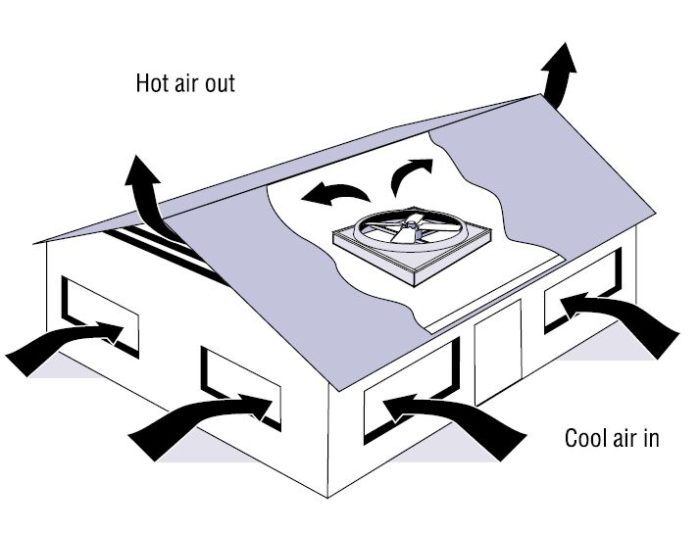
Image Credit: U.S. DOE
More Musings of an Energy Nerd


There’s a lot of confusion surrounding attic fans. Here at GBA, we regularly receive e-mails from homeowners with questions about attic fans: What’s the purpose of the fan in my attic? How often should I run it? Do I need a bigger fan?
Before addressing these recurring questions, it’s important to define our terms. First, we need to distinguish between three different types of ventilation fans.
The most common kind of residential ventilation fan is one used to provide fresh air for building occupants. Examples of this type of fan include the fans in a heat-recovery ventilator (HRV) or an energy-recovery ventilator (ERV), as well as some types of bathroom exhaust fans. (For more information on this type of ventilation fan, see Designing a Good Ventilation System.)
Whole-house fans are sometimes confused with ventilation fans that provide fresh air. Unlike a ventilation fan, a whole-house fan — an attic-mounted fan that exhausts air from a home at night — is designed to cool a house (that is, to lower the indoor temperature).
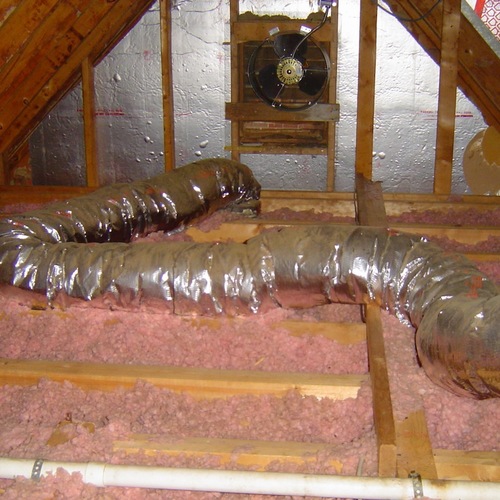
A powered attic ventilator has a different purpose: it is designed to lower the temperature of an attic by exhausting air from the attic and replacing attic air with outdoor air.
At the risk of oversimplifying,…
Weekly Newsletter
Get building science and energy efficiency advice, plus special offers, in your inbox.

This article is only available to GBA Prime Members
Sign up for a free trial and get instant access to this article as well as GBA’s complete library of premium articles and construction details.
Start Free TrialAlready a member? Log in


130 Comments
Night Breeze doesn't need windows opened
Another fantastic article Martin!
Davis Energy Group of Davis, CA developed the Night Breeze system which does not require window opening to cool the house. This would seem to mitigate the concerns about security - it also supports a filter for incoming air. I have never used one, but it seems like a good system.
http://www.esource.com/esource/getpub/public/pdf/cec/CEC-TB-4_NightBreeze.pdf
http://new.advancedenergyproducts.com/wp-content/uploads/2011/11/NightBreezeDiagramA.jpg
The attic "coffin" you mention, which is used to air seal and insulate pull-down stairs, scuttle hole, or a whole house fan, is good in theory, but in practice, is cumbersome to install. Even though a manufactured cover costs more, it is far easier to install. It also requires no assembly.
Response to Kris Knutson
Kris,
The NightBreeze has been around for a while; I first wrote an article about the product 8 years ago, for an article that appeared in the September 2004 issue of Energy Design Update. In that article, I wrote:
"The NightBreeze includes a variable-speed air handler with an ECM blower, a hydronic heating coil, a large motorized damper to control the intake of exterior air, and a wall-mounted control unit. The thermostat-like control unit also regulates the operation of the air conditioner, if any. In addition to providing nighttime ventilation cooling, the NightBreeze system provides year-‘round whole-house ventilation.
"In order to pull in enough outside air to cool the house at night, the NightBreeze requires a large exterior intake grille — usually about 3’x3’ (assuming the grille has 50% free area). If the air handler is located in the attic, the air intake grille can be mounted in a gable, in a doghouse dormer, or at the top of a false chimney. The air-intake duct is connected to a damper box containing a large hinged motorized damper blade. Damper leakage is minimal — at 25 Pascals, it’s about 1.4% of total fan flow. According to David Springer, the president of Davis Energy Group, one of the main consulting groups that developed the NightBreeze, ‘It is possible to achieve 6 percent duct leakage in a system that includes the damper.’ The wall-mounted NightBreeze control replaces a conventional thermostat. ‘At my house, the control is set for a 5-degree delta T,’ says Springer. ‘The upstairs thermostat is set to 80°, so it’ll start ventilating when the outdoor temperature drops to 75°. By morning, the outdoor temperature might be in the fifties or low sixties, and the indoor temperature might be 68°.’
"The control unit uses historical monitored temperature data to predict next-day outdoor temperatures. When the control predicts relatively mild weather, the ventilating blower will run at a lower speed than when hotter weather is predicted. ...
"Like a whole-house fan, the NightBreeze system will not provide effective ventilation cooling in all climates. According to Springer, ventilation cooling works best in areas of the country with a mean daily temperature range of at least 30°F. According to the ASHRAE Fundamentals book, such areas include Idaho, Nevada, Utah, and Wyoming, as well as most of Arizona, California, Colorado, Montana, New Mexico, and Oregon. In most of the rest of the country, however, the mean daily temperature ranges are narrower than 30°F. An investment in ventilation cooling equipment makes more sense in a dry Western climate than in a humid Eastern climate. ‘I was convinced it would never work in Florida, but Danny Parker [from the Florida Solar Energy Center] convinced me otherwise,’ said Springer. ‘He showed me that even in Florida you can do some good with ventilation cooling, at least during a few weeks of dry weather in the fall. Whether the investment in the equipment can be justified is another question.’ ..."
Good stuff!
I'm constantly up against folks who sell or have bought powered attic ventilators for use in Florida. Most who have them "get it" when I explain that conditioned air is pulled up out of every ceiling penetration.
whole house 'attic fan'
Grew up with one in the 60s in NY. worked pretty well and was an obvious choice before the family had central AC. Another thing to remember is to cover the large attic exhaust vent in the off season. In our case it was a louvered opening about 30in square that we covered with a plywood piece every September or the attic would get really cold.
thanks
Solar Attic Fans are easily managed and fixed and a great product for proper attic ventilation. [Brand name deleted by editor] solar attic fans are no. 1 by builders and are the highest attribute made in the USA!
[Website link deleted by editor]
Response to Kelly Jones
Kelly,
It's amazing that your urge to post spam is stronger than your willingness to read.
Attic Temperatures and Roof Lifetimes
Standard asphalt shingle roofs is northern Vermont, where Martin Holladay lives, last 30 or more years, while roofs in south Texas last about 15 to 18 years. I think that the difference is due to the hotter attic temperatures in the south, which increase the shingle temperatures. The cost of a new roof for a modest size house is roughly $8000, or $500 per year for a roof that lasts 16 years. If an owner could get an increase in roof lifetime by 4 years by keeping the attic cooler, that would cover the cost of about 20,000 kWh at $0.10/kWh!
That 20,000 kWh would go a long way toward operating a pair of thermostatically controlled, powered attic ventilators (operated off the same thermostat) that had fans both blowing air into and out of the attic, through gable vents, with a balanced pressure so that air was not sucked through the ceiling of the house. It would also reduce heat gain into A/C ducts in the attic, a standard practice in older homes.
I get the idea that people that suggest a hot attic with a well-insulated ceiling have never crawled around an attic in south Texas on a summer day trying to string a TV cable or electrical wiring. It is not a matter of comfort, but rather, a matter of survival.
Flat roofs & whole house fans
Martin,
Since the desert southwest is prime territory for whole house fans and a common building style is flat roofs with either no attic space or very minimal, non-accessible attic space, what is an appropriate detail for installing a whole house fan? This is relevant as a remodeling question also.
How important is insulating the fan cover?
While I agree that more insulation is generally better, I wonder how important it is to attain large R-values in the cover for a whole house fan installed in the floor of the attic/ceiling of the hallway. The article says of R-5, "Clearly, that’s not enough insulation." I wonder what the energy consumption difference would be, between an R-5 cover, and the R-26 advocated as the low end by Erik North. If we are talking about less than 10 sq ft of opening for the fan, then the difference in energy consumption between R-5 and R-26 for the cover will add up to how many pennies per year?
Obviously, it depends on the average ambient temperature, humidity, and the nature of the attic. Still, an example calculation for an average home in New Jersey, and another in Vermont, would be enlightening.
My guess is that way more attention should be given to creating a flawless air seal around the cover than to adding a few more Rs to the R-value. Of course, doing both is nice.
Response to Lee Dodge
Lee,
Your argument rests on three legs. You assert:
1. Asphalt shingle roofs last 30 or more years in Vermont, and only 15 to 18 years in Texas.
2. The best way to lower the temperature of asphalt shingles is with a powered attic ventilator.
3. Cooler asphalt shingles last longer than warmer asphalt shingles.
To determine whether your argument has any merit, we need to look at each of these three assertions in turn.
1. In fact it is quite rare for an asphalt shingle roof to last 30 years in Vermont. Your estimate of 15 to 18 years is much closer to the average here (as it appears to be in Texas). Many factors affect shingle longevity; shingle temperature is only one factor.
2. The best way to lower asphalt shingle temperatures is to choose white-colored shingles over black shingles. No other factor, including attic ventilation, plays as much of a role as do color and orientation. This fact holds true in Vermont as well as Texas. While the correlation between shingle temperature and longevity has not yet been definitively shown, it remains true that anyone concerned about elevated shingle temperatures should simply choose white shingles.
More information on this topic can be found here:
http://www.jlconline.com/Images/Letters_tcm96-1126954.pdf
"In his recent book, Water in Buildings, Rose summarizes what he has learned from years of careful research: “Does ventilation significantly reduce shingle temperatures? The short answer is no, not significantly. Shingle color is a very strong determinant of shingle, sheathing, and attic temperature. ... In a vented cathedral ceiling, venting can cool shingles in the lower part of the roof; it cannot cool shingles high in the roof. ... As long as shingle manufacturers ignore the effects of shingle color as a determinant of temperature, they may be admonished for asserting so strongly the importance of venting to control temperature. ... In short, on the basis of currently available information, attic ventilation is only marginally beneficial to shingle durability. Attic ventilation does not deserve the attention it has received in relation to shingle durability.” If your clients prefer cool shingles to warm shingles, the amount of ventilation behind the sheathing is far less important than the shingles’ color; so advise them to choose white shingles."
http://www.buildingscience.com/documents/reports/rr-0302-roof-and-attic-ventilation-issues-in-hot-humid-climates
"Our simulations and measurements have shown that asphalt shingles applied over vented roofs in hot-dry climates operate warmer than the same asphalt shingles applied over unvented roofs in hot-humid climates. To our knowledge, there have been no shingle warranty adjustments for Las Vegas versus Orlando, and that difference in location is more significant in regards to shingle temperature than vented versus unvented."
Insulated Rooflines and Shingle Temperatures:
"One study showed that shingle life is reduced by less than a year on homes in Miami with no attic ventilation."
3. On the third point, the jury is still out. However, if you really care about shingle temperatures, the best solution is clear: choose white shingles! Roof ventilation won't help much.
Response to Kim Shanahan
Kim,
Q. "Since the desert southwest is prime territory for whole house fans and a common building style is flat roofs with either no attic space or very minimal, non-accessible attic space, what is an appropriate detail for installing a whole house fan?"
A. Several manufacturers make whole-house fans for homes without attics. Click here to see a website with many inexpensive models of whole-house exhaust fans for flat roofs.
A better option would be the TC1000-H fan from Tamarack -- a model with an automatic insulated damper that prevents heat flow and air flow when the unit is not in use.
Response to Derek Roff
Derek,
Q. "I wonder what the energy consumption difference would be, between an R-5 cover, and the R-26 advocated as the low end by Erik North?"
A. Let's do the calculation. As I explained in my article, How to Perform a Heat-Loss Calculation — Part 2, "The heat loss formula for determining transmission losses through floors, roofs, and walls is Q = A • U • ΔT. In other words, the rate of heat flow through a building assembly (in Btu/h) is equal to the area of the assembly (in ft²) times the U-factor (in Btu/ft² • hr • F°) of the assembly times the ΔT (in F°)."
To perform the calculation you requested, we'll have to make some assumptions. You can adjust the assumptions to fit your own case and run your own calculations if you want.
Let's assume that the insulated box in the attic measures 40 inches by 40 inches, and it is 24 inches high. The exposed area of this box is therefore 26.6 square feet for the sides, and 11.1 square feet for the top. The total area is 37.7 square feet.
Let's assume that the attic temperature is 32°F, and the indoor temperature is 72°F. That means that the ΔT is 40 F°.
First we'll do the calculation assuming that the box has an R-value of R-5:
Q = A • U • ΔT = 37.7 • 0.2 • 40 = 302 Btu/h
Next we'll do the calculation assuming that the box has an R-value of R-26:
Q = A • U • ΔT = 37.7 • 0.038 • 40 = 58 Btu/h
The difference in the rate of heat flow is 244 Btu/h. Over 24 hours, that would be 5,856 Btu. Over 5 months, that would total 878,400 Btu, or 257 kWh.
If you were supplying heat to your house with electric resistance heat at a cost of $0.14/kWh, that would cost you $36 over the winter.
If your space heating costs were only 1/2 the cost of electric resistance heat -- a more likely scenario -- the difference in R-values would cost you $18 over the winter.
Cold climates will have a higher ΔT than I assumed, and warm climates will have a lower ΔT than I assumed. My calculation is only an example to show you how to figure this out for yourself.
Thanks for the help with the calculations
Thank you, Martin, for showing me how to do the heat-loss calculation, and providing an example. It certainly may be a good, average example, but I'd like to take other information from your article, to suggest a significantly different example. Let me know if I have misunderstood or miscalculated.
Choosing the Tamarack HV1600, the larger of the two Tamarack whole house fans that you recommend, the product literature says that the rough opening in the ceiling should be 14 1/2” x 22 1/2". This gives an area of ~2.25 sq ft. If we keep everything else equal, this is 1/17th of the insulated area in your calculation, so the rough cost differential over a season drops from $18 to just over $1, for the cheaper heating source. Of course, that isn't entirely fair, since the needed insulating "coffin" in the attic would be smaller for this fan, and the fan comes with insulating doors. But let me finish explaining the difference I am contemplating in insulation location.
We could get R-5 out of an inch of a high-quality foam. Even adding the necessary cosmetic and structural elements, it would be reasonable to build this 1" plus thickness into a flat insulating cover mounted below the fan opening, on the ceiling, inside the living space. In that scenario, calculating the insulation area based on the rough opening seems reasonable to me. Higher insulation levels would require an insulation coffin in the attic, which leads to greater surface area and greater heat loss area. So I'm thinking that there is even less final energy loss/cost difference between an R-5 insulated cover in the living space and an R-26 coffin in the attic, if we consider the advantageous placement of the insulation possible with R-5.
We could make a similar comparison with your example 40"x40" fan. The inside-the-house flat R-5 cover that I am suggesting would have an area of 11 sq ft. This is less than a third of the surface area of the R-26 coffin in your example. Again, keeping other things equal to your example, this would give us a seasonal cost difference of roughly $6.
Considering lower materials cost, easier fabrication, and simpler attachment and removal, I'm thinking that I would be very happy paying an extra $1-$6 per year to use an R-5 flat cover on the ceiling of the hallway. Have I missed something critical?
Response to Derek Roff
Derek,
Most whole-house fans require a rectangular opening that is at least 32" x 32", and often larger; some whole-house fans are 48 in. in diameter. A ceiling grille measuring 32"x32" or 36"x36" isn't unusual.
Of course, the size of the Tamarack fans is smaller, as is the required ceiling grille.
Your plan to install an interior cover should work fine. But as long as you're making a cover, why not use at least 2-inch-thick rigid foam instead of 1-inch-thick foam?
Asphalt Shingles
Asphalt shingles and other asphalt-based materials are the reason attics get so hot. I've recorded temperatures up to 180 deg F on back side of asphalt shingles in the California summer sunshine and attic temperatures of 160 deg F. White shingles are marginally cooler. The key is solar reflectivity and thermal emittance of the roofing material. Asphalt is a great material for absorbing solar radiation and has poor thermal emittance. Walk barefoot on an asphalt road and see how that works.
It is interesting that asphalt single warranties are based on having attic ventilation to code or the warranty is voided. I've measured attic temperatures with various types and amounts of attic venting and there is really little effect that can be detected with venting on attic temperature. Cooling ends up being localized around the vent openings, while the attic stays hot.
So the biggest cause hot attics is our roofing materials, not the lack of ventilation. Of course if you want to make lemonade out of that lemon, use the attic heat to preheat water and call your roof a solar collector.
Response to Tom Barrett
Tom,
Thanks for your comments.
I agree with your conclusion that "there is really little effect that can be detected with venting on attic temperature."
Thanks for the follow-up response
Thank you, Martin, for your further comments on my point. I picked one inch of foam in my example to match the R-5 mentioned in your article. However, I agree that choosing two inches of foam for a cover would be twice as good.
Ridge vent versus powered attic ventilator
So one part of my roof/attic has a ridge vent but does not have a gable vent. And then the main part of my roof/attic has NO ridge vent but does have gable vents on both ends. I was thinking about adding some sort of powered attic ventilator. But I was wondering if I would just be better off installing a ridge vent along that main roof/attic. According to this article the powered option is not an option. So are the gable vents enough or should I install ridge vents? Also we have debated about putting in a whole house fan, since there are some weeks when its cool outside but hot inside the house with no wind outside to help. BTW, I live west of Philadelphia, PA. Anyway, great article!!
Response to Chris Grabowy
Chris,
If your attic doesn't have any problems, I wouldn't worry about adding more attic ventilation.
What problem are you trying to solve?
Attic fan reduced my electricity bill
I've been an energy engineer for over twenty years. My experience has taught me to think beyond articles like this one. In the real world, comfort, low first cost, and immediate gratification take precedence over theory and lab results. To wit, I have intalled two attic fans; both installations were resounding successes:
1) My 1960-vintage home in northern Alabama runs 5-tons of central air conditioning plus one small window A/C unit. In the summer, the upstairs bedrooms are unbearably hot, due to the ceiling radiating attic heat. The bedrooms can be filled with cool air, yet the hot ceiling makes them feel like being inside a broiler. This past summer,a major outdoor renovation forced me to disconnect the condensing units from the central A/C, leaving me with just the small window unit. So, I put in an attic fan to relieve the hot ceiling. The A/C is off during the day when I'm at work; but the fan runs. By the time I go to bed, the attic is cooler than the inside of my house, so it is drawing heat out. The small window unit is plenty to keep the house comfortably cool.
2) My mother-in-law stays in her hot home all day and was considering replacing her central A/C system with one of higher capacity. However, the cost was prohibitive, so I installed an attic fan. With a cooler attic, the A/C system had lower heat gain, therby reducing the supply air temperaure at the diffusers. Additionally, the hot ceiling effect was alleviated. MIL was able to turn her thermostat up a few degrees, thereby saving energy and increasing comfort.
It's very easy to write that better insulation, radiant barriers, and light-colored roofs are components of a superior solution. And they are; I can't argue otherwise. But in the real world, we look for practical solutions that people will actually implement. In the two cases, I've described, the most practical (by far) solution was contrary to the conventional wisdom.
Response to J Wing
J Wing,
You have installed powered attic ventilators in two homes in recent years, so you obviously like them. According to your anecdotes, the electricity use decreased in both of these buildings.
Even if your anecdotes are accurate in all details, and even if you have no financial interest in promoting powered attic ventilators, two anecdotes aren't convincing. Needless to say, there are all kinds of reasons that electric bills fluctuate from one month to the next; one of the biggest reasons (when it comes to air conditioning) is variations in weather.
You have described two buildings with "hot ceilings." I have no idea why anyone with a hot ceiling would think it was easier to install powered attic ventilators than a layer of cellulose insulation. After all, the cellulose insulation doesn't require any electricity.
Here at GBA, we strive to advise readers of the simplest and best solutions to common building problems. I'd like to repeat my advice: if you have a hot ceiling, install more insulation on your attic floor. Don't install a powered attic ventilator, since these devices, on average, use more electricity than they save.
Thanks
Excellent article. Thank you Martin.
Well, to me two anecdotes are
Well, to me two anecdotes are more compelling than one article, no matter how many times it's been re-written. I have been a professional energy engineer for 2 decades; I understand that there are many variables that account for enrgy use.
The most important variable, however, is the human beings involved and the particular situation they are dealing with. In both of my anecdotes, the human beings felt that the cost in money, time, work, and hassle would not have sufficient return in comfort. In the case of my house, it is impossible to lay down another layer of insulation.
On the other hand, each attic fan took about $100 and hour to install. As a curious professional, I was willing to risk the investment to see for myself what effects are. If the attic fans didn't do the trick, then I'd move on to the next solution and be out only $100. The results of my experiments, so far, differ from this article and all the other ones that say the same thing. I report my findings not to argue or to be off-handedly accused of having financial interest, but to advance our understanding and knowledge.
Building a new house? Definitely insulate the roof and add a radiant barrier. Is your fan-coil unit in a hot attic? Consider an attic fan, especially if you turn the A/C off during the day. Are you at home with the A/C on all day? Consider a different roof heat-gain management system, if you can afford a long-tem investment. Not staying in the house long enough to make the investment worthwhile? Consider a less-expensive solution that may have some drawbacks. Does your attic have insufficient ventilation openings that will cause an attic fan to draw through your house? Increase your ventilation area, or consider a different solution.
Energy engineering is way more complicated than telling people that there is but one solution to a problem.
Response to J Wing
J,
Thanks for sharing your anecdotes. I certainly appreciate the information, as I appreciate all information provided by GBA readers. And I accept your assertion that you have no financial interest in promoting powered attic ventilators.
However, after having read the reports of researchers who have studied the issue and measured energy use in buildings with powered attic ventilators, I'm going to stick with the conclusions and advice of the researchers, even in the face of two anecdotes that buck the trend.
What about a garage attic??
I'll be building a large garage with attic storage in NE Texas. I will use a radiant barrier decking, but does a powered attic ventilator make sense here ??
Response to Robert Williams
Robert,
Running a fan always requires electricity. Of course, a fan cannot cool your garage unless the outdoor air temperature is lower than the indoor air temperature. If you have radiant barrier sheathing, the temperature difference between the two spaces won't be very great, and probably won't be enough to justify the use of the fan.
The other question: what are you storing in your attic? Does it matter what the temperature is? If you have an old lawnmower and some Christmas ornaments up there, it probably doesn't matter if the garage is 80 degrees or 110 degrees.
Whole House Fans
Martin,
Your research into attic fans is of great interest. It is valuable to have the data from those who have studied them recently.
Your comments about Tamarack are surprising. Tamarack is a fine company with leading edge insulation technology but you do your readers a disservice by inserting your opinion that they "make the best whole-house fans available".
I had hoped you would have done a little more research into other suppliers in order to offer a more unbiased view.
I would be very happy to assist you in a thorough market overview which I do regularly for the http://www.WholeHouseFanGuy.com
Like so many other "plug in"
Like so many other "plug in" solutions attic fans certainly have the potential to make things worse rather than better. Your article does a great job of outlining how this happens. As a general rule unless a homeowner has a highly qualified person to evaluate their house, I think its safe to say that attic fans should be avoided.
I do think that under CERTAIN circumstances an attic fan can be beneficial. The problem is that in most cases, there is no one available to accurately make that determination.
The primary reason attic fans are not helpful is that they can depresureize the attic and draw air out of the house. Many houses have significant leaks in the air barrier(attic floor) and it would be easy for the attic fan to draw a significant amount of air from the house. If a house has been air sealed by someone with an understanding of the air leakage, then it would seem that the depressurization would be minimal and the attic fan could then be beneficial.
The amount of air being drawn out of the house is a function of the pressure difference and size of the air leaks in the attic floor. In an attic with gable vents, soffit vents, and ridge venting, I suspect that the attic fan would not create a significant pressure difference and the air leakage from the house is probably small. (assuming even a rudimentary level of air sealing).
Lee Dodge suggests a "balanced" system where there is an incoming and exhaust fan. This seems like an approach that could also limit depressurization.
If air leakage is minimized, and depressurization is controlled with either a balanced fan or adequate openings for incoming air then it seems reasonable that the amount of depressurization would minimal and the attic fan could be beneficial.
Arnie Katz's study concluded that (an undefined amount of?) depressurization was enough to increase cooling costs. This assumes that there is a cooling system in place and operating. In a house not running an ac system any air being drawn from the house is being replaced by outdoor air. If the windows are open in the house there is no "cooling penality" to having some air exhausted from through the attic. if late in the afternoon the house temps rise above the outdoor air temps there is actually a cooling benefit. (we hope the amount of air being exhausted through the attic floor is minimal because the house is air sealed).
If the house without AC running was closing the windows during the day to keep the house cooler, then any air being exhausted to the attic would be replaced by warmer outdoor air, but that warming of the house is tempered by a cooler ceiling.
You propose the question "who cares how hot the attic is if there is enough insulation in the attic floor?" Insulation can only slow and not stop the energy transfer. Regardless of what the insulation level is, there will be some level of energy transfer from the warmer attic to the cooler house. So everything else being equal, any house would benefit from a cooler attic. In many houses it is impractical to increase the insulation in the attic. (At least when compared to the difficulty/cost of installing an attic fan. Of course the insulation is the better option if possible.).
My own experience points to anecdotes showing the attic fan is beneficial. I know of two houses using them and the owners are certain that they make a large difference in comfort. Both houses do not use AC. Both have a large amount of venting for incoming air.
Response to David Jones
David,
If you install a powered attic ventilator, there is one thing you can be sure of: your electricity bill will go up. That's because running a fan requires electricity. This increase in your electric bill is especially guaranteed in homes without AC (because there is no possibility that running the fan might decrease electricity devoted to AC). But research has shown that, even in a house with AC, powered attic ventilators increase homeowners' electricity bills -- they don't lower them.
You wrote, "Insulation can only slow and not stop the energy transfer. Regardless of what the insulation level is, there will be some level of energy transfer from the warmer attic to the cooler house. So everything else being equal, any house would benefit from a cooler attic."
Just because insulation slows down heat transfer rather than stopping it, doesn't mean that insulation isn't the best (and most cost-effective) way to prevent hot attics from making homeowners uncomfortable. Insulation is still the best approach. It's cheap and it doesn't require any electricity to run. If you are worried that your ceiling is still warm, the solution is simple: pile on a little more insulation.
You wrote, "Everything else being equal, any house would benefit from a cooler attic." That statement is only true during the summer. Believe it or not, many homeowners with powered attic ventilators leave them running all year long, because they forget to turn them off or the thermostat breaks. As a result, the fans increase the homeowners' energy bills during the winter.
From start to finish, powered attic ventilators are nothing but trouble. Homeowners should avoid them like the plague.
Yes, of course more
Yes, of course more insulation with no moving parts and year round benefit is the better option. I should have made that clear.
Yes, as the insulation level increases the potential benefit from the fan decreases.
In some cases additional insulation on the attic floor is not practical. In those cases the options are to "sweat it out", cool the poorly insulated house with a large AC system, or try to limit the heat gain to reduce the temperature in the house. If a $100 attic fan (which consumes little electricity compared with an AC unit and contains far less embodied energy) can be part of a plan to reduce heat gain there may be a significant energy and environmental benefit compared to the AC option.
Can an attic fan offer some benefit? I think so under some very specific circumstances.
In a house with no ac running and the windows open there has to be some level of cooling benefit from lowering the attic temp with an attic fan. (You can certainly argue that the cost of electricity to power the fan outweighs the comfort benefit).
Yes, installing an attic fan raises the electric bill. If the attic fan increases the comfort level of the house, it may be worth it. If the attic fan keeps the house cool enough so that the owners leave the AC off, there is almost certainly an energy benefit.
Of course if the attic fan isn't working correctly and is running all year long that would be a significant problem. The same can be said for any mechanical equipment in the house that is not operating correctly.
Unpowered vents?
Growing up in NE and West Texas, we used un-powered attic 'turbine' vents. Do those make sense these days? ... After moving to Houston roofers only wanted to remove the un-powered ones and put in powered ones, and I insisted they put them (and more) back in PLUS ridge and soffit vents. ... In the summers the vents spun day and night relentlessly. ... In North TX and OK (where wife grew up, and West Texas attic fans were great. In dry climates day to night temp difference was often 30 to 40F. So they worked great. In the Coastal plains and East Texas the humidity make the whole house fans not a reasonable solution. ... Sorry about the diatribe. The discussion was centered around powered fans and vents. How about the un-powered vents? They are inexpensive. Are they normally cost effective? (They are cheap and not hard to DIY install properly.)
Also, living in West Texas (think El Paso or Lubbock) 'swamp coolers' work great for all but about 2 days a year. Even running without water is good to act as a 'whole house fan' at night. My house in ELP had a roof top swamp cooler that was attached to the ducting in the house. (Yes, we insulated and sealed the vent (drained the water and cleaned/painted them inside in the fall. Checked them and replaced the filter pads in the spring when un-winterizing the systems.) When moving to ELP it wasn't initially natural to open the windows in the rooms you wanted to cool, and close them when the room is not in use.
Ahh, the differences from living in the NE and the SW (and the South) is really different on how we live with our environment. Saving energy and needing insulation is the same. Just the numbers and how to build reasonably changes.
Response to Jack Coats
Jack,
Most attics are vented; for years, this was required by code. Recent code changes allow unvented roofs and unvented attics, but most attics in the U.S. are vented.
The usual way to vent an attic is with soffit and ridge vents. A ridge vent is basically a hole in your roof. Most experts don't see any advantages to turbine vents (or whirligig vents). When the wind isn't blowing, the devices are no different from any other hole in the roof; and if the wind is blowing, the devices can potentially depressurize the attic, sucking indoor air into the attic through ceiling cracks. That's undesirable.
Roofers hate them because they are a frequent source of roof leaks.
There is a basic fallacy to all attempts to move more air through an attic, since moving lots of air through your attic isn't the best way to keep your house cool. Ideally, you have sealed your attic floor (otherwise known as your ceiling) tightly against air leakage. Ideally, you have installed a thick layer of insulation on your attic floor. If you've done that, you don't have to worry about attic ventilation. Who cares what your attic temperature is?
It's a waste of effort to try to move more air through your attic. A better use of your efforts would be to perform air sealing work on the attic floor and to install thicker insulation. I'll repeat Bill Rose's words: "Ventilation is like a little boy who goes around the house looking for a job. ... He can do some things well, but can’t do anything really well."
who cares how hot the attic is?
Martin, even if you have R-100 insulation and perfect air sealing there will always be an energy flow from a 150 degree attic to a 78 degree living space. There is just no way around that.
Regardless of the insulation level there is always a benefit (in the summer) to a cooler attic.
In a house with no ac running and the windows open there has to be some level of cooling benefit from lowering the attic temp with an attic ventilation fan -even with a less than perfectly air sealed attic floor. (Remember all make up air going to the air space is coming from the outdoors. Once the outdoor temperature is equal to or lower than the indoor air temp, air leakage in the attic floor isn't hurting anything at that moment.)
Your primary point is that an attic fan results in an energy penalty when it draws conditioned air through a poorly sealed envelope. That's a great point. To conclude from that point that ALL attic ventilation is ALLWAYS a bad thing surely can't be correct.
Response to David Jones
David,
You are correct, of course, when you note that insulation doesn't stop heat flow; it merely slows it. That said, if we examine the heat flow across your hypothetical R-100 attic insulation, we will find that the heat flow is so small that any heat flow -- even if the attic is at 160 degrees F -- into the conditioned space below will be so low that it doesn't represent much of an energy penalty. That's why the energy required to run an attic fan is wasted: the attic fan consumes much more electricity than any possible saving from reduced air conditioner run time.
So, yes: during the summer, there is always a benefit to a cooler attic. But it is senseless to run a counterproductive electrical appliance (the attic fan) if that appliance is just adding to your electrical load -- especially when the benefit is much smaller that the added cost from running the fan.
In your next case -- a hypothetical house without any AC -- does an attic fan make sense? Well, it's possible that it will lower the attic temperature a few degrees. But it will also add to your electric bill. Let's say it costs you $5 a month (or $35 a season) to operate. After 5 years, you've spent $175. I maintain that you would be much better off spending the $175 on air sealing work or added insulation rather than on running the fan.
Once you get your attic floor insulation up to the minimum code level (R-30 in Florida), it really doesn't matter very much what your attic temperature is (with the usual proviso: you shouldn't have any ducts or HVAC equipment in your attic).
When HVAC equipment is in the attic
Interesting article. I'm in the position where there is HVAC equipment installed in the attic of a South Florida home I just purchased. Moving the unit is not an option at this time.
While I am planning on insulating the attic properly, is there sense in me having an attic fan as well? There is currently a fan installed, but it's not operating so would need replacing.
Any advice would be greatly appreciated. Thanks!
Response to Bob Barnum
Bob,
You wrote, "I am planning on insulating the attic properly." That's good. If you are investing in new insulation, I strongly urge you to install spray polyurethane foam on the underside of your roof sheathing. If the work is done properly, this step will create a conditioned, unvented attic, bringing your HVAC equipment and ducts inside your home's thermal envelope.
For more information, see Creating a Conditioned Attic.
Response to Martin Holladay
Thanks for the advice Martin.
Am I correct in noting that a properly 'conditioned attic' would have zero vents in the roof?
Currently there is already a hole in the roof (for the attic fan). I imagine this hole would need to patched. Is that correct?
Response to Bob Barnum
Bob,
Q. "Am I correct in noting that a properly 'conditioned attic' would have zero vents in the roof?"
A. Yes. That is correct.
Q. "Currently there is already a hole in the roof (for the attic fan). I imagine this hole would need to patched. Is that correct?"
A. Yes.
green washed?
I just had 2 attic ventilator fans installed in my 1979 home. When I called the attic fan company I'd intended to get 1 whole-house fan installed, however when the installer came out we realized that the upstairs of my home had a separate roof that wasn't connected to the lower level roof, so he said I would need an attic ventilator on the lower roof. The attic ventilator was much cheaper, so I opted to get two of these installed & see what happened. My home has no air conditioning & we routinely open all the windows in the evening & close them in morning. We have ceiling fans in 4 rooms that work wonders. I have very little insulation in my attic. It is only about 1 foot thick. This is something we intend to remedy prior to winter. I have a gas furnace & a gas hot water heater in the basement. I also have a gas pottery kiln. Another reason I opted for the attic ventilators is that I was hoping it wouldn't create a negative pressure situation that would disrupt my gas appliances. Currently I have the access panels to the 2 attics opened a few inches, hoping this will help draw hot air from my house into the attic so it can be ventilated. The ventilators are programmed to come on when the attic reaches 100 degrees & go off when it reaches 90. I can change this set-point, however I'd like to avoid having the ventilator run constantly. I was just looking for a solution to vent the night-time heat gain that piles up throughout the house between the hours 5pm & 9pm. If anyone has any comments to this, feel free to pick it apart. I realize I may have gotten green-washed & duped by the cheaper price! I'm just keeping my fingers crossed that my particular home & conditions might allow the attic ventilators to be sufficient.
Response to Brite Niezek
Brite,
It sounds like you wanted to install a whole-house fan, but ended up with two powered attic ventilators instead.
I don't think that the fans you have make any sense, especially if they are controlled by attic temperature. Instead, you want a whole-house fan that is run when the outdoor temperatures are low -- not when the attic is hot -- and you want that fan to have a wall-mounted switch that you can control.
Ideally, your installer would have found a way to increase the vent openings in your attic so that a whole-house fan could be installed. If it is impossible to add vent openings to your attic, then your house is not a good candidate for a whole-house fan.
Again, I recommend that you disable the powered-attic ventilators.
Response to Martin
hi, thanks. well you've confirmed I definately made the wrong choice. Since I've already wasted $1050 for the two attic ventilators, do you think there's a way I could extend the wiring & install an indoor manual controller on the two ventilators & open the access hatch into the attic fully & just turn the ventilators on once it has cooled off outside? I guess it would be like having an really expensive roof window with a box fan in it. I'm inclined to call the company & see if they can un-install them & patch the roof back up, however I imagine that would cost another $700 or so.
Response to Brite Niezek
Brite,
Q. "Do you think there's a way I could extend the wiring & install an indoor manual controller on the two ventilators & open the access hatch into the attic fully & just turn the ventilators on once it has cooled off outside?"
A. Yes, an electrician could perform the work you describe. If you do that, your fans will operate better than with the current controls. But it's too bad that you don't have a louvered opening in your ceiling instead of a hatch that needs to be opened and closed.
Attic Duct Sweating
My house was built around 1950, and has been added onto several times. It is a low slope ashpalt shingle roof with deteriorated batt attic insulation. There was at one time a whole house fan but at some point it was replaced with an air handler in the attic with hard duct. The insulation on the duct is in very bad shape. The roof has soffit vents, but no other form of venting. I live in Louisiana and this summer the attic has gotten to be over 140 degrees on a regular basis. This has caused my AC ducts to sweat causing water damage to the ceiling. I priced getting open foam insulation at the roof line, but that solution is price prohibitive to me at the moment. I am looking at installing an attic ventilator fan, radiant shielding, new ducts and blown in insulation to combat the problem. This will be significantly cheaper than insulating the attic line. This article strongly recommends against the attic fan, but the only solutions presented to problems such as mine are very expensive. If I can't insulate the attic line, and I shouldn't install attic ventilation then what is the alternative.
Response to Micah Morgan
Micah,
Clearly, you need to address your immediate problem -- sweating ducts. But that doesn't mean that you need to rush out and buy a powered attic ventilator.
You admit that "The insulation on the ducts is in very bad shape." In order to prevent condensation from forming on your ducts, the most important step you can take is to fix your deteriorated ducts and deteriorated duct insulation. That should solve your immediate problem.
First, inspect the existing ducts. It sounds like you have galvanized ductwork. Strip off all of the deteriorated insulation and throw it away. Make sure that there are sheet-metal screws in each duct seam. Make sure that each duct seam is sealed with mastic. Then install new vinyl-backed duct insulation with taped seams. That should solve your problem.
If the existing ducts are in very bad shape and aren't worth saving, you could remove and discard all of the exiting attic ductwork are replace the ducts with new insulated flex duct.
Good luck.
old vs new whole house fans
Our fan is probably 20+ yo. It is noisy, but pretty powerful, and we try to remember to take advantage of the drop in temps at night. How do the old fans compare to the new ones in efficiency? Do the new fans come with an outside temp sensor to coordinate with the AC? Are they noticeably quieter? Is it worth replacing a functioning fan?
Response to Larisa Solonenko
Larisa,
Q. "How do the old fans compare to the new ones in efficiency?"
A. I don't have any specific information on this topic, although there is a good chance that a newer fan -- especially one from Tamarack -- will be more efficient than the fan you have. However, the difference in efficiency probably isn't enough to justify the investment in a new fan.
Q. "Do the new fans come with an outside temp sensor to coordinate with the AC?"
A. Not that I know of.
Q. "Are they noticeably quieter?"
A. Yes -- especially if you buy one of the Tamarack models.
Q. "Is it worth replacing a functioning fan?"
A. Not if you think that the investment will have a payback in terms of efficiency. But if your fan is so noisy that it's driving you crazy, and you can afford a new Tamarack fan, go ahead and buy one.
Whole House Fans for sealed attics?
Newer construction calls for some attics to be completly sealed, no vents. The space is more friendly for air handlers located there. The question is if the house, including the attic, is very well insulated is there a application for an attic fan. (It seems to me there is) But a sealed attic has no vents to dump the fan air from the interior of the house. So I guess there would have to be a duct from the fan discharge through the roof. I guess it would have to be pretty big, too. Any thoughts.
PS. My home is in the Sacramento CA area.
Response to Mike Baldinelli
Mike,
If your house has an unvented conditioned attic, then your attic is just another room in the house -- just like a bedroom in a finished attic.
Several manufacturers make whole-house fans designed to be installed in insulated roofs. Here is a link to some models that are not necessarily optimized for air sealing:
http://www.atrendyhome.com/romowhhofano.html
Here is a link to a Tamarack fan that is optimized for air sealing (and that provides high-R shutters controlled by a motorized operator):
http://www.tamtech.com//store/tc1000-h-whole-house-fan-brown,Product.asp
Attic fans and mold
Hi, Martin,
Thank you for this informative, well-written article. My husband and I are closing on our first house next week (we live outside Chicago), and one of the red flags in our home inspection was the non-working attic fan. The inspector also found a bit of mold in the attic, which he deduced came from the non-working attic fan, his logic being that if the fan worked, there would be more air circulation and no mold would be able to grow. But after reading your article, I don't know that we need an attic fan because we should have a whole house fan. So that being said, how do we prevent more mold from appearing (and deal with the current mold) if we do not install the attic fan? Does the whole house fan allow for adequate air circulation even in the winter to prohibit mold growth?
Thank you.
Response to Hannah Mills-Fee
Hannah,
Most attics are dry and mold-free. If you see mold in an attic (and you know that you don't have a roof leak), it's almost always a sign of a leaky ceiling. Warm, humid indoor air is leaking out of your house and into your attic through ceiling cracks.
In many homes, this type of mold is associated with a wet basement or a wet crawlspace.
If you know how to inspect an attic for air leaks, the first step is to spend a few days in your attic sealing air leaks. For more information on this task, see these articles:
Energy Upgrades for Beginners
How to Insulate and Air Seal an Attic Hatch
How to Air-Seal an Attic: Introduction
If there are signs that you have a damp basement, you'll need to address those issues. The first steps to addressing a damp basement are to make sure that you have roof gutters connected to conductor pipes that carry the roof water to a location far from your foundation, and to adjust the grade around your foundation as necessary so that the soil slopes away from the foundation in all directions.
If those steps don't work, you may need new footing drains.
Good luck.
Powered Attic Ventilators
Martin,
My excursion into PAV's has yielded some important side benefits, not the least of which was discovery of this site. First things first. I live in low humidity inland CA and I needed to deal with a very hot attached garage. My workshop is out there, along with a freezer, washer dryer etc. I did not want to cut a hole in the ceiling for an exhaust vent as this opens up code issues (fire dampers) that complicate the design. There are code complaint exhaust fans available w/dampers but displacement of the air has to be addressed, especially since I have a gas WH in the garage, as most CA homes do. On my home this meant cutting inlet vents in the wall or garage door. Wall option is expensive, and of course ugly. I did not want to cut a hole in my garage fire envelope in any case, code or not. Additionally, drawing 100 degree air into a space does not cool it. Ergo, buy a high efficiency (40 watts, 15 cents a day) gable mounted PAV to reduce the radiant broiler effect on the ceiling of my garage. I have generous soffit vents (but no ridge vents) in this space. As it happens, there is a 6 sq foot cutout in the OSB boundary between my garage and house attic so the garage exhaust drew a bit of the hot air via intermittent soffit vents. Not sure if this cutout is code but the house passed inspection. My findings:
1. As you suggest, lay persons are jumping into PAV's without doing proper research and the on line vendors are not helping with this problem. They want to sell you a product, first and foremost. This applies to whole house fans as well. Creating a vacuum in your home can cause serious problems. For instance, filtering dirty air through the edges of your nice carpet and wall outlets. Air quality, controlling the inlet source, is a huge concern. These fans should be supplied and installed by licensed contractors. If you are required to open windows to create displacement you are adding a human element that is not acceptable. Position switches on windows or automatic inlet dampers, something is needed.
2. The high efficiency PAV I purchased from a reputable CA company worked for me. My garage was much cooler this summer and my home AC bills dropped, with caveats. Part (maybe all) of the cost savings were due to sealing air leaks (thanks GBA!), weather variables, and behavioral changes. Will never know. I plan on upgrading my R38 fiberglass batt insulation and attic venting (soffits and ridge vents) but that is $$$ with a long payoff. My heating and cooling bills in my small house are manageable for now.
Bottom line, for my unique circumstances the PAV works, a bridge to the next step. I think I will still need it at times to reduce garage temperatures regardless of insulation and passive ventilation improvements.
Engineering question: How much pressure is developed in a hot attic? Regardless of ventilation design I would guess that X relative temperature would lead to Y pressure. I run my PAV when it is hot only and I get a sense that all I am doing is neutralizing the pressure, and reducing reverse stack effect. Your input will be appreciated.
Response to Richard James
Richard,
Your account raises several questions. I assume that your garage is not conditioned. Yet (if I understand correctly) you have R-38 insulation on your garage ceiling.
If you do, indeed, have R-38 insulation on the garage ceiling, the temperature of your garage attic should be irrelevant. There certainly shouldn't be enough heat flow downwards through the R-38 ceiling to cause any problems in your garage -- certainly not enough to merit the installation of a powered attic ventilator.
There are many possible explanations for this puzzle. One possible explanation is that your R-38 insulation is sloppily installed. Another possible explanation is that you are really battling heat sources inside your garage, including your water heater, your freezer, and your clothes dryer -- and that your powered attic ventilator is a placebo rather than an appliance that succeeds in altering the temperature of your garage.
You asked about the pressures exerted by the stack effect. They are relatively low -- usually on the order of 1.5 to 4 pascals.
Martin,
I took another look.
Martin,
I took another look. The plans called for R38 in all ceilings, R19 in walls and crawlspace. The attic over living space is indeed R38, 10-12 inches thick and well placed. Garage batts look thinner, perhaps R19 and not as well placed. Some day I'll make a compromise. Move the R38 batts to the garage attic. Seal the living space attic floor and implement passive ventilation improvements as Joe Lstiburek suggests, then blow in cellulose. The passive ventilation improvements are the biggest expense and it makes sense to go all in at once. No point in the insulation alone, once cellulose is in it is a pain in the butt working around it. The air leaks that I have addressed, and still working on, are already paying dividends. Regarding the heat source, no question it is the ceiling. Before the fan I could put my hand on the ceiling and feel the heat. Since installing the PAV no heat to touch and the garage is more comfortable. Other factors have not changed. All other comments are well noted and thanks for your support.
Response to Richard James
Richard,
OK. During the summer you can put your hand on your ceiling and feel the heat. You investigate, and discover R-19 insulation that is "not well placed."
The normal solution to the problem you describe is to install adequate insulation -- and to make sure that it is installed well. If, instead, you choose to install a fan and pay for the electricity to run it... well... it's your choice, but that decision doesn't make any sense to me.
Whole House Fan Installation
Newer construction calls for some attics to be completely sealed, no vents. The space is more friendly for air handlers located there. The question is if the house, including the attic, is very well insulated is there a application for an attic fan. (It seems to me there is) But a sealed attic has no vents to dump the fan air from the interior of the house. So I guess there would have to be a duct from the fan discharge through the roof. I guess it would have to be pretty big, too. Any thoughts.
Response to Fan Installation
As I noted in previous responses to questions on this issue, you can buy a whole-house fan that is designed to be installed in an insulated roof. Here, once again, are some links:
http://www.atrendyhome.com/romowhhofano.html
http://www.tamtech.com//store/tc1000-h-whole-house-fan-brown,Product.asp
Bought a house with a whole house fan
I bought a ranch house last year in Central PA. The previous owners had installed a whole house fan, but never insulated the attic beyond 6" batts between the joists, and nothing under part of the attic. After our first winter's oil bill, it's pretty clear that insulation is more critical than the fan -- particularly for our humid location. My contractor wants to use blown-in insulation. That seems a bad move for using the fan. What are my options?
Response to Penny Dorneman
Penny,
Blown-in-place insulation like cellulose is compatible with a whole-house fan. However, you will probably need to build an insulation dam to surround your fan so that the insulation doesn't interfere with fan operation.
Do you have actual references?
You state: "Several studies show that even in a house with a tight ceiling, a powered attic ventilator uses more electricity than it saves." What studies? Where? Real or imaginary? Your article comes across as biased. In what year were those studies written? In what location? Electricity costs vary greatly over time and location.
And what's what the "tight ceiling" claim over and over again? Does everyone you know live in a dilapidated log cabin? A properly maintained home doesn't have cracks in the ceiling.
Response to Green Asalep
Green,
Q. "What studies? Where? Real or imaginary?"
A. My article provides several links to studies by researchers, including researchers at the Florida Solar Energy Center (FSEC) and Advanced Energy in Raleigh, North Carolina. Of all of the links in the article, I would start with this one from FSEC: Fans to Reduce Cooling Costs.
That paper notes, "Data measured at FSEC and elsewhere show that attics with nominal natural ventilation and [at least] R-19 ceiling insulation do not need powered vent fans. Such fans cost more to operate than they save in reduced cooling costs, so they are not recommended."
Q. "And what's what the 'tight ceiling' claim over and over again? Does everyone you know live in a dilapidated log cabin? A properly maintained home doesn't have cracks in the ceiling."
A. In fact, energy raters and home performance contractors who do blower-door testing know that it is very rare to find a house with a tight ceiling. Most U.S. homes have lots of ceiling leaks: at the attic access hatch, at the plumbing vent pipe, at wiring penetrations, at duct penetrations, around the bathroom exhaust fan housing, and along the cracks between partition top plates and partition drywall. It's sad, but it's true.
Whole House Ventilation
I recently moved into a three-year-old manufactured home with a switch labelled "whole house ventilation." I am not sure what this is for. I have emailed the manufacturer of the home asking for any information they can give me. I'm not sure whether this term refers to what you call whole house fans or something else.
I live in Arkansas; our summers are hot and humid and our winters not too cold. I'm hoping to learn whether I should be using this ventilation system in conjunction with my air conditioner, or if it is only useful for spring and fall when I can open my windows, or whether it should never be switched on in my climate. Can you advise me?
Thanks.
Response to J Freeman
J. Freeman,
It's hard to know what a switch labeled "whole house ventilation" controls. Options include:
1. A whole-house fan designed to lower indoor temperatures at night when the air conditioner is off.
2. An HRV or ERV that provides fresh ventilation air to the indoors in all seasons.
3. An exhaust fan installed as an exhaust-only ventilation system.
One way to try to figure it out is to turn on the switch on a quiet day and listen for a motor coming on.
If that doesn't work, climb up in your attic and look for a whole-house fan. Look in your basement or mechanical room for an HRV or an ERV.
If all else fails, hire an electrician to come to your house and figure out what the switch is hooked up to.
Insulation vs. lowering attic temps
It is not an accurate statement to say that if you have good insulation, you don't care what the attic temperature is. Heat conduction from the attic to the house is proportional to the temperature difference divided by the R-value. So, for example, going from R-30 to R-38 insulation is the equivalent of lowering the attic temperature by 15 deg F (assuming starting point of 150 F attic temp and 78 F interior temp). I am not making conclusions as to the relative difficulty of either of those approaches, but a quick look says that to insulate 2000 ft^2 of attic space to R-38 vs. R-30 has a marginal cost of about $375. So, if you can lower the attic temperature by 15 F for under $375 (with no recurring energy penalty per a powered attic ventilation fan), that would be the more advisable route.
I am not arguing in favor of powered attic ventilation fans, but I just favor some clarity with regards to the general topic of attic ventilation (passive or wind/solar driven) vs. insulation.
Should also note that the user should do his own calculations based on his climate. Since for example, insulation is helpful year round whereas the attic ventilation is only favorable during air conditioning season. So, the trade-off varies depending on your climate of course.
Any advice on cooling a house in Kauai?
Martin,
We moved to Kauai about a year ago. Most of the year the temperature was fine, but for about 3 months in summer, the house temperature became almost unbearable. Our house is about 2000 square feet. It is one story with an attic space. The attic, apparently like most on the island, doesn't have any insulation. We have no central AC, but do have 3 window AC units that can help to cool those individual rooms. Also, like many of the homes here, our house isn't built directly on a foundation. It is raised up about 4 feet on stilts. I don't know if that matters, but it seems it might, with the air being able to circulate under the house as well.
During those hottest 3 months last year our house heated up quickly in the mornings and by early afternoon it was often hotter in the house than it was outside on the decks. It would stay extremely hot inside until almost midnight, despite us having (screened) doors and windows open and ceiling fans going. We tried completely shutting the house up during the day, as well as keeping the house completely open during the day. Neither seemed to help. The only way be reasonably comfortable was to be in one the of rooms with the AC and have it running. Even at 10 or 11 at night, when it was comfortable outside, turning the AC off in those rooms meant that they would quickly heat up and become very uncomfortable.
Afterwards we were told by a friend that the heat problem was most likely caused by heat coming from our attic and that we should get more attic vents and potentially an attic fan. After reading your article it looks like we shouldn't get the powered attic ventilator that our friend was talking about. But, in a humid climate it sounds like the whole house fan wouldn't work that well either. What are your suggestions for the best way to keep the house from turning into a sauna this summer?
Thanks,
Greg
Response to Greg Calarco
Greg,
The first step would probably consist of installing some attic insulation. That will reduce the transfer of heat from your hot roofing to the interior of your home.
If you think you might be able to get away without any air conditioning, you might try installing a radiant barrier on the interior side of your rafters. However, if you expect that you will need to continue running your air conditioners, insulation makes more sense than a radiant barrier.
If you have any east-facing or west-facing windows that get direct sunshine, you should check whether these windows have low-solar-gain glazing -- that is, glazing with a low SHGC. If they don't, you might consider replacing the windows that get the most sun with new windows with low-SHGC glazing, or installing exterior shading devices.
Finally, it's worth pointing out that there are many climates where three months of air conditioning is totally normal.
Attic Ventilation Fan
All I know is when ours worked, it kept the second floor a tad cooler. We have no AC, heater is in attic, in old, renovated ('81) house. The second story is over back half the house and the original front half of the attic butts up against our clothes closets and the master bedroom. So it gets HOT up there, even here not far from the ocean in L.A. It's 90° in my clothes closet in hottest part of summer. Without spending a fortune I was just going to replace the ventilation fan in the attic. Do you have a recommendation for fans? The heating svc company wanted to put one in but seemed like a lot of money. Can an electrician do this job?f Thanks so much!
Response to Kaye Kittrell #66
Verifying that the attic insulation is still there would be an important first step. If it's just 6" of blown fiberglass or R19 batts (common in 1981), an overblow of 3-6" of cellulose would improve the performance considerably, since low-density fiberglass is fairly translucent to infra-red (radiating heat) coming down from the hot roof deck.
If the partition wall between the attic and bedroom/closet is not currently insulated, installing R13 batts in the cavities then an inch of foil-faced polyiso on the attic side will do quite a bit toward reducing the unwanted heat gained through the wall from the attic side.
If that isn't cutting it, painting the underside of the roof deck with a low-E paint or installing perforated aluminized fabric radiant barrier on the underside of the rafters in the attic will knock the attic temps back a bit without using power or driving air infiltration.
For a ventilation approach, a self contained solar attic ventilator can purge heat from the attic without the cost of wiring it up and powering it from the grid will do some good:
http://www.fsec.ucf.edu/en/publications/html/FSEC-GP-171-00/
Cooling attic from subarea
I live in a relatively benign climate north of San Francisco, moderate humidity but summer days often exceed 90 and, rarely, 100 degrees. I created 2 additions and extensively remodeled our now 1,800 square foot single story rancher in 2010 and 2007. I am a general contractor and all systems were upgraded to modern and very energy efficient units.
Note: The bottom 2 paragraphs describe the essence of the problem
As part of this construction I installed a small, 350 cfm, exhaust fan in the sidewall of a skylight well which was both unobtrusive and the high point of the house. It worked ok, but slowly, so last year I installed a 3,200 cfm house fan in the same location. The evenings and mornings here can cool down to the 50's even if the days are in the 90's, which is one of reasons grapes grow so well here. The whole house fan worked great in rapidly reducing the interior temperature of the house so that we rarely require the a/c to kick on. There was one large flaw with the fan though, while the large fan duct was insulated and it had a damper on the end that exhausted to the attic, the heat build up in the attic caused heat to flow back into the house and would noticeably warm the house during the day. I thought I had made a large mistake, but I mostly fixed that problem by wrapping the duct with more insulation and by modifying the damping system creating new damper flaps insulated with foam sheet.
One mistake in the remodel was installing the furnace and duct work in the attic and heat is transferred from the attic to the ducts and then to the house. I want to address this issue so I am exploring solutions. Today was low 80's and a thermometer inserted one of the ducts registered 95. I have not tested attic temperature. Attic has a light colored roof and is well ventilated with extensive eave venting, eyebrow vents, gable end vents and two turbine vents. Even with this, we do not often use the a/c, the ceiling is insulated with R-30 between the joists with an additional R-13 or R-19 run across the ceiling joists giving a total of about R-45.
I have wrapped the ducts with additional insulation which helped a bit, but I want to cool the attic by 10-25 degrees if possible. Since the discussion here recommends against an attic venting fan, I have another idea for consideration. There is a dead spot in the corner of a closet where I could create a 100 square inch chase connecting the subarea with the attic and install a 500-800 cfm in line fan. This would draw cool air from the well vented subarea and pull it into the attic hopefully displacing the hot attic air and thereby cooling the attic without creating negative pressure. I would probably distribute this air with over size ducts so this cool air can reach most of the attic space. Most of these fans require an 8-10" duct.
What do you think, I have not seen this solution discussed here? One thing that comes to mind is fire damping since I will be creating a chimney. Everything is easily accessible including power, I would control the fan with a switch and/or a thermostatically controlled switch in the attic.
Response to Gary Seifer
Gary,
What is a "well-vented sub-area"? Is it a crawl space? Basement? Garage? Shed? Outdoor shady spot under your grape arbor?
Crawl space, typical !8"
Crawl space, typical !8" clearance from joists to grade, no moisture problems, a lot of foundation vents.
Response to Gary Seifer
Gary,
I'm not in favor of any attempt to use fans to try to change the temperature of the attic -- whether the fans are used to depressurize the attic (as typical powered attic ventilators do) or to pressurize the attic (as you propose).
Either approach can cause unexpected side effects -- in the case of your proposal to pressurize the attic, you might end up forcing attic air (or crawl space air) into the home through ceiling cracks.
Moreover, if you use a powerful fan for your proposed pressurization, the fan will quickly remove all of the cool air from the crawl space, and the fan will be pressurizing the attic with hot air drawn from unknown sources, but probably from outdoors.
The best way to limit heat transfer across the thermal boundary (the attic floor, in this case) is to make sure that the thermal boundary is air sealed, and that the insulation is very thick.
There are many reasons to doubt that your proposed fan installation will change the temperature of the attic enough to save any of the energy required to operate your air conditioner. Moreover, it is certain that operating the new fan you want to install will increase your electricity bill, because fans use electricity.
Thanks for the response, i am
Thanks for the response, i am still interested in cooling the attic and I might try it after monitoring attic temperatures before and after to see if it makes much of a difference. If I do it, I figure a few mornings and $200-300 since I can do it myself. Not a massive loss if I abandon it. A Tjernlund 6" fan is rated at about 530 cfm and draws 125 watts, an 8" pushes 670 cfm and draws 210 watts so I am not too concerned about electrical operating costs it if increases the comfort of the house and reduces the a/c load.
Again, I am most concerned by the ducts in attic space warming up and transferring heat to interior. If not for them, we would rarely need a/c. Yes, a mistake to install the HVAC system in the attic, but given job restraints I would probably do it again but wrap the ducts with more installation at the install. Right now I closed the registers to restrict hot air from entering the system and I shut off the system to prevent an accidental firing of the forced air system, but I realize this is not a long term solution because of the risk of the system turning on with the registers closed.
Per your warnings I will better seal ceiling penetrations, smoke detectors, electrical boxes etc. to reduce chances of positive pressure pushing air into the house. Wiring and plumbing penetrations of the framing were generally not caulked, but since there are two layers of insulation across the the attic, I hope that will be enough to restrict penetration of the ceiling envelope and that cooler air forced into the bottom of the attic will force warmer air to be pushed through the higher eyebrow and gable end vents rather than through the any penetrations in the framing, the path of least resistance.
If the attic is 115-140 degrees and I push 80-100 degree exterior air into the attic, I will monitor to see how much of a difference it makes. Now all I have to do is satisfy the WAF, the Wife Acceptance Factor. If I decide to continue, I will inform you of the results, it should be fairly simple project. All this and trying to massively conserve water and reuse water where possible. Ah, life in California.
Other Solutions
The mind begins to reel as other solutions begin to present themselves. On the theme of creating positive pressure in the attic and displacing hot attic air with cooler exterior air, ventilation fans designed for foundation ventilation could possibly used in place of 22.5 inch eave vents to push in exterior air and thereby push out attic air through high gable vents and eyebrow vents.
The problem is not the hot attic but the ducts in the attic. So I am beginning to search for motorized registers that would open if the thermostat starts the a/c or furnace. With all the home automation occurring, a plethora of products are beginning to emerge, but so far what I have found are registers controlled in individual rooms by temperature and humidity. Since I would need only 5 or 6 of these, that seems like an optimal solution if it can be easily retrofitted using a low voltage system and I can find something relatively affordable and controlled by the thermostat rather than these products designed to zone a system. There are even some Kickstarter ventures that have products on the verge of release.
Response to Gary Seifer
Gary,
I'm not sure where you are thinking of installing these "motorized registers." It sounds as if you intend to install them in the supply ducts that are located in your unconditioned attic, so that your air conditioner can send cold air to your attic. If that's what you are thinking, it's nuts.
That would be equivalent to trying to air condition the outdoors. Talk about wasting energy!
There are standard solutions to the problem you describe (ductwork in unconditioned attics), and the solutions don't involve motorized registers. Here are links to two articles you might want to read:
Keeping Ducts Indoors
Creating a Conditioned Attic
Sorry for confusion
I am considering, if such a product is available, installing motorized registers on each duct where it enters the room so they are normally closed, but open when the air conditioning system starts. When closed, they would prevent warm air in the ducts from entering the room. but open to allow a/c air to cool the room. Right now the registers are closed manually and I will reopen when I next turn on the a/c at the thermostat, but that is not a long term solution. Yesterday the temperature in ducts reached 100 degrees when the exterior temperature was 88, so I realized the problem was worse than I thought. I noticed the difference in room comfort once I closed the registers. All this being said, the house is quite efficient and we rarely use the a/c, I am just trying to increase the performance of the house at the margin. Conditioning the attic or rerouting the duct work is completely impractical or way too costly in this instance.
I have seen motorized registers that operate as part of a zoning system, I need to find some, that will open as the a/c system starts. Duct dampers that can be installed at the boot in the ceiling could also work. All these seem to operate on 24 volts. The advent of smart and automated homes are increasing the availability of these products, I just need to find the right system and products, I only need 6 of these smart registers or duct dampers. Thanks for your help, my wife thinks I am creating a problem where none exists.
Response to Gary Seifer
Gary,
Thanks for clarifying your intent. While your plan makes more sense than my earlier interpretation, it's still not as good as the two conventional solutions to your problem (either creating an unvented conditioned attic, or increasing the thickness of the duct insulation).
Increasing duct insulation is
Increasing duct insulation is part of the plan, I have already wrapped about half of the duct work, which means I have done the easily accessible part. For the benefit achieved, creating an unvented and conditioned attic is way too costly and complex. I have lived with the current flawed system for 8 years and it is not that bad, mostly because of our moderate climate where temps rarely exceed 90. Trying to create increased energy and water efficiency at the margin.
Whole House fan with attic fans
Hi Martin,
Thanks you for the excellent article and thoughtful responses to questions. Here's one for you. I live in Southern California where it gets warm during the day and nice and cool at night. We have a 2-story 2600 sq ft home, and installed the EXCELLENT Tamarack Ghost along with two attic fans, thermostat controlled, one blowing air out of the the attic, and one blowing air in (against the advice of my electrician, who wanted both blowing air out). My thought was that to move air through the attic without drawing air up from the home, we wanted to create cross-ventilation through the attic. After reading your article, I'm wondering how the Tamarack would work if I had NOT installed the attic fans. How would all of that warm air ventilate out of the attic? I picture the Tamarack blowing hot air up into the attic, which joins the cross-ventilation and carries it out of our attic. We do have very low electric bills, despite the attic fans running from noon to midnight on hot days (thermostat-controlled) and the Tamarack running all night as well. But the house is incredibly comfortable. I also have a well insulated attic floor. Thoughts on my Tamarack + an in- and an -out attic fan solution? Thank you.
Response to David Miller
David,
If (a) your house is incredibly comfortable, and (b) your electric bills are low, and (c) you have a well insulated attic floor, then it doesn't sound like you have a problem.
I think there is no need to run the fans you have installed to exchange air in your attic. You aren't living up there -- why waste electricity to move air around in your attic? Just use the whole-house fan when nighttime temperatures are cool and daytime temperatures are hot -- that's all you need.
Open flow on both gables
Greetings Martin --
I recently bought an electric attic ventilation fan in order to cool my attic space. I'm in Montana, do not have AC, but feel that it is incredibly hard to cool the interior of my house after the outdoor temperature cool down in the evening. My thoughts on this were that there is a heat load sitting on my ceiling (in the attic) keeping everything hot. So, the theory behind the attic fan was to be able to turn it on as the outdoor temps cool in order to clear the hot air out of the attic space. This fan would be installed on one end of the house, while the opposite end already has an open, screened vent -- thus air would be drawn in from one end and expelled out the other. With the screened vent opposite the fan, it seems I wouldn't get all that much draw from the interior of the house, and if I did, it would be cool outside air anyway. Blowing in additional insulation is not an option at the moment financially. Does this sound like an appropriate and effective use of an attic fan, or will I still be wasting my time and money? Thank you!
Response to Brian Chaszar
Brian,
Once more, I will repeat one of the basic themes of this article: If your ceiling is hot during the summer, then your insulation layer is too thin. Fix the insulation layer.
Here is a corollary: The money you spend on installing and operating powered attic ventilation fans will never be recovered in energy savings. It's money down the drain.
If you were thinking about spending $300 on powered attic ventilators, and another $30 per year in electricity to run them, take the $330 you would have spent during the first year and use it to buy $330 of insulation.
Powered attic fan with no AC?
I can't find a definitive answer as to whether or not powered attic fans are a good idea if you don't have AC or a whole house fan. Are they worth it? Will they cool the home? I've found two sites that recommend them if you have no AC and others saying there's almost always a bad idea. I read a little about back-drafting and other things of the sort. I also had a thought about adding an intake valve in the attic sheet rock access panel (have no idea if that's good idea or not) so the powered attic fans can draw from the house (like a mini whole house fan). Any advice is much appreciated! Thanks.
Response to K Costa
K.,
Q. "I can't find a definitive answer as to whether or not powered attic fans are a good idea if you don't have AC or a whole house fan. Are they worth it?"
A. No, they are not worth it. If you have installed enough insulation on your attic floor, a hot attic won't make your house hot. If your insulation is thin, invest in insulation, not a powered attic ventilator.
Q. "Will they cool the home?"
A. See the answer to your first question. If you want to cool your home at night, when the outdoor air is cool, then you need a whole-house fan, not a powered attic ventilator.
Q. "I read a little about back-drafting."
A. Good. Then you know that a powered attic ventilator can pull dangerous fumes from a water heater into your house.
Q. "I also had a thought about adding an intake valve in the attic sheetrock access panel."
A. That would increase the rate of backdrafting, not decease it, so it is a bad idea. I certainly hope that your "sheetrock access panel" has insulation and weatherstripping. If it doesn't -- fix the panel.
Q. "Any advice is much appreciated."
A. I suggest that you read the article on this page and follow its advice.
Tamarack fan recommendation
Thanks for the article. I agree with the theory and most of the recommendations. I am interested in replacing my effective, but noisy, whole house fan of 1970s vintage.
I spent some time researching the Tamarack HV1000 after the author's recommendation. The rule of thumb in the article (CFM/3) suggests that at 1000 CFM, the HV1000 is only adequate to cool 333 square feet of building space. This means it can only cool 1-2 rooms, not a whole house. If the response is to "just run it longer" than what is the purpose of the rule of thumb, and where does the energy cost savings come from when running 3x longer than a traditional 3000 CFM fan?
I looked on Amazon and some other review sites and there are a lot of negative reviews of the HV1000. Complaints about the noise level, inadequate airflow, cheap plastic components, malfunctioning remote controls, etc.
I am curious if the author has personally installed or used the Tamarack products, and if he has an affiliate relationship with that company?
Response to Tyler Davis
Tyler,
Designers of whole-house fans have to balance competing goals when optimizing the specs. Large fans that move a lot of air have an obvious advantage -- they change the air in the house at a fast rate -- but several disadvantages: they tend to be loud, they use a lot of energy, and they are so large that it is hard to design a motorized insulated weatherstripped door to seal them.
The Tamarack isn't for everybody. If you want a big fan, you can buy one.
The Tamarack fans move fewer cfm but use less energy and seal tightly. Take your pick.
Tamarack fans have been around for years, and have a good reputation. It is certainly possible that the manufacturer has changed the specs on these fans or cheapened the way they are built, so (like you) I welcome reviews from GBA readers.
To answer your questions: (a) No, I have never installed a Tamarack fan, and (b) I have no affiliation or financial relationship with the manufacturer (and neither does GBA).
If you post your questions on the Q&A page, more people will see your question, and you are more likely to get answers from people who have installed a Tamarack fan. Here is the link:
https://www.greenbuildingadvisor.com/qa
whole house fan
I live in central Florida and have a 5000 sqft roof over conditioned and non conditioned parts of the house. My attic temperatures get extremely high over our 6 month summer. In addition, my garage is so hot that I cannot comfortably work in there. I was thinking of adding buying a floor fan for the garage but thought of an idea. What if I could kill 2 birds with one stone and installed a whole house fan in the garage ceiling to draw in air (albeit warm air, but air movement nonetheless) to the garage and at the same time push the same 90 degree air into the attic to replace the 130 air that is up there. So instead creating a negative pressure with attic ventilators I am creating positive pressure. I have plenty of soffit, ridge and gable venting to allow the air to escape under the pressure. I know there will also be the potential of the attic air pushing its way into the house through cracks as well. If the air infiltration is minimal, it would seem that a 90 to 100 degree attic would be easier on the the AC than 130 degrees. And, yes, unfortunately the AC equipment and ducts are in the attic.
Thanks you in advance for your comments.
Response to Scott Widdows
Scott,
If you have ductwork in a hot attic, the best solution is to transform your vented unconditioned attic into an unvented conditioned attic by installing insulation along the roofline.
If you don't want to do that, the next best solution is to seal the seams of your ductwork to make your ducts airtight, and then to add more duct insulation around your ducts. This approach can be supplemented by adding more insulation on your attic floor.
I don't recommend the use of fans to depressurize or pressurize your attic. This approach usually increases rather than decreases your energy bills.
If you like to hang out in your garage, install an air conditioner in your garage, or install a fan that blows air on you to help you feel cool when you hang out there.
Attic ventilation-Useful or not-icicles on gutter
I have a metal roof, I am getting icicles on my gutters. My understanding is that it is possible that my attic is too hot (I have adequate insulation since I added some prior to new roof and new gutter install. I never had a problem with icicles before the new roof and gutters. So, will installing additional venting to attic solve the icicle problem? I currently have a ridge vent so, I am mystified.
Icicles
Kay,
Check out the excellent articles on ice dams, perhaps starting with https://www.greenbuildingadvisor.com/articles/dept/musings/ice-dam-basics
It's likely you have air leaks from the house into the attic; finding and sealing those could be a big benefit. You might also need soffit vents if you don't have them, so that air can flow in there and then out at the ridge vent.
Response to Kay Alldone
Kay,
Q. "Will installing additional venting to attic solve the icicle problem?"
A. No. In addition the the article that Charlie suggested, you may want to read this one: Prevent Ice Dams With Air Sealing and Insulation.
Q. "I currently have a ridge vent so, I am mystified."
A. The type of problem you are describing is almost never related to attic venting -- except in the sense that a ridge vent can actually make your problem worse. For more information on this issue, see All About Attic Venting.
attic fan but with no attic
Dear Advisor. We live in a very hot and humid tropical area. Our house has no attic, just ceiling space and roof. Ceiling is sealed, and it is made of gypsum. If there are any leaks would be the lighting installations.
We are considering installing a gable solar fan following ideas researched in web sites from Australia and the US. Roof has vent intake openings, but don't have top exhausts. So we cam to the conclusion that rooms get hot due to radiation that goes down from roof to ceiling. How this can be a bad idea, considering climate situation is a little different from where most of these commentators come from? We still believe this is a good idea.
Response to Carlos Alvarado
Carlos,
I'm going to try to repeat what you wrote to see if I understand correctly.
You have a house with a gable roof. The ceiling is sloped -- it follows the roofline. Your roof assembly has no insulation; that means that the rafter bays are empty. There are soffit vents but no ridge vents. You are planning to install a wall-mounted fan indoors, on a wall, on the gable side of your house. Is that correct?
It's possible that I misunderstood, and the "gable solar fan" will not really be installed in the gable. Maybe you are talking about a roof-mounted fan that is solar powered -- a fan that is designed to pull air from your rafter bays. Is that it?
Options for non air conditioned homes
Hi Martin - find your whole site very interesting (had visited reading about passive house and solar water/voltaic before) and almost thought my question would be answered in another comment above since the guy was also in Kauai but it was not.
Anyway, I also have a house in Kauai but no AC. Lived there for years comfortably without AC and also lived in Philadelphia, SF, NYC and upstate NY without AC (i like being warm) but some folks who go to the house in Kauai wish there was AC from about 5-9 PM mostly in July and August. Inside temps probably 80-90 degrees at that time, outside temps 70-80. Is this a good situation for a whole house fan? The house has tons of windows, many louvered (so leaks/ventilation everywhere) and no attic insulation. (No heating or AC in most houses there built by people not transplanted from the Mainland) Or would adding attic insulation be a better idea?
I just always used ceiling fans and kept windows open but that does not appear to be sufficient for those accustomed to AC. Electric is about 40 cents/kWh in Kauai so I started looking at solar attic fans because the whole house fans seem to consume so much energy and ended up here (very few non-manufacturer sponsored opinions out there on this topic) There is almost always a decent breeze so maybe one of those non powered turbine type fans?
Essentially, it is a climate where the outside temps are always comfortable but the house does build up heat during the day and needs some cooling. Your thoughts?
Response to Cathy Shin
Cathy,
I'm not experienced enough with your climate to know whether a whole-house fan would work, but I suspect that it would work better than attic insulation. Some of the daytime temperature rise comes from internal loads (refrigerator, television, lights), and some from solar gain through windows, and attic insulation won't reduce those heat sources.
Attic bedroom with no AC but a gable fan
We are approaching our first summer in Portland OR and it's already hot in our attic bedroom/office on these warm spring days. We're self-employed and working upstairs all day. We have no AC, and the only insulation is in the crawl spaces at the sides (since the room is half ceiling, which is directly underneath the roof). We do have blackout shades and close those during the day, which makes it dreary. The previous owners installed a gable fan at one end of the crawlspace. Fan has on/off switch in our office, not a thermostat. Is this thing of any use to us at all? Should we turn it on when it's hot out? Once it cools down outside in the evening? Or just get rid of it? We are not considering central AC, because the main level of our house stays pretty comfortable. But maybe we need a large window unit for just the upstairs? Thank you!
Response to Lesley Matson
Lesley,
Since the fan is already installed, it sounds like it's easy enough to turn on the switch and see what happens. If the fan lowers the indoor temperature, why not use it?
Plenty of people with the problem you describe end up installing a window-mounted air conditioner. That works too.
If your roof is uninsulated, the long-term solution is to install insulation with an adequate R-value in your roof assembly. This might mean installing rigid foam insulation above your roof sheathing the next time you need new roofing.
Thanks and follow-up question
Thanks, Martin. When we have the fan on should we open the door between the bedroom and the crawl space where the fan is located? And what about the door at the bottom of stairs between the bedroom and the main level? Thanks again!
Response to Lesley Matson
Lesley,
It's your house -- you can operate the fans any way you want. Experiment! See what works best.
Depressurization
I live in FL, and I'm considering a fan to exhaust hot air from the attic. I have an area of wall where I can install it, so I won't need any holes in the roof.
It seems like the primary argument against using an attic fan is that it could cause a pressure difference, and cause cooler air to be sucked into the attic from the living space. I'm curious how this would be the case, as there are vented soffits completely around the perimeter of the house. Unless someone installed multiple fans or a fan which can really push a great volume of air, wouldn't the soffits allow for completely unrestricted airflow? (Surely, MUCH more air can be drawn through the soffits than a single fan could ever hope to draw.) If the airflow is completely unrestricted, how can there be a pressure differential?
In my case, I have the HVAC ducts and also the air handler in the attic space. It's so hot that it's impossible to work there in the summer.
If I don't depressurize the attic and I don't have leaks, what is the downside?
Response to Dan Puccio
Dan,
Researchers have confirmed that powered attic ventilators depressurize the home under the attic ceiling. This conclusion isn't speculation; it's based on pressure measurements.
In theory, if your ceiling is perfectly airtight, you could limit or eliminate depressurization problems. But very, very few ceilings are airtight. They are generally filled with (invisible) holes.
You are basing your hopes on the "smart arrow" theory -- namely, that the air entering your attic will follow the "smart arrows" shown in diagrams produced by soffit vent manufacturers. Alas, air doesn't pay any attention to the smart arrows in illustrations. You are likely to increase your energy bills significantly if you install an attic fan, because your air conditioner will be working much harder (due to the conditioned air being pulled through ceiling cracks).
If you want a cooler attic, you need to install insulation along the roof slope. For more information, see Creating a Conditioned Attic.
Response to Jon R
Jon,
Powered attic ventilators cause more problems than they solve, so if solar-powered models have gone up in power, that makes them less desirable than ever, not more desirable.
The beneficial effects of solar-powered attic fans, if any, are limited to a subset of houses -- those with airtight ceilings. Most ceilings are leaky.
Installing two gable-mounted fans -- one to introduce outdoor air, and the other to exhaust attic air -- in hopes that this method will eliminate depressurization problems is a fool's errand. The interactions of the stack effect, wind, HVAC equipment with duct leaks, and attic fans are complicated and unpredictable. Adding two more fans to the mix (instead of addressing the real problem, which is the leaky ceiling) is risky.
Solar-powered attic fans hold a strange fascination for many homeowners, especially homeowners who are worried about their attic temperature. I don't recommend the use of solar-powered attic fans, but logical arguments aren't always enough to dissuade homeowners from buying and installing them.
-- Martin Holladay
Note that since this article
Note that since this article was written, solar powered attic fans have come down in price and gone up in power (ie, fewer are needed). Perhaps a 10 year payback in the example given, which is quite good in the green building business.
Also note that solar fans are available in gable vent models that could be installed in push-pull pairs - so no depressurization.
Also note that when the AC is on, stack effect causes a house to pull air from the attic. Exhausting moderate amounts of attic air (as solar fans do) can counteract this, reducing infiltration (my calculations show it to be about right for a vented attic, but either do the calculations or measure the pressures). This pressure balance improvement (and the cooling provided by the air flow) are most significant in the case of a leaky ceiling.
All this being said, I agree that in most cases, air sealing, insulation and adequate soffit and ridge passive vents are most effective.
Attic Fans Again
We just had our shingles replaces with white energy-star shingles, and had the attic floor insulation brought up to code. We told the roofing company not to remove the attic fan. We keep it turned off at the fuse box, to keep it from potentially causing other problems. We have a pretty good AC system that we only run occasionally through the day to remove humidity and generally cool the air to maintain reasonable comfort - probably 15 to 20 minutes at a time. We keep the inside temps in the 80s, again, depending on comfort.
We use ceiling fans.
The AC handler is in the attic. We're not planning to move it right away. Maybe in the future if/when the unit needs to be replaced.
We are in West-Central Florida, a couple miles from the water. Daytime highs in the summer range from 89 to 94, as we have frequent afternoon showers, and slight breezes from the water. Humidity is generally miserable.
Recently we have found that by opening the (east-facing) garage door in the afternoon and turning on the attic fan, the house seems to be cooled a bit, without turning on the AC. The opening to the attic from the garage has been left open, and the attic fan is quite nearby the opening, so obviously we're pulling outside air directly into the attic. (The effect with the garage door closed seemed to be slightly negative, at least unhelpful.)
Any thoughts/suggestions? (Sorry to beat a dead horse.)
Response to Carlos Gonzalez
Carlos,
You are living in a poorly designed house. Your house has many problems. You have developed a work-around -- a way to reduce the problems associated with the design flaws of your house. While this type of work-around may help, it would be better to solve all of the design problems.
You don't mention whether your house has an atmospherically vented gas water heater. If it does, depressurizing your attic with the attic fan is risky, even if the garage door is open.
If the time ever comes when you can afford to fix your home's problems, you need to convert your vented unconditioned attic into an unvented conditioned attic. Here is a link to an article describing the work: Creating a Conditioned Attic.
The cost of a conditioned attic is high- it may not be worth it.
Carlos already spent the money on a brand new cool-roof shingle and bringing the attic up to code. The opportunity moment for converting the attic into a conditioned attic at least cost has passed, not to return for another couple of decades or so when re-roofing is in order. A few inches of re-used rigid insulation above the roof deck and batts of fluff between the rafters is less than half the cost of doing it with a combination of spray polyurethane &/or spray polyurethane + fiber blown in mesh.
The cool roof + code compliant attic-R has reduced the radiated heat from the ceiling to manageable levels, and humidity is the primary comfort issue. But having the ducts & air handler in the hot attic means as a system the AC is running at very low "as-used" efficiency. Since humidity is uncontrolled when the AC isn't running a significant duty cycle it stays uncomfortable even at lower temperatures. But humdity in most houses can be reasonably conrtolled with point-source cooling. While a small window AC unit that runs a high duty cycle will fix most humidity issues, a single right-sized mini-split that runs nearly continuously (but at lower power than window units, operated in "dry" or "dehumidify" mode if not keeping up with the humidity in normal cooling mode) would provide more comfort, and more quietly to boot. The key is to right-size it for the load, but find one that can modulate down to very low levels so that the duty cycle is quite high, even when set to 80-85F.
A right-size mini-split will cost a LOT less than a conditioned attic, and a good one will operate at twice the as-used efficiency of a typical oversized central air conditioner, even if the ducts were inside the insulation & pressure boundary of the house. A single stage AC unit operates at well below it's nameplate efficiency during the first 8-10 minutes of a cycle, and doesn't reach it's steady state nameplate efficiency until it's been running 12-15 minutes. Used only 15-20 minutes at a time (as reported) would yield pretty low average efficiency, probably at lower efficiency& more energy use than a half-ton window unit that runs several hours per day, keeping up with the humidity.
How big is the house, and how many tons (what is the BTU/hr rating) of AC?
Attic Fan (roof mounted type) and ceiling shutters ?
When I was about 16 my father installed an Attic power vent fan. We had a small house about 1000sf. The house had a removable cover to get into the attic. If the entrance cover was left open, and the fan came on. You could fell the rush of air being pulled into the attic.
Present day. I have a 3 level spit house. With a semi catherial ceiling on the middle floor ( house is about 1900sf). My house gets very hot in the summer/ like an oven (NE Ohio)/ 85* plus.When I use My AC it never shuts off/ cant keep up. Even if I run the AC for several days in a row. The AC will not shut off.
The AC system is very old. But does work. A three level split house is very hard to heat and cool , I've been told.
The house has an old non working power attic vent fan.
What would be wrong with replacing the power attic fan. And installing a set of ceiling shutters like whole house fans use ?
I remember the days at my parents house. And the Attic power vent fan pulling all the heat up and out of the house.
I'm sure you will tell me it's a bad idea. Just as a note : We usually only run the AC when it is so hot that we just have to (which is not often). My wife is on blood thinners so she is always cold/ even though I want the AC on. I don't use it often , so that she will not be cold.
Whats wrong with a large CFM attic power vent fan (say 1400-1600 CFM) and a set of ceiling shutters ?
No Soffit vents
Just asked about using a power attic vent with shutters.
But I have another question. My house built in 1965 3 level split NE Ohio. Does not have any soffit vents. The house has been resided with vinyl (poorly done). I do not know if the house "HAD" soffit vents before residing. But all of the soffit area is covered with solid ventless soffit.
For venting there is 1 gable vent, 1 turtle vent, and 1 non working power attic vent, this is on the upper level (bedroom section).
On the middle level (living room/kitchen)(this section of the house has a semi catherial ceiling) . There is a ridge vent, and one turtle vent.
During the winter In the middle (livingroom/kitchen) section I will get some ice dams . This happens were the two levels of the house meet.
I've looked at other houses in the area. Some do have soffit vents/ some do not. Should I install soffit vents. Or just add more turtle roof vents ?
Or will the old covered up soffit vents continue to work (if I had any)(i'm sure that the siding/soffit work is not all that air tight). Just not sure what to do.
As I stated on my other post. The house gets oven hot in the summer. And the few times I use my AC. It can not keep up /and never shuts off.
Any help you can give me would be great, on both topics. Thanks
Response to Rusty Tools (Comment #106)
Rusty,
Q. "What's wrong with a large CFM attic power vent fan (say 1400-1600 CFM) and a set of ceiling shutters?"
A. There is nothing wrong with whole-house fans. That's why my article give advice on sizing, installing, and using these fans.
Response to Rusty Tools (Comment #107)
Rusty,
Q. "Should I install soffit vents, or just add more turtle roof vents?"
A. The answer depends on the insulation details (and the airtightness details) of your ceiling assembly. Some cathedral ceilings are vented, and some are unvented. If you don't know what type of air barrier or insulation has been installed in your cathedral ceiling, you'll need to investigate further.
For more information on different ways to insulate a cathedral ceiling, see How to Build an Insulated Cathedral Ceiling.
For more information on the purposes of attic venting and cathedral ceiling venting, see All About Attic Venting.
A blower-door test will tell you more about your air barrier details, and a few small inspection holes will tell you more about your insulation details. But if I had to make a guess based on your description of your home's performance, I'd guess that something is seriously wrong with your air barrier and insulation details -- a common problem with cathedral ceilings.
Q. "Will the old covered up soffit vents continue to work?"
A. If your cathedral ceiling is intended to be vented, you need soffit vents. You can't cover them up.
Reply to comment 106
I was not asking about "whole house fans". But asking If I could use a roof mounted Attic power vent fan. And use a set of the shutters (like used with whole house fans). And get the same effect (as a WHFan) , like my fathers house.
I can get a roof mounted power attic vent fan that is 1400-1600 CFM.
Buy the way my attic area is about 750-800 sf.
Response to Rusty
Rusty,
The advantage of using a whole-house fan (like the Tamarack) is that it includes foam-insulated motorized shutters to limit heat loss. Using a product designed to work as a whole-house fan makes more sense than using a product that is designed to ventilate an attic.
whole-house fan with furnace in attic
Why should whole-house fans not be installed in homes with a furnace in the attic? I was thinking of installing one in my house, but our furnace is in the attic. Is it just inefficient, or is there some sort of danger to that kind of setup?
Response to Jrowen42
Jrowen42,
Q. "Why should whole-house fans not be installed in homes with a furnace in the attic?"
A. A whole-house fan strongly pressurizes an attic, interfering with the combustion process for any atmospherically vented combustion appliance (for example, a conventional furnace or water heater) in the attic.
A sealed-combustion furnace might be able to operate, but I still wouldn't recommend the experiment.
There can be a danger, but it depends @ jrowen42
If the furnace has a standing pilot ignition high cfm fans can blow out the pilot. The potential back drafting even while the burners aren't active can crud-up the burners with rust/grit from the flue, leading to high CO emissions (and lower combustion efficiency) when the heating season arrives, etc.
Condensing gas or propane furnaces with electronic ignition and piped-in combustion air don't have either these issues. If it's getting it's combustion air from the attic it can still backdraft, but the flues are usually plastic, and pretty clean.
Furnaces & air handlers in attics are inherently inefficient even in the best case scenarios and maybe it's worth re-assessing, even if it has a lot of service life left. Is your furnace married to a split-AC coil using the same ducts?
Response to Martin Holladay and Dana Dorsett
Martin: Don't you mean it strongly pressurizes the attic? And does it matter if the furnace can't get combustion air when I'm running the whole-house fan? I don't think I'd ever be running them at the same time.
Dana: I'm actually not sure if it has a standing pilot or electronic ignition, but I'm pretty sure it's getting combustion air from the attic. And I'm not sure what a split-AC coil is, but the evaporator coil is in the same air handler, and the AC and furnace use the same ducts.
Response to Jrowen42
Jrowen42,
Thanks for catching my error. I have corrected my earlier comment.
While homeowners always assume that they won't make an elementary error like leaving the whole-house fan on when the temperature drops, trust me -- every possible error that homeowners might commit does occur. I don't recommend the installation of a whole-house fan in any attic that includes a furnace.
Split AC as in, "not a package AC.gas-furnace" unit. @ Jrowen42
Sounds like the AC coil is in series with the gas furnace, using the same air handler, with the condenser unit located elsewhere, unlike package units where they'are all under the same sheet metal.
With the gas furnace taking it's combustion air from the attic, running the fan will also result in air moving through the furnace's burners and heat exchangers. Find out if there's a standing pilot ignition running 24/365 if you're going this route. Energy regulations for new equipment phased out standing pilots as of 2012, but that was the industry standard type of furnace ignition 20+ years ago.
Martin: Thanks. That makes
Martin: Thanks. That makes sense. And I suppose that even if we're really careful with it, we couldn't guarantee that the next owners would be just as careful if we sell the house.
Dana: Yes, that's right. The condenser/compressor unit is outside, and the evaporator coil is in series with the gas furnace. I think the furnace is original to the house, which was built in 2006. I'll have to check to see what kind it is. But even if the fan doesn't blow out the pilot, I hadn't considered the fact that it would force air back through the vents. Between your comments and Martin's, it sounds like this isn't really the best idea for my setup. Thanks for the input.
Good day. I am so glad I found this and I hope that you are still keeping up with this thread!
On Wednesday, I saw that we had a wet spot on our ceiling in our laundry room. Our air conditioner is near that space. I called an air conditioner repair man. He said there was condensation on the trunk duct. Whatever that is. He said he would have to get someone else to look at to see how to fix the problem. We are still waiting on that estimate to arrive three days later. In the meantime, we got another air conditioning person to come out on Friday. He said the same thing. There are two sections that are showing condensation and this dripping water. He said that those two sections would be replaced and rewrapped. But he said that we would still have the same problem again because the attic was so hot. His recommendation was to get an attic ventalation fan and that should take care of the problem and we wouldn't need to replace anything if we did that. Their company doesn't do that so we would need to find someone else.
So, now we don't know what to do. We live in NC, it has rained every day for a month when this happened while being in the 90s. Our house is total electric.
Baby Bear,
Don't install an attic fan.
Here is an explanation of the physics: In the summer, your ducts are cold (because they are conveying cold air from your air conditioning system to your registers). The outdoor air is hot and humid. If this hot, humid air contacts your cold ducts, you'll get condensation -- just like you will on the exterior of a cold can of beer or soda that you remove from the refrigerator on a hot, humid day.
One of the problems with your house is that you have chosen to install your ducts outdoors. (Your vented attic is basically outdoors.) Installing a fan won't help -- all the fan will do is bring more outdoor air into your attic. But the outdoor air is the source of the moisture -- so that proposed solution is clearly counterproductive.
The standard solution -- and any HVAC contractor in North Carolina should know this -- is to make sure that any attic ducts have sealed seams (this is usually accomplished with mastic or high-quality tape) and that the ducts have adequate duct insulation. Standard duct insulation consists of fiberglass insulation with a polyethylene jacket. The polyethylene jacket is an essential part of the system -- it blocks air and moisture flow from the attic air.
A long-term improvement to your house might involve converting your vented unconditioned attic into an unvented conditioned attic. This work is expensive, however. For more information, see the articles below.
"Keeping Ducts Indoors"
"Solutions to the Attic Duct Problem"
"Creating a Conditioned Attic"
The physics say that a lower attic temperature (at the same dew point) will cause even more duct condensation.
Consider DIY closed cell spray foam for insulation.
What is the most comprehensive energy efficient (non-AC) home cooling system for a Michigan climate? I'm trying to make second floor bedrooms in an old brick colonial tolerable during a Michigan summer.
I don't have duct work and I don't intend to install it. Other than making sure all second floor ceiling insulation is air tight and there are adequate soffit and ridge vents in place, is there anything else I can do? I am heeding your advice on not installing powered attic fans.
There are also 12 ground level windows (in 3 dormers) in about 500 square feet of space.
What is the best resource for understanding all the components of an ideal ventilation and natural air cooling system?
Thanks!
More insulation helps. So does ventilation to the outdoors when outside is cooler than inside and purely internal air movement when it's not.
But personally, I'd go for better than "tolerable" - install a mini-split and use it sparingly.
Evan,
Insulation can reduce the rate of heat flow from the outdoors to the indoors. But if you're having a heat wave, and the average temperatures (night and day) are above your comfort level, eventually everything is going to get hot, indoors and out, with our without insulation. In those circumstances, insulation doesn't help.
You can't cool a space under those circumstances without an air conditioner. If you don't want to install ducts, install a window-mounted air conditioner or a ductless minisplit.
As Jon R correctly noted, if temperatures outdoors drop during the night to the 50s or 60s, opening all your windows at night helps.
For more information, see this article: "My House is Too Hot."
Outdoor dew points reach the 70s F in MI in the summer, making it uncomfortable indoors even at less-than-torrid indoor temperatures. During an average summer the outdoor air's dew point is above 65F about 1/3 of the time, and above 70F about 10% of the time, but there will be days-long periods when it's above 70F for the majority of hours, which is pretty uncomfortable. See:
https://weatherspark.com/m/16075/7/Average-Weather-in-July-in-Lansing-Michigan-United-States#Sections-Humidity
There isn't really much that can be done to make top floor bedrooms comfortable at night during those high humidity periods without mechanical dehumidification/air conditioning. Opening up windows to let the 70F+ near-fog outdoor air into an 80F room (or even a 70F room) doesn't really do it.
A room dehumidifier doesn't really help either- it just turns the latent heat of vaporization of the water it is removing into sensible heat (= higher temperature air). A half-ton window shaker can still do a LOT of dehumidification, even if it's not keeping up with the sensible load, but the windows & exterior doors have to stay closed for it to work, since any outdoor air introduced adds to the humidity load.
One nice thing about living in Southern California is that the weather is perfect for whole-house fans. Hot during the day, cool at night, and usually quite dry if not near the beach.
Living the the San Fernando Valley in the summer we would often run the AC for a few hours during the later part of the afternoon and then switch to the whole house fan once the temp outside fell below the AC set point. Seemed to work great.
Great post still! My own, scenario, however, doesn't quite fit.
Like Gustave, I live in an ideal climate for whole house fan (coastal California). By 5:00, it's rarely above 70F outside, even if the house is hot. We have no AC installed.
The house does have some issues (split level, stucco, built in 1939)... It's a complex roof (multiple pitched sections, as well as flat areas). There is literally no access to the attic, though I've cut some test holes to see what's in the space. The west-facing stucco wall routinely gets over 100F, even on days where the outside temperature never gets above 75F, and radiates heat into the house for hours. Putting insulation inside the attic space would likely require cutting several different access holes and probably removing the kitchen ceiling. Even so, there are areas where the ceiling is less than 10" from the roof, so not much room for insulation. The other option seems to be SIP above the roof.
A whole house fan seems ideal for summer cooling. I currently open the downstairs door and stick a box fan in an upstairs window and it cools off in 5 or 6 hours. However, this option still leaves me with a heat loss nightmare in winter. If I go with the SIP roof, there will no longer be a vented attic space at all. At this point, what can I do? Do I install a whole-house fan, but duct it out through the roof? Is this actually a situation for a much-maligned attic fan, but only if I find some way to cover it up in the winter?
Mooseo,
You live in a mild climate, and the occupants of your house have managed to survive for 70 or 80 years without insulation. No one builds an uninsulated house any more, but you are stuck with a relic. Whether it makes sense to install insulation depends on your budget, and how long you intend to live there.
People who live in old, uninsulated houses make compromises all the time. If you want to install a whole-house fan, go right ahead. A whole-house fan is a good thing, as my article explains. Install a model manufactured by Tamarack -- one with a tight-fitting insulated damper that closes when not in use -- and you're all set.
I'm not sure what you mean by "a heat loss nightmare in winter." If you are talking about air leaks through your whole-house fan, the Tamarack solution solves that. If you are talking about the lack of ceiling insulation, you're right. To solve that problem, you need insulation. For more information on the solution, see this article: "How to Install Rigid Foam On Top of Roof Sheathing."
Thanks very much for your comment. Your'e definitely right, they survived without insulation (the old open-flame floor heater probably got quite a workout back in the day!).
Reading the "Rigid Foam on top of Roof Sheathing" was really helpful and is very much what I have in mind to do. However, this gets back to my question about whole house fans. If I create an unvented conditioned attic, then the house fan is just moving air into that conditioned space, correct? In that case, is the insulated cover on the Tamarack fan doing any good?
It seems like a big tradeoff between winter efficiency and summer comfort.
Mooseo,
If you insulate your sloped roofline, you need to install the whole-house fan in the roof assembly, not the attic floor. Read the other comments on this page, or do some Googling -- you can buy a whole-house fan that is designed to be mounted in a sloped roof assembly.
Log in or become a member to post a comment.
Sign up Log in