
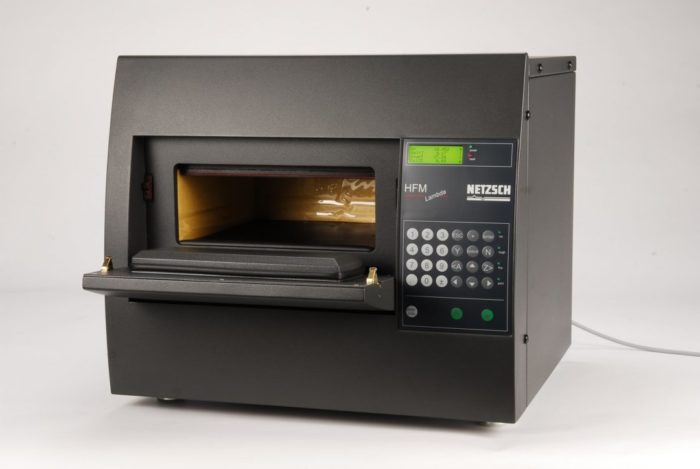
Image Credit: NETZSCH-Gerätebau GmbH
More Musings of an Energy Nerd


R-value measurements are subject to a fair amount of ridicule, especially by marketers of radiant barriers. As it turns out, however, the ridicule is mostly unwarranted.
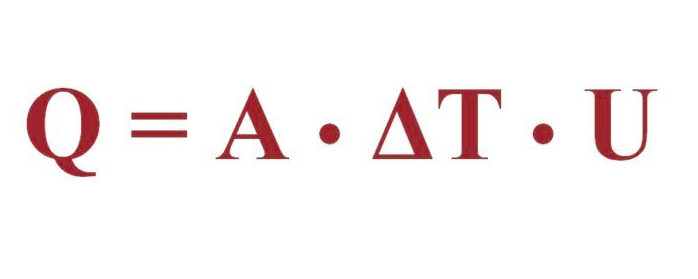
R-value is a measure of a material’s resistance to heat transfer. Before 1945, resistance to heat flow was measured by referring to a material’s U-factor. The lower a material’s U-factor, the better the material is at resisting the flow of heat. Because many people assume that high numbers on a scale are “better” than low numbers, insulation manufacturers found it hard to market insulation by bragging about low U-factors. So the R-value — which is simply the inverse of U-factor — was proposed by Everett Shuman, the director of Penn State’s Building Research Institute. Since R = 1/U, the higher the R-value, the better the insulation.
Does it “only measure conduction”?
Some manufacturers of radiant barriers falsely claim that R-value measures only conductive heat flow while ignoring the other two heat-flow mechanisms, convection and radiation. In fact, R-values include all three heat-transfer mechanisms.
The usual procedure for testing a material’s R-value is ASTM C518, Standard Test Method for Steady-State Thermal Transmission Properties by Means of the Heat Flow Meter Apparatus. The test method requires a technician to measure the thermal resistance of a specimen placed between a cold plate and a hot plate.
When a fiberglass batt is tested, heat flows from the hot side of the batt to the cold side. Wherever individual fibers of insulation touch each other, heat is transferred from fiber to fiber by conduction. Where fibers are separated by air, the heat is transferred from a hot fiber to a cooler fiber by radiation and by conduction through the air. Finally, the effects of any convective loops within the insulation are also captured by the test procedure.
Since…
Weekly Newsletter
Get building science and energy efficiency advice, plus special offers, in your inbox.

This article is only available to GBA Prime Members
Sign up for a free trial and get instant access to this article as well as GBA’s complete library of premium articles and construction details.
Start Free TrialAlready a member? Log in

18 Comments
R-value and radiative heat
You said
Some manufacturers of radiant barriers falsely claim that R-value measures only conductive heat flow while ignoring the other two heat-flow mechanisms, convection and radiation. In fact, R-values include all three heat-transfer mechanisms.
I wonder if (intentional marketing obfuscation aside) this issue arises from a subtle distinction between how the energy passes through the wall assembly (or test coupon) vs how the energy is absorbed into the assembly/coupon in the first place.
As you explain, the R-value test captures the effect that the insulation has on all three heat transfer modes. However, your description of the test -- with the coupon between two plates -- suggests that the heat is transmitted to the hot side of the coupon exclusively through conduction. Is this a correct understanding?
If so, one could argue that the test fails to capture the real-world performance of a wall, which is subject to heating predominately from convection (which is essentially conduction from the air film layer) and direct radiation from the sun and other radiant heat sources.
How about real-world performance?
Brent,
You're quite right: the real-world performance of a wall assembly includes many factors not captured by an R-value test designed to calculate the R-value of a piece of insulation. However, it's impossible to begin understanding how a wall assembly will perform until we know, as a starting point, the R-value of each of the components in that wall assembly. That's why R-value testing is so important.
In addition to knowing the R-value of the insulation, we need to know many other factors to understand how the wall assembly will perform. These factors include: the R-value of other materials used in the wall assembly (for example, exterior sheathing); the emissivity of any surface in the wall assembly that faces an air space; the rate of air leakage; and the Delta-T. (This is just a partial list.) However, knowing the R-value of the insulation is an essential starting point.
R Value misuse
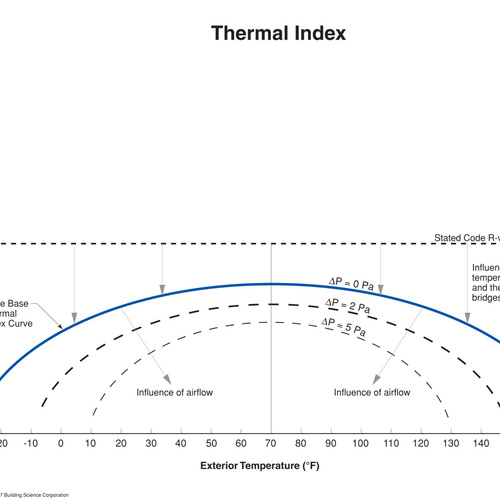
One aspect of ASTM C518 that wasn't addressed is that the test is typically conducted at a 75 degree temperature and 0 mph wind. When manufacturers describe a material as being a specific R value they have to include those test parameters as part of the information. All materials will vary in R value as the temperature varies. An R19 batt will not be R19 at 32 degrees nor at 97 degrees. When you also introduce varying wind speeds, fiberglass is known to be a poor performer. The R value number as typically used is a poor indicator of performance because it is not a constant value. Yet it is allowed to be stated and specified as if it was non-varying. From that perspective, R value is essentially useless and its use should not be allowed in building codes. Real world simulation of building materials should be the acceptable test method rather than laboratory measurements.
Response to WDA
WDA,
R-value is useful, because it is a measure of the thermal performance of a material under certain known (defined) conditions. Knowing a product's R-value, a product specifier can compare that material to others.
Such comparisons would be impossible if we allowed each manufacturer to devise their own test, with some manufacturers testing at 0°F and others at 70°F.
That said, it's still important to keep your thinking cap on. Just because you know a material's R-value, doesn't mean you know everything. It's still important to know something about the material's resistance to air flow, for example.
But there is no reason to deride the usefulness of R-value just because it doesn't tell you everything.
could i test R-value in my science class?
We talk about r-value in my environmental science class but I've always wanted to conduct a lab where we measure R-values for different materials. Could I set up an in-class test to look at these issues or do I need a fancy machine.
You need a special machine
Anonymous,
You need a special machine (see the photo and caption).
A variety of simple hot-box displays can be used to demonstrate the effectiveness of insulation -- but beware, it's also possible for such displays to be misleading. (The classic example is the radiant-barrier display you see at trade fairs -- the one with the incandescent light bulb. It doesn't represent typical conditions affecting a wall or ceiling.)
If you're tempted to set up a display for your students, consider controlling for differences in air leakage and consider whether any radiant effects are an accurate representation of real-world conditions.
RADIANT BARRIER
jUST A COMMENT.. Oakridge National Labortories (dept of energy) Florida Solar Energy Center and Texas A&M University tests state that R-19 and radiant barrier are the equivelant of R-30 or better. We all should disregard some sellers of radiant barrier who make unnessary claims about R values or effectivenes because thier national sales are just a tiny sliver of the market and from what I have heard they go out of business as fast as they start.. Most installations of foil insulation and radiant barriers are new construction.
Response to Ed Gilson
Ed Gilson,
No responsible researcher or scientist would make the claim that R-19 insulation and a radiant barrier are equivalent to R-30. A radiant barrier has no R-value.
It is possible to build a radiant barrier assembly (a radiant barrier facing an adjacent air space) in such a way that the radiant barrier boosts the R-value of the air space from about R-1 to R-3. However, it's the air space that has a measurable R-value, not the radiant barrier. And you are still a long way from R-30.
Re: to Martin Holladay
There are now triple-pane windows that get R-8 to R-10 value rating, so those responsible researchers that won't test a combination of materials and give it value are out to lunch there.
A single-pane glass has no R-value so what does that say? Think on that, so-called researchers.
The first inch or two on the heated or cooling side is the most important as well, and should be the biggest part on how to make a high R-value wall or ceiling system.
Let me give you a hint: the smaller and closer together a material like a common made bubble wrap for example you can make those R-values go off the chart on the side you want to keep from escaping temperatures.
Response to Syvain Dutil
Sylvain,
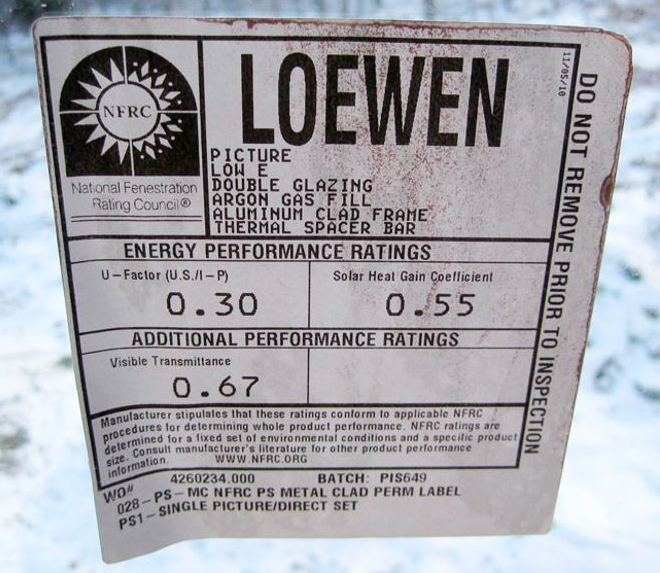
If you are talking about whole-window U-factor (NFRC rating), the best operable triple-glazed windows are rated at U-0.17. That's about R-6, not R-8 or R-10. European windows that claim R-8 or R-10 are using a rating system that is not comparable to the system used in North America. (Many are providing glazing-only numbers, not whole-window numbers.)
I'm not quite sure how you think that bubble wrap can make your R-value go "off the chart." I suppose if you want to install 20 layers of bubble wrap, eventually you'll get a respectable R-value. But there are much more affordable ways to get R-40 than to install 20 layers of bubble wrap.
Wet insulation
These materials are measured for resistance to heat transfer after they were dehydrated in a desicant chamber. Never again will they measure as such. Moisture immediately affects the thermal transmission and reduces R-value. The wall cavity must remain dry as much of the time as possible, therefore the wall system must allow for drying capability to the inside and to the outside.
A vapor barrier defeats this capability.
If the wall is sealed against air with an effective air barrier (6 sided) we can reduce the moisture within the cavity because air always contains moisture. Paying close attention to where the dew point takes place within the wall system will also help.
example of misleading display of insulation effectiveness
Re: your comment to anonymous about the misleading display of insulation effectiveness classically illustrated by the radiant barrier display at tradefairs with the incandescent lightbulb. Would you explain in more detail why this display is misleading, and how it is different from typical conditions affecting walls or ceilings?
Response to Brooke Alexander
Brooke,
It's often fun to perform science experiments in the kitchen. However, if you are setting up a demonstration for a trade show booth, the demonstration should be realistic, not misleading.
In a northern climate, the main reason we install insulation is to keep heat inside the house. At night and on cloudy days, the sun isn't shining on our insulation. Even on sunny days, the sun isn't shining on our insulation -- it's shining on our roof shingles and our siding.
Aiming a sunlamp at a piece of fiberglass insulation simulates what happens when the sun shines directly on a piece of insulation. But it doesn't simulate what happens when the sun shines on siding or roofing.
Obviously, in a cold climate, it's a good thing when sun shines on your building, because the effect of the radiant energy from the sun is to reduce heat loss from the building.
In a hot climate, the radiant energy from the sun isn't beneficial, because it can contribute to overheating. But the sun isn't shining on the fiberglass batt. It shines on the siding. When the siding heats up, the heat is transferred from the siding to the sheathing by conduction, not radiation. The same can be said for the heat transfer from the sheathing to the fibers of the insulation batt between the studs.
There is a certain amount of radiant heat flow from fiber to fiber inside a fiberglass batt. But when the batt is install in a stud cavity, the radiant heat flow is far, far less than it is when the batt is installed in front of an electric sun lamp in a trade-show booth.
trade show demo
Martin,
I haven't seen the trade show demo that you are discussing. However, I was thinking of something like it even before reading about it in the comment section. Ironically, I was thinking it might make a good demo to back up what you said in the main article. Namely, "only a tiny percentage of that heat is “shine-through” radiation that manages to miss all of the fibers in the insulation blanket and emerge unscathed on the other side."
A couple of things that may be useful to keep in mind. First, radiant heat transfer is primarily via infra-red radiation. We can't see it without special equipment. However, visible light is immediately next to it in the electro-magnetic spectrum and will have somewhat similar attenuation proprieties as infra-red. In that regard, I believe using a light bulb may not be a bad approximation. Second, the human visual system is a logarithmic detector. It allows us to see orders or magnitude differences in luminance, e.g. from night at moonlight to a sunny day at noon. So, even though you can see that light bulb on the other side of a fiberglass batt, the percentage of light getting through could actually be somewhat small, but not zero.
Some more information regarding thermal radiation
All warm objects emit thermal (infrared) radiation into adjacent air spaces and this will be absorbed by any nonreflective solid object it strikes. So in addition to convection and conduction, radiation also transmits heat through walls as was stated in the original article regarding what R-Value measures. For example, when siding heats up it will radiate some of the heat inward to warm the next wall component, and this process continues from component to component into the interior of a house. This even occurs from one glass fiber to the next and across the air bubbles in foam insulation. A radiant barrier that reflects radiation back helps keep the house cooler by reducing this one mechanism of heat transfer. Thermal radiation also works in the opposite direction when it is warm inside and cold outside, so a reflective barrier facing inward reduces heat loss from a house.
Steve
Response to Stephen Fish
Stephen,
You wrote, "A radiant barrier that reflects radiation back helps keep the house cooler by reducing this one mechanism of heat transfer. Thermal radiation also works in the opposite direction when it is warm inside and cold outside."
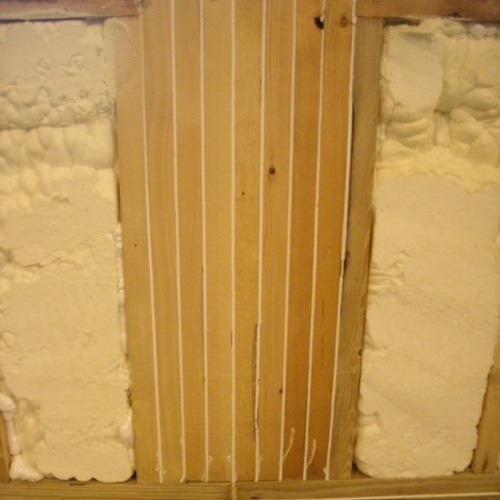
Strictly speaking, that's true. But conventional mass insulation materials (cellulose, rigid foam, and spray foam, for example) also do that. Here's the difference: conventional mass insulation does a better job, and costs less, than a radiant barrier.
Response to Martin Holliday, GBA Advisor
Hi Martin thanks for the response. I was mainly commenting on the physics of radiant transfer of energy. That is, that thermal radiation transmits heat between separated solid objects and this process can cool houses in the winter and warm them in the summer. Because tinfoil (polished aluminum) can reflect more than 95% of infrared radiation, is not that expensive, and the albedo of other conventional insulation is much lower, I believe that reflective radiant barriers can be useful in some applications beyond just attic spaces. This is especially true when there is an air gap bordering the barrier such as in some types of siding on south facing walls, and behind rock or brick cladding (e.g. Matt Risinger).
Steve
I read your article on R value and also your article on aluminum backed foil insulation. I need to wrap my air exchanger blower in my attic to prevent heat generated by the machine from escaping into the attic. Ideally I should have at least R40 but that may no be attainable.
What do you suggest I use?
Log in or become a member to post a comment.
Sign up Log in