
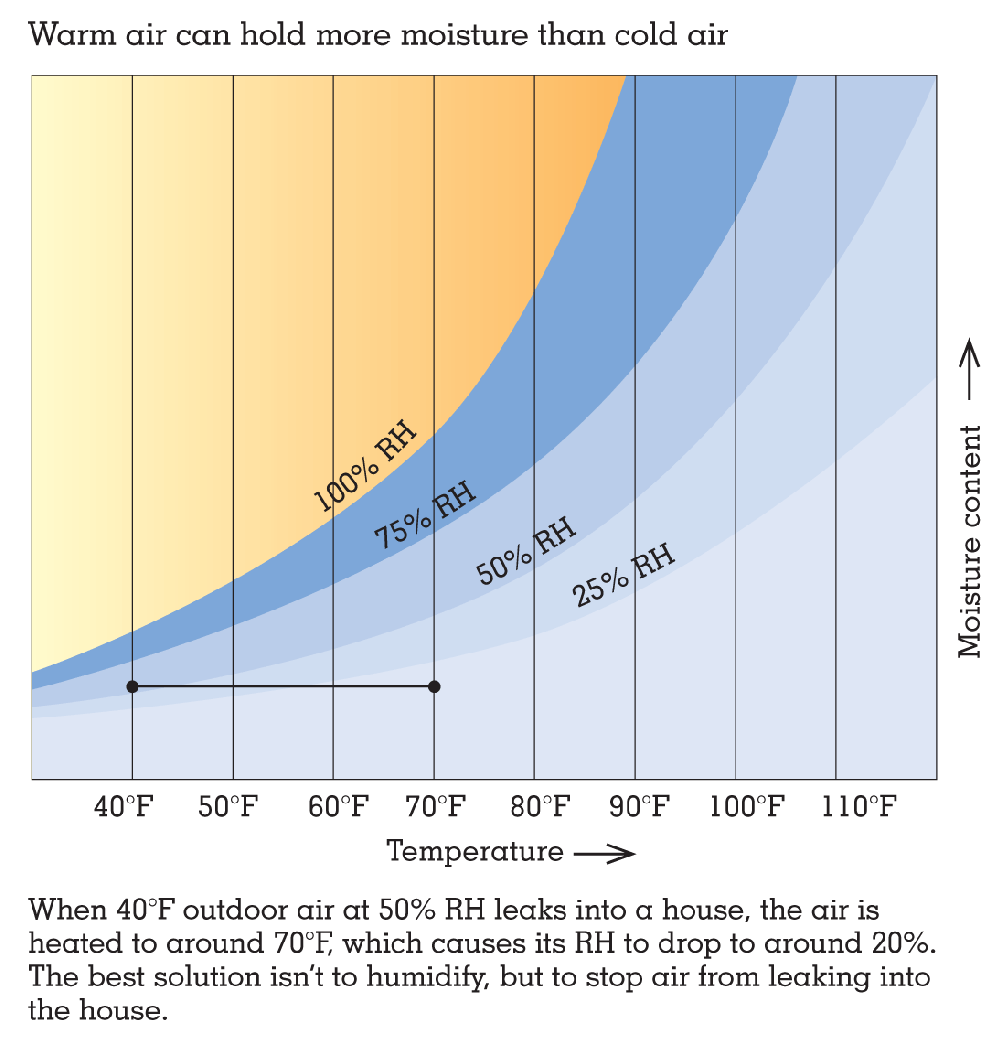
Moisture rides on air currents, and warm air carries more moisture than cool air. To control air flows, make sure the air barrier is continuous. An air barrier helps control airflow both through and within the building enclosure. By controlling airflow, you also control moisture.
If moist indoor air contacts a cold surface — for example, exterior sheathing in cold weather — condensation can result. An air barrier prevents those cold surfaces from being connected with humid indoor air.
Air has a maximum storage capacity for water vapor which depends on temperature. Warm air can store lots of moisture, while cold air can store very little.
According to Straube, as the temperature falls from 90°F down to 20°F, the amount of moisture that can be stored in the air changes by a factor of ten. “This is like a gas tank that shrinks as the temperature gets colder,” he says. “When it’s hot, you can store a lot in this tank, but when it’s cold you can’t store much at all. And if you were to have a large gas tank filled with gas and you shrunk it, eventually it would spill over. And that’s condensation.”
Leaky homes didn’t have condensation problems
Older buildings rarely had condensation problems in cold weather because they were so well ventilated — meaning leaky. The relative humidity in an old home would rarely rise above 25%. As we have built tighter houses (and in some cases failed to provide mechanical ventilation), the indoor relative humidity has gone up.
In a heated, tight, unventilated house, the amount of moisture in the air and the amount of condensation that can occur are dramatically different than in an old leaky house. Condensation can occur wherever water vapor can find a cold spot — on roof or wall sheathing, on the inside faces of the windows, and inside the walls.
Let’s say it’s 40°F outside and the outdoor relative humidity is 50%. If you allow that outdoor air to enter a building and heat it up to 70°F, the amount of moisture in the air stays exactly the same, but the “tank” gets bigger because the storage capacity of the air increases with the temperature. As a result, the relative humidity initially drops. Then, as moisture is added to the air, the relative humidity rises, and the absolute moisture content rises as well. How do you add moisture to the air? You breathe, sweat, boil water for spaghetti, take hot showers, grow houseplants — and all of those activities generate moisture.
When does indoor humidity become a problem?
Let’s say that air leaks out of a house through holes in the enclosure. As it reaches surfaces colder than 52°F or 53°F, the air will cool. Once it reaches its full capacity to store moisture, condensation occurs.
If the temperature of the outdoor air is around 30°F, the indoor air will drop all of the moisture that it gained on the way out, dumping it on the cold sheathing surface. That’s a typical example of the air leakage condensation cycle. Since condensation in walls can cause puddles — and in extreme cases, rot the framing — condensation is something you want to avoid. Installing an air barrier is one way to help prevent condensation.
Air conditioning can also create condensing surfaces
The same phenomenon can happen in reverse in the summertime. Let’s say the outdoor air is 85°F and the relative humidity is 75%. When outdoor air leaking inward contacts a surface below about 76°F, the moisture in the air will condense. So if you have an exhaust fan in your home, the air leaking in may cause condensation on the air-conditioned surfaces — for example, on the back side of vinyl wallpaper.
If moist air leaks into a house through gaps in the wall or roof, you can have problems. But in a tight house with a good air barrier and a supply-only ventilation system, most of the air that’s drawn inside is drawn in through the air conditioner, so the first cold surfaces it sees are the cooling coils.
If you have air leaks in your building envelope, you usually can’t see the condensation — unless you’re a forensic engineer like Straube, who goes around cutting holes in walls. However, condensation is sometimes visible in the attic; all you have to do is look for frost or dampness forming on the underside of the OSB or plywood roof sheathing.
It doesn’t take much of a hole in the ceiling of a humid house for the condensation to accumulate as frost. Then, when the sun warms up the black shingle roof, the frost melts, the water falls, “and then you have a ‘roof leak,’ ” Straube says. “Then you call the roofer, and he puts on a new roof, and it doesn’t fix a damn thing because that wasn’t the problem.” It was an air leak.
PDRTJS_settings_1467312 = {
“id” : “1467312”,
“unique_id” : “default”,
“title” : “”,
“permalink” : “”
};
More Building Science


Weekly Newsletter
Get building science and energy efficiency advice, plus special offers, in your inbox.



18 Comments
RH
These articles were very helpful to me. Thanks.
air leaks
GREAT! KEEP 'EM COMIN' !!! Info on retrofitting existing houses...ideas for attic, attached garages, inside utility venting, when modernization is overkill, etc. thanxs!
air leaks?
I 'm having a little difficulty visualizing why the air leak is the problem...The article says that outside air entering through leaks warms and picks up moisture, then condenses on cool surfaces...That is clear, but why is that any different from the warm moist air already in the house? For example, a reasonably tight house with a RH of 40% might be causing condensation on windows if cold enough outside .. Open a window, let in outdoor air, the RH inside first drops and then rises. Shut the window and after a while the RH is back where it was before outdoor air was let in...and condensation will form again...So, my question is..what is the difference if the cycle is continuous and the Rh remains the same whether from inside or warmed up outside air?
Response to Donald Mallow
Donald,
Ordinary interior air can, indeed, cause problems when the moisture in the air makes contact with a cold surface (for example, the interior of a window pane or the interior side of wall sheathing).
In a tight house, however, interior moisture shouldn't be flowing through your wall and roof assemblies, on its way out the cracks in the envelope. So tight homes have few, if any, opportunities for that warm, moist interior air to contact a cold surface -- especially if the house has triple-glazed windows.
In a leaky house, however, air is constantly flowing through the building envelope. Dry air may be entering your home through cracks in your basement, while warm, moist interior air is leaving your home through cracks in your walls. As the air exits, the warm, moist air hits a cold surface, leading to condensation in hidden areas of your wall. That's bad.
Sealing air leaks lowers the risk of this happening.
Humidity, Mold, and Indoor Air Quality
Martin
In many New England homes we have plaster over blueboard finishes, how does a plaster finish effect moisture movement in a home? Is plaster considered an vapor and/or air barrier?
Response to John Roy
John,
Air leakage is a much more important moisture transport mechanism than vapor diffusion. Plaster is not a vapor barrier, although most homes don't need a vapor barrier (because diffusion doesn't matter much). The more layers of paint on the plaster, the lower the rate of vapor diffusion.
Plaster is a fairly effective air barrier if it isn't cracked and doesn't have holes or flaws. However, most plaster walls leak a lot of air -- through electrical boxes, through cracks behind the baseboard, and through cracks where the plaster meets window openings and door openings.
Window Condensation
OK now that I have a tight house I have condensation on the windows. How do I resolve that? When the house was leaky the windows never condensed. I'm not sure that the latter is better than the former. Perhaps it is better to spend money on heating and not worry about the windows condensing.
Response to Walter Strobl
Walter,
The reason that moisture is condensing on your windows is because they are the coldest surfaces in your house.
There are only two ways to solve this problem: either make the interior window panes warmer, or lower the indoor humidity.
If you don't have any storm windows, adding storm windows should raise the temperature of your glazing. If you have storm windows, you could upgrade to better windows with more layers of glazing or low-e coatings.
To lower your indoor humidity level, find the sources of the moisture and eliminate them, or increase the ventilation rate of your mechanical ventilation system.
Window Condenstation
Martin all of the windows were replaced 14 years ago. It would be silly to replace them again? Not too mention the cost of doing that again. Adding storm windows is not that easy since all of the windows are casements. Humidty fluctuates when cooking and bathing. I try to run a fan 300 cubic ft/min to help with cooking and I have a fan in the bathrooms to exhaust the air to the outside. But on cold nights it still condenses. Just breathing causes the windows to condense. It gets even worse if the blinds are down because air can't get at the windows.
If I were to install an air exchanger would that reduce the humidy? But that seems pretty much the same as having a drafty house. You are just doing it in a controlled manner. Take in fresh air as you exhaust stale air.
I don't know how much lower I can lower the humidy. I have already experienced all sorts of cracking on the separation on some of the wood work.
Response to Walter Strobl
Walter,
You can't fight physics. If you want to prevent the condensation, you only have the two choices I mentioned.
To address the problem, you have to start by measuring you indoor relative humidity level. You can get a hygrometer at Radio Shack. During the winter, you want your indoor RH to be at 30% or below.
Increasing your ventilation rate will lower your indoor humidity level. If you install an HRV, you will be able to recover some of the heat that would otherwise have escaped through your exhaust air stream.
Problem?
I moved into a new apartment recently and it was painted just days before. I have really bad allergies to new paint along with anything else new. To cope, I have been leaving both bathroom vent fans running 24/7. This does seem to help with the odor and my allergies, but am I causing a moisture problem? Is it something that I can continue to do if I buy a dehumidifier?
Thanks
Response to Trent Pain
Trent,
Leaving the exhaust fans running will not cause any problems (except for an increase in your energy bill). If you operate a dehumidifier, it may be harder for the dehumidifier to keep up if you keep running the fans, however.
It's your choice -- high energy bills or a lower air flow rate in your apartment.
Martin
Martin,
Thanks for the quick reply. I'm still a little confused. I'm not sure why but I'm having a little trouble following the difference in things. Wouldn't the constant exhaust fans be like having a leaky home?
You said " In a leaky house, however, air is constantly flowing through the building envelope. Dry air may be entering your home through cracks in your basement, while warm, moist interior air is leaving your home through cracks in your walls. As the air exits, the warm, moist air hits a cold surface, leading to condensation in hidden areas of your wall. That's bad."
Response to Trent Pain
Trent,
Q. "Wouldn't the constant exhaust fans be like having a leaky home?"
A. Yes, it would. One result would be an energy penalty, as I already pointed out. You really don't want to ventilate your house at a higher rate than recommended by ASHRAE 62.2. (For more information on mechanical ventilation systems, see Designing a Good Ventilation System.) Of course, there are some circumstances when it may be advisable to ventilate at a higher rate -- for example, to get rid of a paint odor.
During the winter, running all of your exhaust fans for 24/7 won't cause any problems, because outdoor air is dry. If outdoor air leaks into your walls, it won't cause any problems during the winter.
During hot, humid weather during the summer, however, running all of your exhaust fans for 24/7 could conceivably cause problems, especially if you air condition your house, because the infiltrating humid air could contact cold wall or floor surfaces, leading to condensation. If you're just running two or three bath fans for a few weeks, though, I wouldn't worry too much.
Humidity Problems
Hopefully I can get myself out of this mess I got myself into :)
I recently built a pretty tight house with my old fashioned dad, I think we ended up doing a pretty good job with making the house tight, but didnt include any mechanical ventilation in the home. Right now in early october we are seeing relative humidity levels around 75% with temperatures inside of around 70 deg F.
How can I fix this? Should I install exhaust fans in the two bathrooms upstairs? My Dad says open a window, but its going to be winter very soon, and recently its been raining so much the humidity is worse outside than inside.
Im moved into the house, so any mechanical ventilation i pick im sure is going to be a disaster. The home is double 2X4 walls with a 2 inch layer of closed cell foam with 10 inches of cellulose inside of it.
Heating on the house is done with 2 mini split units, one located in the hallway upstairs and the other in the kitchen downstairs of a conventional layout dutch colonial.
Thanks in advance,
Denis
Response to Denis Recchia
Denis,
It look like you posted the same comment and questions in three different places. To avoid multiple postings, all of the answers will appear here -- on the Q&A page.
Dehumidifiers and ground source heat pumps
I'm building a tight house with a central air unit and passive bathroom ventilation. The central air is a geothermal heat pump. I don't read much about these on this site. I'm also using cellulose insulation, and considering its fire safety and green roots, especially when compared to foam, I'm amazed that I rarely see it mentioned in projects on this site.
Finally, would a central air unit with a dedicated humidistat address any condensation issues without pulling in outside air that will raise the energy requirements due to a significant temperature difference? At this point, I'm concerned a little about indoor air quality, but I have addressed condensation and will be circulating and dehumidifying air regularly.
Am I crazy for not wanting outdoor supply ventilation?
Response to Jared Morgan
Jared,
Q. "The central air is a geothermal heat pump. I don't read much about these on this site."
A. The correct technical description for this type of system is a ground-source heat pump. If you search the GBA site for "ground-source heat pump," you will find lots of information. Here is a GBA Encyclopedia article on the topic: Heat Pumps.
Q. "I'm also using cellulose insulation, and considering its fire safety and green roots, especially when compared to foam, I'm amazed that I rarely see it mentioned in projects on this site."
A. Again, Jared -- I suggest that you use the GBA search function. Here are two articles to get you started:
How to Install Cellulose Insulation
Blown-In or Loose-Fill Insulation
Q. "Finally, would a central air unit with a dedicated humidistat address any condensation issues without pulling in outside air that will raise the energy requirements due to a significant temperature difference?"
A. An air conditioner does not introduce outdoor air into a home. This is true for window-mounted air conditioners, conventional split-system air conditioners, and ground-source heat pumps like the one in your home. These air conditioners blow indoor air over a coil in your air handler. If you want fresh outdoor air, it won't come from your air conditioner; it will come from your ventilation system.
Some ventilation systems introduce outdoor air into the return air plenum of your air handler. This is one ventilation option, but it is not the only one.
It's your house, so you get to design any type of ventilation system you want, and you can ventilate at any rate you want -- a little or a lot.
Here is a link to an article about ventilation systems: Designing a Good Ventilation System.
You can lower the indoor humidity level during the summer with an air conditioner or a dehumidifier if you want. During the winter, however, it's always less expensive to lower the indoor humidity by increasing the ventilation rate rather than using a dehumidifier.
Adjusting the indoor humidity level to an appropriate level is one aspect of addressing potential condensation issues. The other aspect is to design your walls, roof assembly, and windows in a way that avoids condensation.
Q. "Am I crazy for not wanting outdoor supply ventilation?"
A. It's your house; you can do what you want. If your house is well sealed against air infiltration -- and it should be -- providing fresh ventilation air is a good idea. You can install an exhaust ventilation system, or a supply ventilation system, or a balanced ventilation system.
Log in or create an account to post a comment.
Sign up Log in